
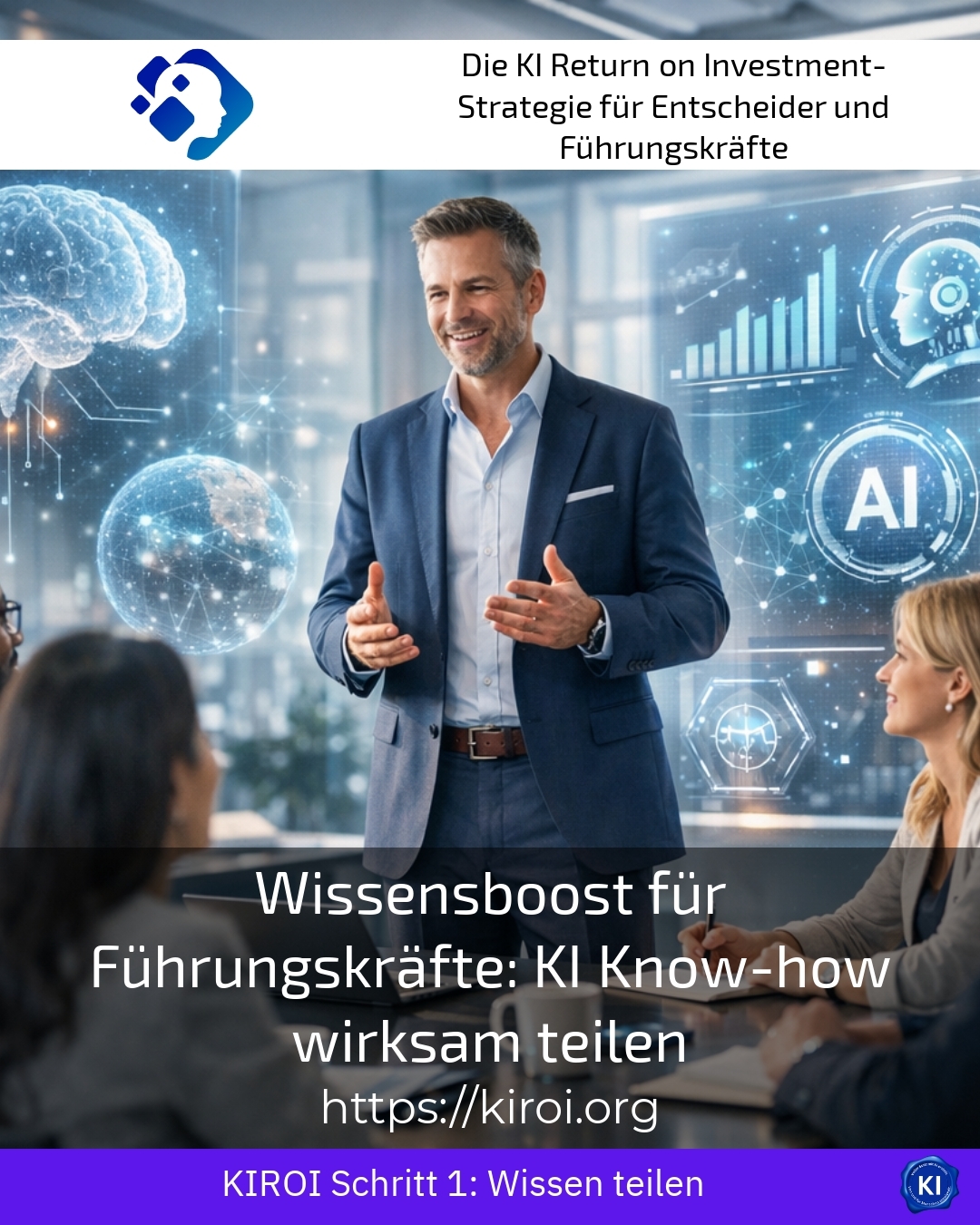
Have you ever wondered why some companies seem to keep pace with technological changes effortlessly, while others, despite enormous investments, lag behind? The answer often lies not in the technology itself, but in the way knowledge is shared and embedded within the organization. The decisive Boost for leadership: Sharing AI expertise effectively It doesn’t start with software or algorithms, but with people who are willing to actively share their understanding and grow together. In a time when artificial intelligence permeates almost every business sector, the ability to effectively transfer knowledge becomes the crucial competitive advantage that no competitor can simply copy.
Why traditional training concepts reach their limits
The traditional approach to continuing education works only conditionally with complex technological topics. Many organizations still rely on one-time workshops or extensive e-learning modules that, while providing theoretical knowledge, rarely lead to lasting behavioral change. Executives often report that after such events, they are impressed, but quickly revert to old patterns in their day-to-day work. This is because knowledge is truly embedded only through repeated application and social interaction. In the field of intelligent automation, this phenomenon is particularly evident. A production manager who has once learned how predictive maintenance works will hardly be able to implement this knowledge if he is not continuously supported. The same applies to sales teams that, while learning how intelligent systems analyze customer data, cannot derive any added value from it without regular practice and reflection. The solution lies not in more training, but in better structures for continuous exchange.
The knowledge boost for leaders: Sharing AI expertise effectively through peer learning
One of the most effective methods for conveying complex technological relationships is the structured learning of peers. When executives from different departments meet regularly to share their experiences, a dynamic flow of knowledge emerges that goes far beyond what any individual could learn in traditional training. In the field of automated quality control, for example, a production manager can benefit from the experiences of his or her colleague from customer service because both bring different perspectives to the same technology. The finance chief, in turn, can explain which metrics are truly meaningful when evaluating investments in intelligent systems. In this way, a holistic understanding is created that individual experts alone could never convey. Companies that establish such peer-learning formats often report a significantly higher acceptance of new technologies.
Best practice with a AIROI customer
A medium-sized manufacturing company with approximately 800 employees faced the challenge of preparing its management team for the integration of intelligent production systems. Although previous external training had provided a basic understanding, the practical implementation was significantly hampered. As part of the transruptive coaching support, a monthly „Innovation Circle“ format was established, in which each leadership team presented a concrete practical example from their area and the others asked questions and shared their own experiences. The head of the logistics department, for example, presented how his team had implemented a system for automated inventory forecasting, what obstacles had arisen, and how they had overcome them. This open culture of error led to other departments being able to implement similar projects with significantly less friction. After six months, the speed of implementation for technological initiatives had improved measurably, and the executives reported a significantly increased confidence in handling complex systems.
The role of the leader as a knowledge multiplier
Leaders cannot expect their teams to accept new technologies if they themselves are emitting uncertainty. Therefore, it is crucial that decision-makers not only passively absorb knowledge but actively act as multipliers. This does not mean that every leader has to become a technology expert. What is more important is the ability to explain complex relationships in a comprehensible way and to establish the relevance to one’s own area of responsibility. In the field of personnel planning, for example, intelligent systems can generate forecasts of future needs, but a leader must be able to explain to their team why these forecasts are trustworthy and how they support daily work. Similarly, in the area of automated accounting processing, the team leadership must understand which decisions the system makes independently and where human control remains necessary. [1]
Practical formats for boosting knowledge among executives: Sharing AI expertise effectively in everyday life
Integrating knowledge transfer into everyday work requires creative approaches. Short „lunch and learn“ sessions of a maximum of 30 minutes have proven particularly effective. During this time, a leader can introduce a concrete tool or a use case. In marketing, for example, such a session could show how automated text generation supports the creation of product descriptions, what quality controls are necessary, and what limits the technology has. In procurement, on the other hand, a brief presentation could demonstrate how intelligent systems assess supplier risks and which factors are taken into account. In customer support, it is easy to illustrate how automated analysis of conversation logs reveals potential for improvement. These short, focused formats also fit into the busy schedules of many executives.
Another proven format is so-called „reverse mentoring“ programs, in which younger employees share their technological knowledge with experienced executives. This arrangement may seem unusual at first, but it creates a valuable perspective shift. An experienced sales manager can learn from a young data analyst how modern evaluation tools work, while simultaneously bringing his experience in customer relationships to bear. In controlling, similar tandems can be formed where long-time financial experts learn from junior staff how to set up automated reporting. [2]
Cultural prerequisites for successful knowledge transfer
Technological knowledge transfer only works in a corporate culture that promotes openness and willingness to learn. Leaders who are afraid to admit ignorance will never be able to learn or teach effectively. Therefore, it is crucial to create psychological safety in which questions are welcomed and mistakes are viewed as learning opportunities. In the field of process automation, it is often observed that initial failures yield valuable insights. A leader who openly discusses which automation attempts in their area have not worked helps others avoid the same mistakes. In project management, for example, failed attempts to automate resource planning can provide important insights into which human factors need to be considered. The same applies in the field of automated scheduling, where cultural peculiarities and individual preferences are often underestimated.
Best practice with a AIROI customer
An internationally operating service provider wanted to keep its executives on the same level of knowledge in twelve countries regarding complex technological developments. The challenge was to take cultural differences into account in communication while still achieving a uniform knowledge standard. As part of the transruptive coaching process, a hybrid concept was developed that combined global virtual sessions with local in-person workshops. In the virtual formats, fundamental concepts were conveyed, while the local workshops provided room for culturally specific discussions. The German branch, for example, placed particular emphasis on technical details and data protection aspects, while the team in Singapore was more interested in practical case studies. This flexibility led to significantly higher acceptance in all regions than with previous standardized training programs. What was particularly remarkable was that executives from different countries began to independently exchange best practices because they recognized the added value of this knowledge transfer.
Measurability and sustainability of knowledge transfer initiatives
Many companies invest significant resources in knowledge transfer programs without systematically evaluating their effectiveness. There are, however, certainly ways to measure the success of such initiatives. In the field of automated data analysis, for example, it is possible to track how often executives actually use such tools and what results they achieve. In customer service, it can be measured whether the introduction of new technologies leads to faster response times or higher customer satisfaction. In the field of financial planning, it is possible to compare forecast accuracy before and after the introduction of intelligent systems. Such metrics help to demonstrate the return on investment of knowledge transfer programs and to make continuous improvements. [3]
The sustainability of knowledge transfer depends crucially on whether the content being conveyed is regularly updated and refreshed. Technological developments progress so rapidly that knowledge can become obsolete within a few months. Therefore, it is important to establish continuous learning structures that can adapt to changing conditions. In the field of automated image processing, for example, the possibilities are developing rapidly, so that quality assurance managers should constantly be aware of new application possibilities. Similarly, in marketing, the capabilities of systems for customer analysis are continuously expanding.
Knowledge boost for executives: Share AI expertise effectively through documented experiences
An often underestimated aspect of knowledge transfer is the systematic documentation of experiences and insights. When a leader has successfully completed an automation project, this knowledge should be prepared in such a way that others can benefit from it. In the field of automated reporting, for example, a documented experience report can help other departments implement similar projects more quickly and with fewer errors. In the field of intelligent route planning, documented learnings can help logistics companies systematically increase their efficiency. In the field of human resources, successful implementations of systems for automated applicant screening can serve as a blueprint for other locations.
The format of the documentation should be adapted to the needs of the target audience. Some executives prefer short video tutorials in which colleagues share their experiences. Others appreciate structured written summaries with concrete action recommendations. Still others benefit most from interactive formats in which they can ask questions. Transruptive coaching support helps find the right format for the specific organization and prepare the documentation so that it can actually be used. [4]
Best practice with a AIROI customer
A healthcare company faced the challenge of preparing its management team for the use of automated appointment scheduling systems in various facilities. The particularity was that the requirements varied greatly depending on the department, and the acceptance among the employees was very diverse. As part of the transruptive coaching process, a knowledge management system was established in which management team members could document their experiences in a structured manner. Each report included a uniform structure that encompassed the initial situation, challenges, solution approaches, and results. For example, the manager of a gynecological practice documented in detail how she had overcome resistance within the team by specifically highlighting the time savings and taking individual concerns seriously. This documentation helped another practice in another city implement similar projects with significantly less resistance. After a year, the system contained over 50 documented testimonials, providing valuable knowledge to the new leadership.
My AIROI Analysis
Supporting numerous executives in the integration of intelligent technologies has shown me that the decisive success factor is almost never the technology itself. Rather, the way knowledge is shared, reflected upon, and applied determines success or failure. Organizations that invest in structures for continuous knowledge transfer achieve more sustainable results than those that rely on point-based training. I repeatedly observe that the greatest progress occurs where executives are willing to show vulnerability and openly discuss their uncertainties. This openness creates a space where real learning is possible and where teams dare to try new things.
The AIROI-methodology offers a structured framework that takes both individual learning needs and organizational frameworks into account. Leaders who work with this approach often report that they were able not only to deepen their own understanding but also to experience a new quality in their collaboration with their teams. The key is to not view knowledge transfer as a one-time event but as a continuous process that is integrated into the work routine. Those who adopt this perspective will find that technological changes are no longer perceived as a threat but as an opportunity. Transruptive coaching support helps to shape this change in a sustainable way and empower leaders to act as true knowledge multipliers.
Further links from the text above:
[1] McKinsey – The State of AI
[2] Harvard Business Review – Knowledge Management
[3] Gartner – Artificial Intelligence Insights
[4] MIT Sloan – Machine Learning Explained
For more information and if you have any questions, please contact Contact us or read more blog posts on the topic Artificial intelligence here.







 Deutsch
 English (UK)