
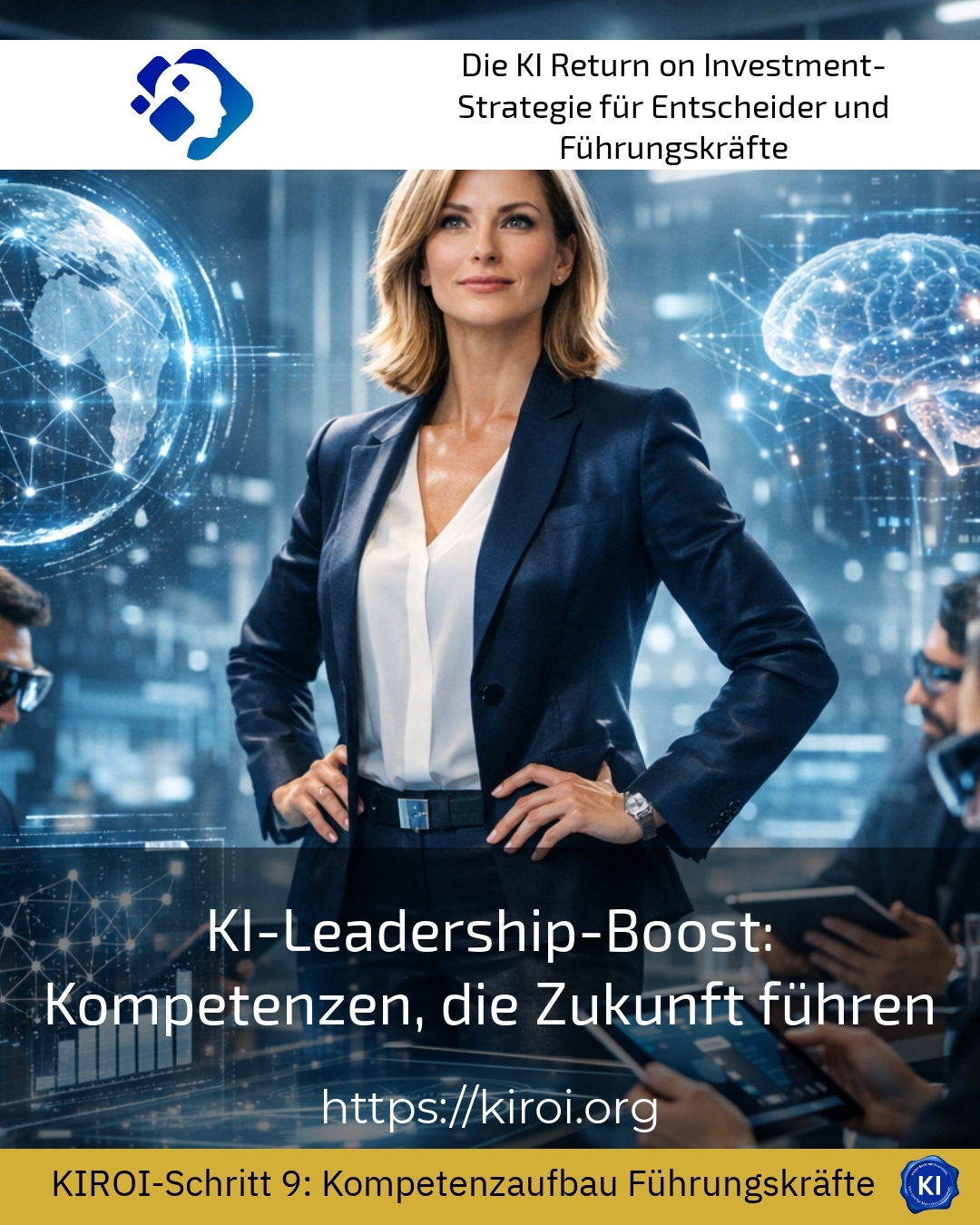
Will you still hold a leadership role in the coming years when intelligent systems are already preparing strategic decisions and optimizing processes today?
This question currently concerns countless decision-makers in companies of all sizes. The AI Leadership Boost It fundamentally changes which competencies will be in demand in the future. Leaders face the challenge of navigating their teams through a technological transformation. At the same time, they must continuously develop their own skills. The combination of human intuition and machine intelligence creates new possibilities. However, it also requires a profound rethinking of the way we understand and practice leadership.
The transformation of leadership culture in the digital age
Traditional hierarchies and rigid decision-making processes are increasingly losing their importance. Modern leaders must be understood as facilitators who empower and inspire their teams. They create spaces for innovation and creative thinking. Intelligent systems support this by analyzing complex data sets. However, the actual leadership performance lies in interpreting and human judgment.
Many leaders face specific challenges when undergoing transruptive coaching. They often report uncertainties in handling new technologies. Others experience resistance in their teams when introducing automated processes. The fear of being replaced by machines burdens both leaders and those being coached. In such situations, professional guidance provides valuable impulses for the change process.
Best practice with a AIROI customer
A medium-sized company in the manufacturing sector faced the fundamental need to reorient its leadership structures. The management team recognized that the previous decision-making processes were no longer relevant. Intelligent analysis systems were introduced to optimize production processes and create quality forecasts. However, the middle management felt outgunned and feared losing importance. As part of the coaching process using AIROI-methodologies, the actual fears and concerns of the management team were first made visible. Subsequently, we jointly developed a new understanding of roles that emphasized the strengths of human leadership. The management team learned to understand the analysis results of the systems as support and not as competition. They began actively involving their teams in the transformation process and sharing responsibility. After six months, the participants reported a significantly improved collaboration between humans and technology.
AI leadership boosted by emotional intelligence and technical understanding
The combination of emotional competence and technological knowledge becomes the decisive factor of success. Leaders must develop and integrate both dimensions equally. Empathy and human understanding remain indispensable for successful team leadership. At the same time, the modern working world requires a fundamental understanding of digital tools and their capabilities.
In a logistics company, automated route planning systems were introduced that provided suggestions to the dispatchers. The experienced employees initially perceived this as interference with their expertise. The manager recognized the situation and created spaces for dialogue between human and system. She encouraged her team to critically question the suggestions and to bring their own experience to the table. The result was a hybrid working approach that combined machine efficiency with human expertise.
Another example comes from the healthcare sector, where diagnostic systems support doctors in their diagnosis. Senior medical professionals had to learn to accept this support without relinquishing their responsibility. They developed protocols that took into account both the machine analyses and the medical assessment. This resulted in a quality improvement that neither humans nor machines could have achieved alone.
Communication as a Key Competence in Transition
The ability to communicate complex technological relationships in an understandable way is becoming increasingly important. Leaders are becoming translators between different worlds and ways of thinking. They must connect technical experts with specialist departments and create a common language. To do this, it helps to use concrete examples and analogies that are understandable to all involved parties.
In a financial services company, the communication barrier between the IT department and sales led to significant delays. The management decided to hold regular cross-departmental workshops. In these sessions, sales representatives learned the basic logic of automated systems, while IT experts better understood the customer needs. The resulting collaboration significantly accelerated product development.
Develop strategic foresight and agile adaptability
The AI Leadership Boost It requires a new understanding of strategic planning and operational flexibility. Long-term visions must harmonize with short-term adaptability. Leaders need the ability to react quickly to changes without losing sight of the overarching goals. Finding and maintaining this balance is among the most demanding leadership tasks of our time.
A trading company used predictive systems to predict demand developments and optimize inventory levels. When unforeseen market changes occurred, the value of human judgment was revealed. The executives decided not to blindly follow the system recommendations. Instead, they combined the data analysis with their market knowledge and made better decisions.
In the education sector, institutions are experimenting with personalized learning paths created by intelligent systems. Educational leaders must ensure that the human dimension of learning is preserved. They are developing concepts that combine technological possibilities with personalized support. This requires a deep understanding of both technology and pedagogical principles.
Best practice with a AIROI customer
An insurance company wanted to speed up its claims processing through automated systems while simultaneously increasing customer satisfaction. The challenge was to involve experienced claims handlers in the transformation process, rather than replacing them. As part of the AIROI onboarding process, we developed an approach that systematically integrated the employees’ expertise into the system optimization. The claims handlers were trained to be trainers of the automated systems by providing feedback on decision-making suggestions. This new role strengthened their sense of self as indispensable experts and significantly reduced resistance. The management learned to moderate this process and establish a culture of constructive criticism. After the introduction, customers reported faster processing times with consistently high quality decision-making. Employee satisfaction also increased, as repetitive tasks were reduced and more time was left for complex cases.
AI Leadership Boost through Continuous Learning
Lifelong learning is no longer an option, but a necessity for every leader. The speed of technological developments requires continuous training and openness to new ideas. It is not about becoming a technical expert; rather, leaders must develop a sufficient understanding to be able to make informed decisions.
One pharmaceutical company established a mentoring program in which younger, tech-savvy employees mentored experienced executives. The exchange of knowledge worked in both directions and fostered mutual understanding. The older managers shared their strategic experience, while the younger ones brought technological expertise. This form of collaboration proved extremely valuable for both parties.
In retail, executives use simulation environments to test new concepts before implementing them. They learn to use forecasting tools and automation solutions in a playful way. Errors in the simulation have no real consequences and encourage the joy of experimentation. This approach accelerates the learning process and reduces the fear of change.
Ethical responsibility and value-based decisions
With increasing technological power, the ethical responsibility of leaders also grows. They must make decisions that are both economically sensible and morally justifiable. The impact of automated systems on employees, customers, and society as a whole requires careful consideration. Leaders become guardians of human-centric technology use.
A staffing provider faced the question of how strongly automated pre-selection of applications should be used. The senior management decided on transparent criteria and regular checks for any risk of discrimination [1]. They established a committee that continuously questioned the decision logic of the systems. This proactive approach protected the company from reputational damage and strengthened the confidence of applicants.
In the energy sector, companies use optimization systems for grid control and load distribution. Executives must ensure that security of supply and environmental protection are equally taken into account. They develop guidelines that combine economic efficiency with social responsibility. Finding this balance requires a continuous dialogue with various stakeholders.
My AIROI Analysis
The examination of the subject area clearly shows that the AI Leadership Boost It requires much more than a technological update. Leaders are facing a fundamental redefinition of their role and competencies. The successful integration of intelligent systems in organizations can only be achieved if human leadership qualities are consciously developed. Emotional intelligence, ethical awareness, and the ability to communicate clearly are gaining in importance, while purely administrative tasks are increasingly being automated.
From my experience in guiding transformation projects at numerous companies, a clear pattern emerges. Organizations that actively prepare their executives for change achieve significantly better results. The investment in leadership development pays off many times over, because well-prepared managers navigate their teams with confidence through the change. Resistance is detected earlier and addressed constructively, rather than escalating. Employees perceive the transformation as an opportunity and not as a threat.
At the same time, it becomes clear that there is no one-size-fits-all solution for all industries and company sizes. The specific challenges vary significantly, and successful concepts must be adapted individually. Transruptive coaching provides valuable support by helping leaders connect their personal development with the organizational requirements. The key lies in continuous reflection and the willingness to question established mindsets. Those who internalize this attitude will be able to play a significant leadership role even in an increasingly technology-driven world.
Further links from the text above:
[1] Federal Ministry of Economics – Information on responsible AI use
For more information and if you have any questions, please contact Contact us or read more blog posts on the topic Artificial intelligence here.







 Deutsch
 English (UK)