
Why do even the most successful executives only use a fraction of their actual knowledge, despite having decades of experience?
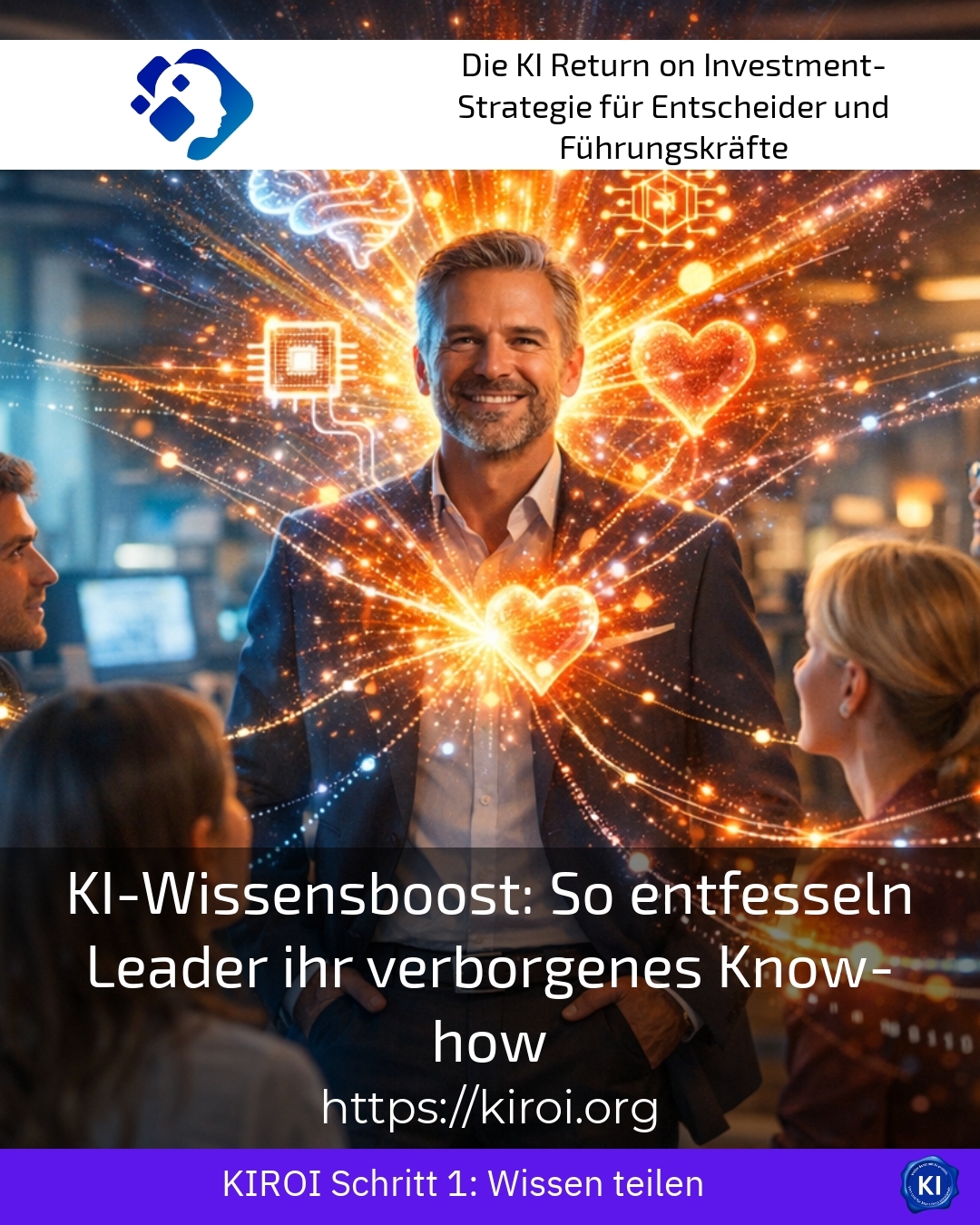
This question keeps coming up again and again in my daily work with decision-makers from various industries. Often, clients report that despite extensive expertise, they are unable to access all their knowledge at crucial moments. The AI Knowledge Boost offers a fascinating approach here because it systematically brings hidden sources of knowledge to light. Intelligent systems support the structuring of implicit knowledge and its use for strategic decisions. In this post, I show you how modern technologies can help leaders realize their full potential.
Recognizing the hidden potential in organizations
Knowledge exists in companies at various levels, with most of it dormant below the surface. Explicit knowledge is found in documents, manuals, and databases. Implicit knowledge, on the other hand, resides in the minds of experienced employees and managers. This tacit knowledge encompasses intuition, experience, and gut instincts. It is difficult to put into words, but it shapes every important decision.
A production manager instinctively knows when a machine is on the verge of failure. A sales manager senses which customers are truly ready to buy and which still need time. A CFO recognizes patterns in financial data that no algorithm can detect at first glance. This leads to valuable decisions that go far beyond standard processes. And it is precisely this knowledge that must be highlighted, because it represents the crucial competitive advantage.
In the automotive industry, for example, experienced engineers possess decades of development expertise. They immediately recognize which design changes will work and which will not. Similarly, in healthcare, experienced doctors make diagnoses that even the most advanced imaging techniques cannot detect. In the financial sector, senior bankers also make credit decisions based on experiences that are not documented anywhere.
How the AI knowledge boost activates hidden expertise
Modern systems analyze patterns in decision-making processes and make implicit knowledge visible. They do not only capture what decisions are made, but also why they are made. Through intelligent question systems, leaders can reflect on their own thinking. This leads to new insights into their own strengths and blind spots. This process requires time and the willingness to reflect on oneself.
In retail, store managers use such systems to optimize their product assortment decisions. This enables them to identify patterns in their own selection behavior that they were previously unaware of. In the logistics industry, similar approaches help improve route planning and capacity management. Because experienced dispatchers make hundreds of decisions every day based on experience. And this experience can now be systematically captured and shared.
Best practice with a AIROI customer
A medium-sized mechanical engineering company faced a special challenge in its development department. Three experienced engineers would retire within the next two years, bringing over ninety years of development experience together. The company feared a massive loss of knowledge because these experts often found complex solutions from intuition. Together, we developed a structured process for knowledge acquisition through transruptive coaching. The engineers conducted documented problem-solving sessions over several months, during which they explained their approach step by step. Intelligent analysis tools identified recurring decision patterns and heuristics that the experts themselves were unaware of. The result exceeded all expectations, as a comprehensive knowledge system was created with over three hundred documented problem-solving strategies. Young engineers can now access this system and benefit from the experience of their predecessors without having to ask them personally. The average time to solve problems was thus reduced by about forty percent, and the error rate for new development projects dropped significantly. This project impressively demonstrates how knowledge transfer can work when the right methods are used.
Re-thinking strategic decision-making
Executives make decisions every day amidst uncertainty. They must weigh various sources of information and assess risks. Traditionally, they rely on reports, meetings, and their own experience. However, this information is often incomplete or outdated. New approaches are emerging that intelligently connect different sources of knowledge.
In the pharmaceutical industry, for example, research leaders must decide on investments in new active ingredients. They need knowledge from chemistry, biology, regulation, and market research. No single expert can fully cover all these areas. Decisions in the energy sector are similarly complex, where technical, regulatory, and societal factors all interact. In construction as well, project managers must make decisions that must take into account architecture, structural engineering, costs, and scheduling.
The AI Knowledge Boost It supports this by compiling relevant information from various sources. It identifies connections that human decision-makers might miss. But it never replaces human judgment; it merely complements it in a meaningful way. This results in informed decisions that are both data-based and experience-driven.
Understanding knowledge networking as a leadership task
Modern leadership also means networking and making knowledge accessible within the company. Leaders act as knowledge brokers between different departments and hierarchical levels. They recognize where knowledge is needed and establish connections. This task is becoming increasingly important in complex organizations.
For example, a manager in the plant construction industry combines the knowledge of his engineers with the experience of the customer service department. This way, insights from practice are fed back into the development of new products. In insurance companies, smart executives connect actuaries with sales representatives to develop better products. And in the food industry, they bring together nutritionists with marketing experts. This results in innovations at the intersections of various knowledge areas [1].
This networking task can be supported by intelligent systems. They identify experts for specific questions and suggest suitable contact persons. They also recognize when similar problems occur in different business areas. This avoids duplication of effort and creates synergies.
Best practice with a AIROI customer
An internationally operating logistics service provider came to me with a specific problem that many growing companies encounter. The organization had grown significantly through acquisitions, with different locations maintaining their own processes and systems. This resulted in knowledge being trapped in silos and best practices not being shared. As part of our collaboration, we developed a company-wide knowledge exchange approach with intelligent support. First, we systematically captured the expertise at all locations through structured interviews and process analyses. An intelligent system then identified overlaps and potential synergies between the various units. It turned out that the Hamburg location had developed excellent solutions for customs clearance, while the Rotterdam location possessed innovative approaches for last-mile logistics. Through the targeted networking of these competencies, new service offerings were created that none of the locations could have developed alone. The company reports significant efficiency gains in overall collaboration and an improved innovation culture. The executives were transformed into knowledge disseminators who actively build bridges between the various business units, rather than optimizing their own areas.
Personal development through reflective practice
The AI Knowledge Boost It also provides impulses for the personal development of leaders. It enables a systematic reflection on one’s own decision-making patterns and behaviors. This makes unconscious competencies conscious and allows for their targeted development. This process requires openness and a willingness to honest self-reflection.
Many leaders come to me because they feel they are not reaching their full potential. They sense that they know more than they can put into practice in their daily work. Often this is due to ingrained routines and time pressure that prevent reflection. In transruptive coaching, I help these leaders discover their hidden resources. We use modern analytical methods to identify strengths and areas for development.
In the consulting industry, for example, senior partners often find that they are unable to effectively pass on their knowledge to younger colleagues. In audit firms, experienced auditors face similar challenges when transferring knowledge. And in law firms, partners must systematically document their legal expertise and client knowledge. All of these situations benefit from a structured approach to knowledge extraction [2].
Anchor the AI knowledge boost in day-to-day leadership activities
Integrating new approaches into everyday work requires planning and perseverance. It is not enough to introduce a system once and then move on to routine use. Rather, it requires a continuous practice of knowledge reflection and development. This practice must be embedded within existing processes to have a lasting effect.
In project management, this can be implemented, for example, through structured lessons-learned sessions after each project completion. In product development, design reviews can be expanded to include elements for knowledge acquisition. And in sales, regular team meetings provide an opportunity for systematic exchange of experience. The key is not to view these activities as an additional burden, but as an investment in one’s own effectiveness.
Executives in software development, for example, use code reviews to share knowledge. In healthcare management, case discussions are used to systematically develop competencies. And in corporate consulting, debriefings following customer engagements serve as a means of collective learning. All of these practices can be made even more effective through intelligent support [3].
My AIROI Analysis
From my experience in numerous coaching processes with executives from various industries, a clear picture emerges. The greatest untapped potential in organizations lies not in new technologies or processes, but in the existing knowledge of their people. Elevating and systematically utilizing this knowledge represents one of the most important leadership tasks of our time. Intelligent systems can support this process, but they can never replace the human judgment and experience.
The projects I support through transruptive coaching always show the same success patterns. First, the leadership needs to be willing to engage in a process of reflection and to question their own mindsets. Then, a systematic collection of existing knowledge follows, with implicit knowledge being particularly valuable. Finally, this knowledge must be prepared in a form that makes it accessible and usable for others.
The challenges are often less technical than cultural in nature. Many organizations still reward knowledge monopolies instead of knowledge sharing. And many leaders see their knowledge as a personal power factor that they do not want to share. This is where real transformation begins, because it requires a change in corporate culture towards greater openness and collaboration. The technological possibilities are there, but they only reach their full potential in a supportive environment that values learning and sharing.
Further links from the text above:
[1] Harvard Business Review – Knowledge Management Insights
[2] McKinsey – People and Organisational Performance
[3] Gartner – Artificial Intelligence Research
For more information and if you have any questions, please contact Contact us or read more blog posts on the topic Artificial intelligence here.






 Deutsch
 English (UK)