
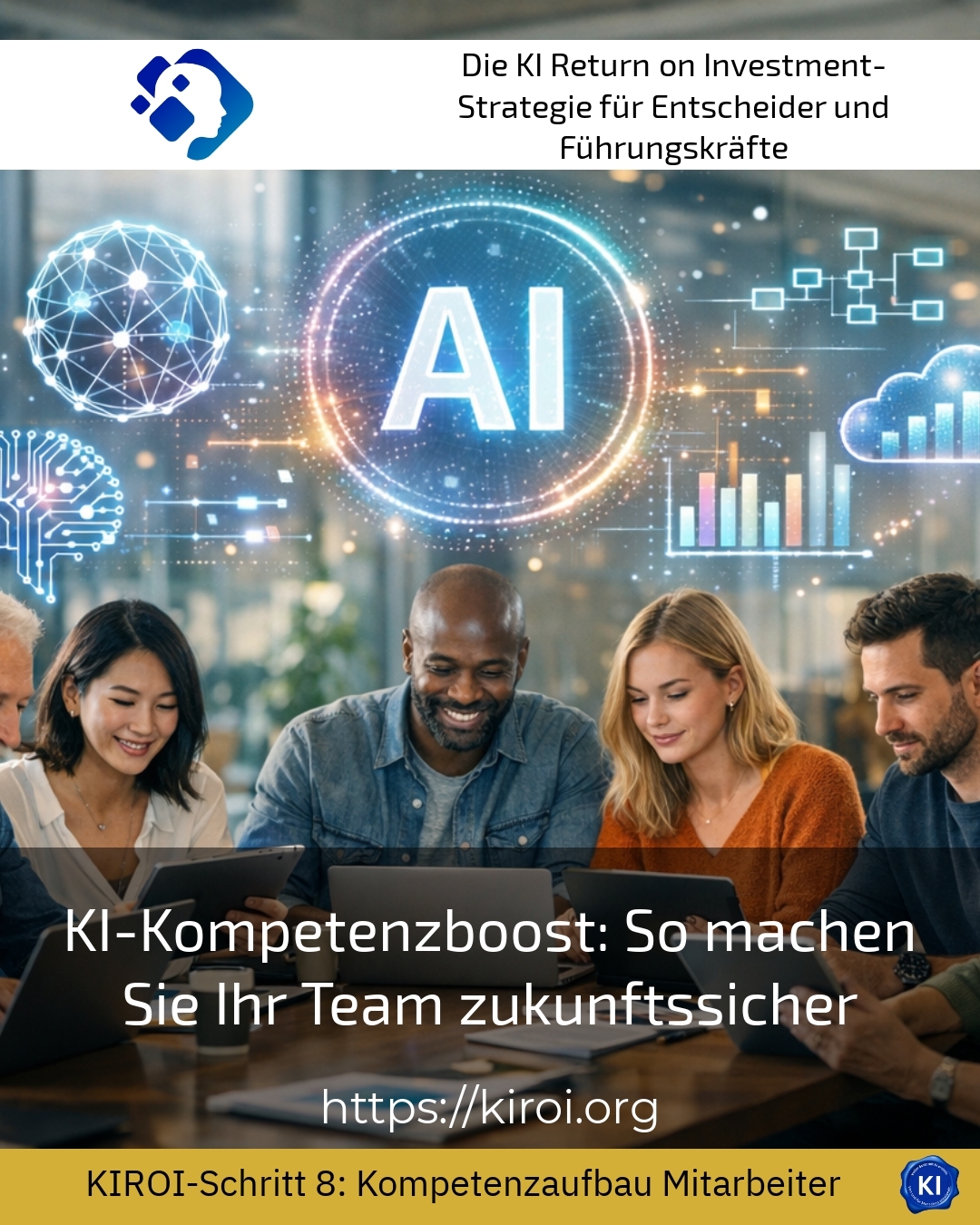
Have you ever wondered why some companies seem to keep pace with technological change effortlessly, while others, despite enormous investments, lag behind? The crucial difference often lies not in the technology itself, but in the people who are supposed to use it. Targeted AI Skills Boost It can make your team future-proof and create sustainable competitive advantages. In a world where algorithmic systems increasingly influence decision-making processes, the ability to intelligently collaborate between humans and machines becomes a valuable asset. It’s not about training every employee to become a programmer; rather, it’s about a deep understanding of the possibilities and limitations of modern technologies.
Why traditional continuing education concepts are reaching their limits
The traditional training formats that many organizations still employ were designed for a different time. They assume that knowledge remains stable over the years and can be imparted once and for all. This assumption is now outdated. The half-life of technical expertise has drastically shortened. What was once considered expert knowledge can tomorrow be part of general knowledge. Therefore, many executives report on a growing gap between the actual requirements and the existing skills of their teams. Transruptive coaching helps companies systematically close this gap and build sustainable learning structures.
The challenge lies in the fact that many employees have developed a fear of interacting with new technologies. These fears often stem from a feeling of overwhelm or from negative experiences with poorly implemented systems. Furthermore, the daily work routine leaves little room for extensive training periods. Daily tasks must be completed, so that learning is often perceived as an additional burden. A well-thought-out competence development program therefore integrates learning directly into the work processes and makes it an inherent part of everyday life.
The AI competence boost as a strategic instrument for personnel development
When organizations have a AI Skills Boost When planning for their teams, they should first conduct an honest assessment of their current state. Where do the individual departments actually stand in terms of their technological understanding? Which specific use cases would create the greatest value for the company? These questions cannot be answered in a one-size-fits-all manner, because every organization has its own strengths, weaknesses, and strategic priorities. However, the answers form the foundation for a tailored development program. Clients often report that they only realize the potential within their teams through this systematic analysis.
Best practice with a AIROI customer
A medium-sized manufacturing company faced the challenge of making its production planning more efficient while simultaneously inspiring employees to adopt new digital tools. The management had already invested in modern planning software, but the team’s acceptance remained significantly below expectations. Together with the transruptions coaching team, we developed a phased introduction plan that included the employees from the very beginning. First, we identified the biggest pain points in the existing processes together with the team leaders. Subsequently, we demonstrated in practical workshops how the new tools could precisely address these issues. The employees thus recognized the direct benefits for their daily work. After six months, the usage rate of the software had tripled and the planning accuracy improved measurably. What was particularly pleasing was that the employees themselves began to suggest further uses for the system and actively participated in the further development of the processes.
The five pillars of sustainable competence development
Effective competence building rests on several pillars that reinforce and complement each other. The first pillar is a basic understanding of algorithmic systems and their functioning. Employees do not need to understand in detail how neural networks work mathematically. However, they should understand the principles on which these systems are based and the types of tasks they are particularly good or less good at performing. This basic understanding enables a realistic assessment of the possibilities and protects against exaggerated expectations or unfounded fears.
The second pillar encompasses practical application skills. Theoretical knowledge alone is not enough, because only practical experience shows how humans and machines can work optimally together. Forms such as sandbox environments, where employees can experiment and gather their own experiences without risk, are proven here. The third pillar concerns critical reflective ability. Automated systems can make mistakes or deliver results that appear plausible at first glance but are problematic upon closer examination. A trained critical judgment helps to recognize such situations and respond appropriately to them.
Ethical competence and responsibility as part of the AI competence boost
The fourth pillar of a comprehensive AI competence boosts It addresses the ethical aspects of technology use. Automated decision-making systems can have significant impacts on people. Therefore, employees must learn to anticipate and evaluate these impacts. Where might unfair disadvantages arise? What data are used and how are they protected? These questions require an awareness of the societal dimension of technological decisions. The fifth pillar ultimately concerns the change-making competence itself. In a constantly changing environment, the ability to continuously develop oneself becomes a key competence. This means cultivating an attitude of openness and curiosity, which views changes as opportunities rather than threats [1].
The role of leaders in this process cannot be overstated. They must lead by example and show that lifelong learning is not a weakness but a strength. Leaders who openly discuss their own learning processes and also admit to uncertainties create an atmosphere of psychological safety. In such an atmosphere, employees also dare to ask questions and perceive mistakes as learning opportunities. Transruptive coaching supports leaders in fulfilling this new role and authentically embodying it.
Best practice with a AIROI customer
A customer service executive came to us with a specific request: the team should learn to use intelligent assistance systems to process customer requests, but resistance within the team was strong. Many employees feared becoming superfluous due to the new technology and reacted with rejection and distrust. In coaching, we first developed a new communication strategy that put the benefits for the employees themselves at the forefront. The assistance systems were to take on the repetitive and tiring tasks, so that more time could be left for complex and demanding customer requests. This repositioning fundamentally changed the perception within the team. Additionally, we introduced a mentoring system in which technically-savvy team members supported their colleagues. This peer-to-peer learning experience proved particularly effective because it took place on equal footing and did not create an artificial hierarchy. After the introductory phase, the employees reported a significantly higher level of job satisfaction and an increased sense of competence.
Practical implementation strategies for different organizational sizes
The concrete implementation of a competence development program depends heavily on the size and structure of the organization. Small companies can often act more quickly and flexibly, but often have limited resources for further training. A focused approach is recommended here, focusing on the most important use cases and specifically acquiring external knowledge. Medium-sized companies have the advantage that they already have some infrastructure in place, but are still agile enough to quickly implement new approaches. Large companies face the challenge of coordinating changes across many departments and locations [2].
Regardless of organizational size, certain formats have proven particularly effective. Learning circles, where small groups of employees regularly come together to learn new things and share experiences, promote both knowledge acquisition and social cohesion. Microlearning units that can be completed in just a few minutes can be easily integrated into the workday. Practical projects where employees test new technologies against real-world challenges create immediate relevance and motivation. The combination of different formats allows for addressing different learning styles and maximizing effectiveness.
Measurement and evaluation of competence progress
A frequently neglected aspect of competence development is the systematic measurement of progress. Without clear indicators, it is difficult to assess whether the measures employed are actually having the desired effect. This is not about putting employees under pressure or pushing them into evaluation systems. Rather, meaningful metrics should help optimize the effectiveness of measures and target resources. Useful indicators could, for example, be the frequency of use of new tools, the quality of the results achieved, or the subjective assessment of one’s own competence by the employees. Regular reflection rounds in which success and difficulties are openly discussed provide valuable qualitative insights [3].
Best practice with a AIROI customer
A company from the financial sector wanted to enable its analytics department to use modern data analysis tools more effectively and also meaningfully employ generative assistance systems. The particular challenge was that the employees already possessed high professional expertise, but had little experience with the new technological possibilities. Together we developed a program that valued the existing expertise and used it as a foundation for building competencies. The employees learned to formulate their professional questions in a way that could be optimally handled by the assistance systems. Additionally, they practiced critically reviewing the results and, if necessary, adjusting them. An important component of the program was the creation of internal best-practice documentation that made the collected knowledge accessible to the entire team. The department was able to significantly increase its analysis capacity without compromising the quality of the results. On the contrary, employees reported that the relief from routine tasks gave them more time to focus on the truly challenging analytical questions.
Long-term perspectives and continuous development
The AI Skills Boost It is not a one-time project with a defined endpoint, but a continuous process of development and adaptation. Technological possibilities will continue to change, and with them the requirements for the competencies of employees. Organizations that invest in sustainable learning structures today create the prerequisites for long-term adaptability. They build a culture in which continuous learning becomes an inherent part of working life. This culture cannot be established overnight, but every step in this direction strengthens the company’s future viability.
Investing in employee competencies pays off in many ways. Qualified employees work more efficiently, make better decisions, and actively contribute to innovation. They feel valued and are more connected to the company. In times of a shortage of skilled workers, the attractiveness as an employer becomes an important competitive factor. Companies that offer real development prospects to their employees have a clear advantage in attracting and retaining talent. The path to a future-proof organization begins with developing their people [4].
My AIROI Analysis
From my experience with numerous organizations of various sizes and industries, a clear pattern emerges. Companies that systematically prepare their employees for collaboration with intelligent systems achieve measurably better results than those that introduce technology without accompanying skills development. AI Skills Boost It works on several levels simultaneously. At the individual level, it strengthens the confidence and ability to act of the employees. At the team level, it promotes collaboration and the exchange of knowledge. At the organizational level, it creates the prerequisites for sustainable innovation capability.
What is particularly remarkable is that the effects of a well-executed competence program extend far beyond the immediate scope of application. Employees who have learned to actively explore new technologies transfer this ability to other areas of their working lives. They develop a general openness to change and a proactive attitude towards challenges. This change in attitude is perhaps the most valuable effect of a successful competence development program. The technical skills may change over time, but the ability and willingness to continuously learn remain a lasting advantage.
For organizations that want to embark on this path, I recommend a step-by-step approach that begins with an honest assessment of the current situation and involves employees from the outset. External support from experienced coaches can help avoid common pitfalls and accelerate the process. Transruptive coaching provides a framework that takes into account both the technical and human aspects of transformation. The future belongs to organizations that can combine both: technological excellence and human competence in a constantly changing world.
Further links from the text above:
[1] McKinsey: AI and the workforce – skills for the future
[2] Forbes: AI training strategies for companies
[3] Gartner: Artificial Intelligence in Human Resources
[4] World Economic Forum: The future of work and AI skills
For more information and if you have any questions, please contact Contact us or read more blog posts on the topic Artificial intelligence here.








 Deutsch
 English (UK)