
Have you ever wondered why some leaders seem to effortlessly drive innovation forward, while others, despite enormous efforts, stagnate?
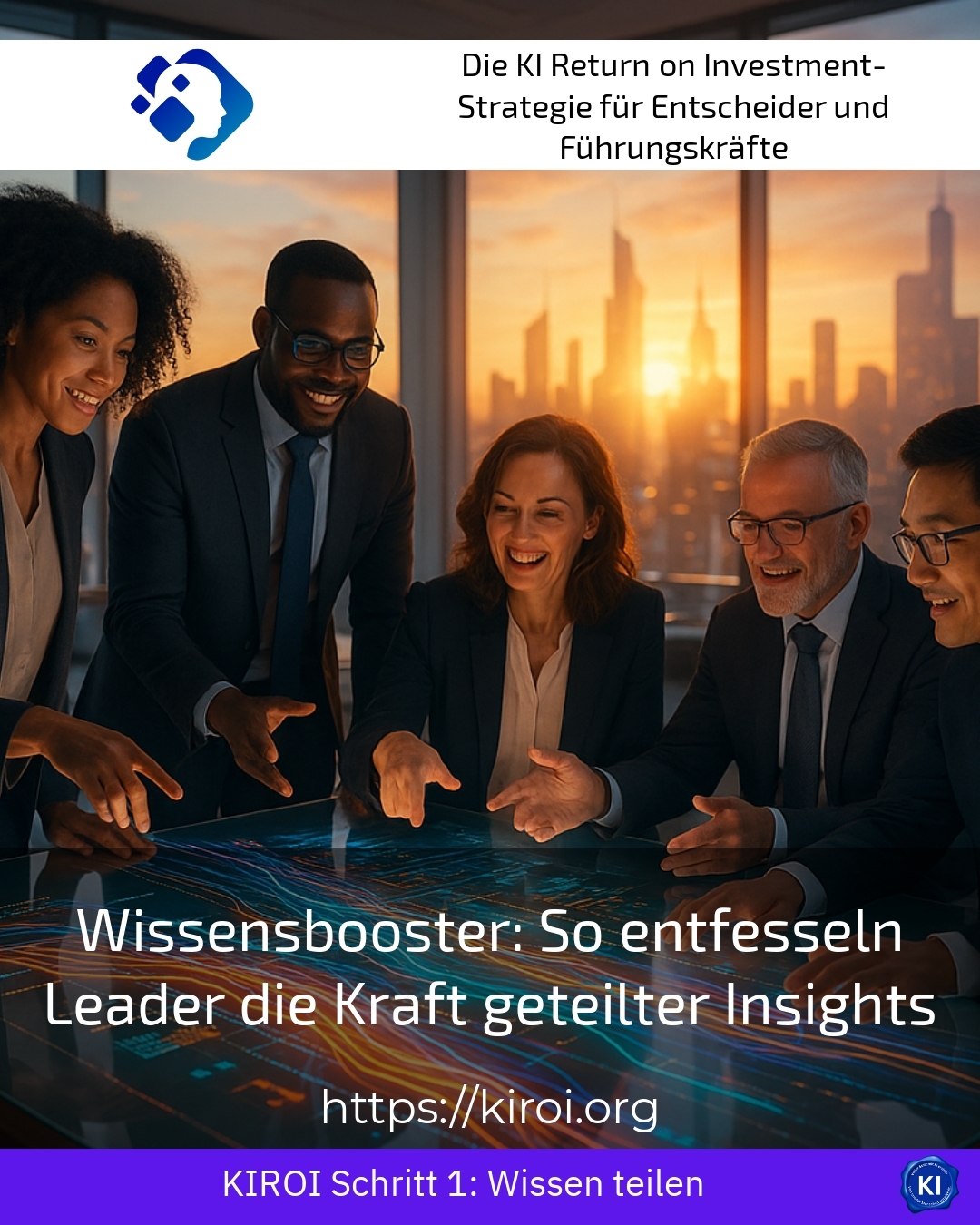
The answer often lies not in individual brilliance or extraordinary resources. Rather, the way in which knowledge circulates within an organization determines success or stagnation. Knowledge booster The essence of modern corporate management is to systematically activate and make collective intelligence accessible to everyone. Leaders who have understood this principle often report a noticeable acceleration in their decision-making processes. They create spaces where experiences do not disappear in silos but are nurtured as a shared treasure.
The hidden dynamics behind successful leadership teams
In the modern business landscape, it is becoming increasingly clear that isolated expertise has reached its limits. Executives face the challenge of making complex decisions under high time pressure. At the same time, they must integrate different perspectives and take into account the consequences for different business areas. For example, a manager of a medium-sized machine engineering company implemented weekly cross-functional meetings. In these gatherings, production managers, sales managers, and development engineers exchanged their current insights. The result was remarkable: The lead time for new product development was significantly shortened. Error rates decreased because problems were identified early.
A financial services provider in the insurance industry pursued a similar approach with astonishing results. The senior management established a digital system that automatically forwarded relevant market observations to all decision-makers. This created new synergies between previously separate departments. Another example comes from the healthcare sector, where a hospital management introduced interdisciplinary case discussions. Doctors, nurses, and administrative staff brought their respective perspectives. Patient satisfaction increased measurably, and internal communication improved significantly.
Knowledge booster: Why shared insights have exponential impact
The power of shared insights lies in their multiplicative effect on organizational intelligence. When a leader retains a valuable insight for themselves, only they themselves benefit from it. However, if they share this insight with ten colleagues, the potential benefit is multiplied by nine. Moreover, through the different perspectives, completely new insights often emerge. A logistics company demonstrated this principle impressively. The sales manager shared his observations about changing customer requirements with the warehouse manager. This combined this information with his own insights about process optimizations. Together they developed a new service concept that neither of them would have conceived alone.
In the automotive supply industry, a similar pattern was observed at a leading component manufacturer. The quality manager shared her analysis results on complaint patterns with the entire management team. The purchasing manager then recognized connections with specific supplier batches. The production manager identified machine-related factors. Only by combining different perspectives did the sustainable problem solution succeed. A third example from the pharmaceutical industry further illustrates the effectiveness of this approach. The research manager and the marketing manager initiated regular strategy dialogues. The scientific findings were previously incorporated into market positioning. At the same time, the researchers received valuable feedback on practical application needs.
Best practice with a AIROI customer
An internationally operating machine engineering company with several thousand employees turned to our transruptive coaching team because the management felt that valuable knowledge was regularly being lost when key personnel left the company or moved to other departments. Together, we developed a multi-stage concept for systematically capturing and distributing leadership knowledge as part of the coaching process. In intensive workshops, the management first identified their most critical areas of knowledge and their interdependencies. Subsequently, they implemented a digital insight-sharing system that was supplemented by regular personal exchange sessions. The special feature was the combination of technological support and cultural transformation. The management began to view the sharing of insights as a sign of strength rather than a surrender of knowledge leadership. After about nine months of intensive support, the participants reported significantly faster decision-making processes and a noticeably improved collaboration between the locations. Transruptive coaching helped to sustainably anchor both the technical structures and the necessary behavioral changes.
Create structures that activate the knowledge booster
The unleashing of collective intelligence does not happen by itself; it requires consciously designed framework conditions. Leaders who act as Knowledge booster To function effectively, the right structures must first be established. For example, a trading company created digital discussion groups where executives from different branches exchanged ideas. The regional managers moderated these sessions and documented the important insights. Furthermore, they implemented a simple evaluation system for particularly valuable contributions. This recognition motivated the participants to actively contribute their experiences.
One energy provider pursued a different but equally effective approach to structuring knowledge exchange. The management team introduced so-called learning journeys. Executives from various departments visited other departments or external partners together. The insights gained were then prepared in structured reflection rounds and made available to everyone. A technology company from the software sector developed an internal podcast format for executives. In short audio episodes, experienced leaders shared their key learnings from current projects. This low-threshold form of exchange reached executives who had little time for longer meetings as well.
Cultural prerequisites for sustainable knowledge sharing
Structures alone are not enough if the underlying culture does not support or even hinder open exchange. Many leaders have learned in their careers that exclusive knowledge means power and must therefore be protected. Changing these deeply ingrained beliefs requires time, patience, and consistent leadership from the top. A construction company began this cultural change by the CEO himself communicating transparently about mistakes and failures. This openness also encouraged other leaders to share their insights without fear of negative consequences.
In a media company, the management established so-called Failure Fridays. On these days, management deliberately shared projects that had not gone as planned and the lessons learned from them. Initially, there was great reluctance on the part of the participants. Over time, however, a culture developed in which admitting mistakes was considered a sign of maturity and willingness to learn. One chemical company even linked the exchange of knowledge with the bonus system for executives. Those who shared valuable insights with colleagues received an additional component of remuneration. This material recognition significantly accelerated the cultural change.
Using knowledge boosters in the digital transformation
Digitalization offers completely new possibilities to Knowledge booster-Strengthen and scale the impact. Modern collaboration platforms enable asynchronous exchange across time zones and locations without significant loss of efficiency. A global consumer goods manufacturer used an AI-powered platform that automatically assigned relevant insights to the appropriate recipients. The artificial intelligence recognized patterns in the shared information and suggested connections. Executives thus proactively received insights into relevant knowledge from other business areas [1].
A telecommunications company successfully implemented virtual knowledge spaces for its executives. In these digital environments, they were able to visualize insights and develop them interactively. The spatial distance between different locations suddenly no longer played a role in the quality of the exchange. A logistics service provider successfully experimented with augmented reality applications for knowledge transfer between experienced and new executives. Complex processes could thus be vividly communicated and experiential knowledge was documented in a tangible way [2].
Best practice with a AIROI customer
A medium-sized family business in the precision engineering sector sought support in preparing a comprehensive generational change at the management level. The challenge was to systematically capture the accumulated experience of the departing generation and make it accessible to the successors without jeopardizing the dynamism and openness to new ideas. In the framework of our transruptive coaching, we developed a hybrid concept together that combined personal mentoring relationships with digital documentation tools. The experienced executives conducted structured reflection sessions, the key findings of which were recorded in an internal knowledge database. At the same time, the successors were given space to express their own perspectives and suggestions for improvement. These were also documented and linked to the existing knowledge. The guidance provided by transruptive coaching helped the company master the delicate balance between preservation and renewal. After about a year, all involved reported a significantly smoother transition than had originally been feared.
My AIROI Analysis
The systematic activation of collective leadership intelligence represents one of the most effective levers for sustainable competitiveness that many organizations have not yet sufficiently utilized. My analysis of numerous leadership projects shows that the crucial difference between average and outstanding leadership teams often does not lie in the individual abilities of the individual leaders. Rather, the quality and intensity of knowledge exchange determines the collective performance level of the entire organization. Leaders who act as Knowledge booster By acting, they create a self-reinforcing cycle of learning, sharing, and joint development that continuously advances the organization.
What seems particularly remarkable to me is the observation that technological solutions alone are never sufficient to achieve this effect. In practice, the cultural dimension proves to be at least as significant as the structural and technical prerequisites. Leaders must be willing to redefine their own role and to understand sharing of knowledge as a core task. The guidance provided by professional transruptive coaching can significantly accelerate and anchor this transformation process. It supports both the development of appropriate structures and the necessary behavioral and cultural change. Organizations that consistently follow this path regularly report noticeable improvements in decision-making quality, innovation capacity, and employee satisfaction.
Further links from the text above:
[1] Harvard Business Review – Knowledge Management
[2] McKinsey – Insights on People and Organisational Performance
For more information and if you have any questions, please contact Contact us or read more blog posts on the topic Artificial intelligence here.







 Deutsch
 English (UK)