
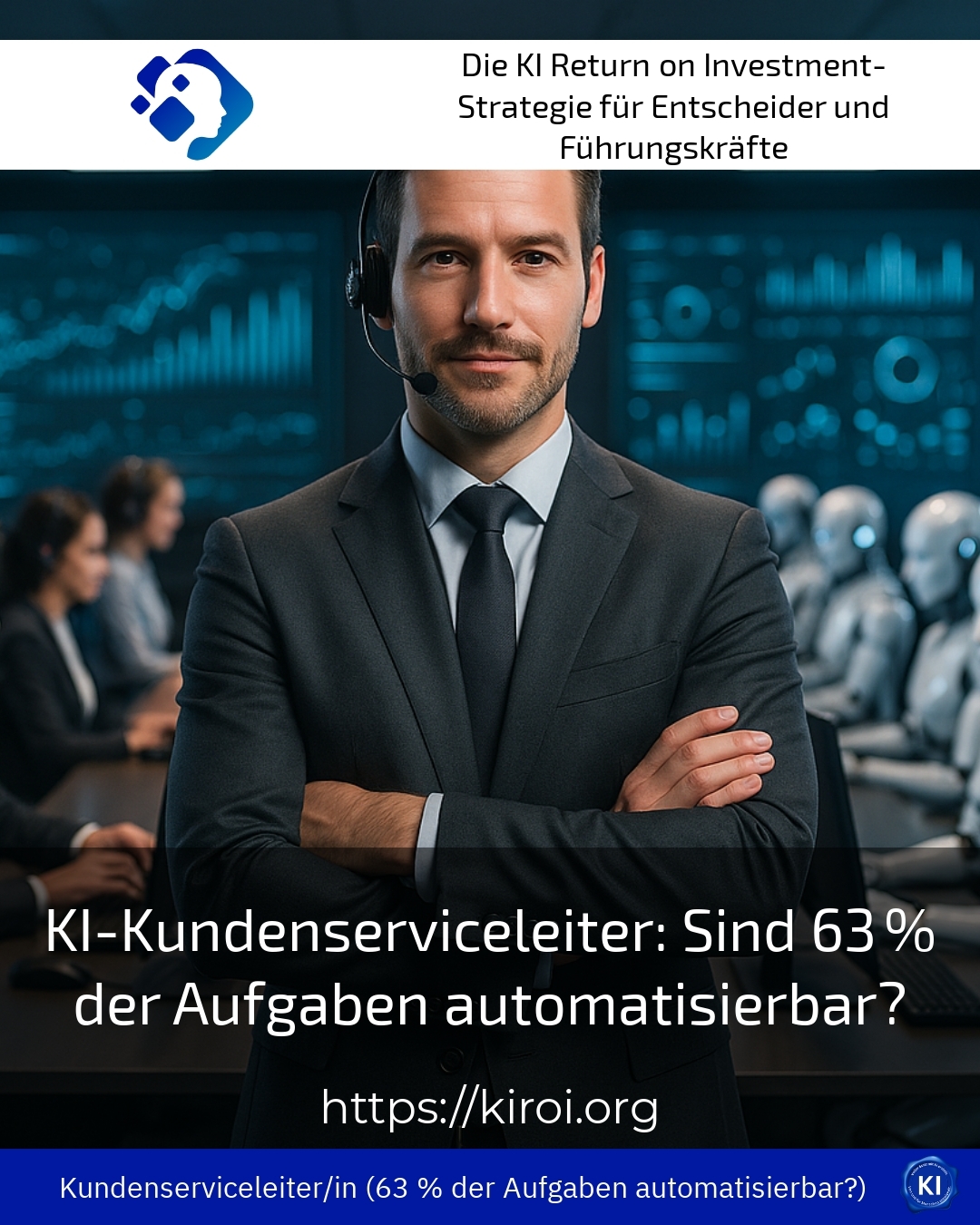
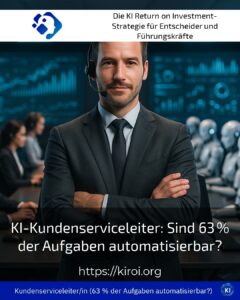
Will your professional expertise soon be replaced by algorithms, or are you facing the greatest opportunity of your career? This question currently concerns countless professionals who work in responsible positions in customer support and service management, because current analyses show that a significant proportion of typical tasks could be taken over by intelligent systems. AI Customer Service Manager We are facing a fundamental change that holds both risks and enormous development opportunities. It is this very ambiguity that makes the issue so explosive. The progressive automation is not only changing individual work processes, but fundamentally transforming entire professional roles, which is why now is the right time to strategically reposition ourselves.
The insights presented here are based, among other things, on data from the Job Futureometer of the Institute for Employment Research [1], which provides scientifically-based assessments of the automatability of various professional fields. If you yourself are active in this dynamic field and want to actively shape the transformation, the AIROI seminars offer hands-on guidance for your individual path. The current dates can be found on the official event portal [2], where regular lectures, workshops, and intensive training sessions are offered. These impulses help you redefine your own role and optimally utilize the opportunities presented by technological development.
The new reality in service management and why the AI customer service manager needs to change their mindset
The landscape of customer support is changing at an astonishing pace. Chatbots answer standard inquiries around the clock. Automated ticketing systems prioritize incoming messages. Intelligent analysis tools recognize customer needs before they are even articulated. A telecommunications company recently implemented a system that predicts intent to cancel based on usage patterns and proactively offers solutions. An insurance service provider relies on automated claims reporting that fully handles routine cases without human intervention. An energy provider uses voice-activated assistants to capture meter readings and resolve billing issues.
These developments do not mean that human expertise is becoming superfluous. Rather, the focus shifts towards more complex tasks. Emotional intelligence remains indispensable. Strategic decisions require human judgment. The ability to handle unforeseen situations distinguishes excellent professionals from algorithmic systems. For example, a trading company reported that despite advanced automation, customer satisfaction only significantly increased through the targeted training of employees.
Best practice with a AIROI customer A medium-sized service company with several hundred employees in the customer support department faced the challenge of efficiently handling the increasing volume of requests without compromising the personal quality of service. As part of the AIROI coaching process, a detailed analysis of the existing processes was initially conducted, which revealed that a significant proportion of daily activities was actually repetitive in nature and therefore could be automated. Together, the team developed a hybrid strategy in which intelligent systems took on the preliminary qualification of requests, while the employees could focus on consultative-intensive conversations. The results exceeded expectations significantly, as not only did the processing speed improve significantly, but employee satisfaction also measurably increased. The employees reported that their work was now more fulfilling because they could focus on truly challenging cases. This example vividly demonstrates how a well-thought-out transformation can succeed if human factors are taken into account from the outset and technology is understood as support rather than a substitute.
Which activities are actually being automated and which are not
The differentiated consideration of individual areas of responsibility reveals a multifaceted picture. Routine inquiries about opening hours, product availability, or delivery status can be easily automated. Standardized complaint forms are increasingly being taken over by intelligent forms. The documentation of customer contacts is now often automatically performed by speech recognition systems. A financial service provider has fully automated account statement inquiries. A travel provider relies on virtual assistants for booking confirmations. A logistics company uses tracking bots that provide shipment information in real time.
In contrast, there are tasks that require human competence in the foreseeable future. De-escalation in the face of agitated customers requires empathy and a sense of intuition. Finding individual solutions to complex problems requires creative thinking. The strategic development of service processes requires a comprehensive understanding of organizational relationships. It is also noteworthy that the ability to lead and motivate teams cannot be replaced by algorithms, which is why the aspect of employee development is becoming increasingly important.
The role of the AI customer service manager in the changing skills landscape
The requirements profiles are changing fundamentally. Technical basic understanding is becoming a basic qualification. The ability to orchestrate human-machine interactions is gaining enormous importance. Data analysis expertise complements classic leadership qualities. One industrial company reported that management in the service sector now regularly attends technical training courses. A healthcare provider integrated digital competencies into leadership development. A media company created a new role that combines technology and service expertise.
This development offers enormous potential for anyone willing to develop further. AIROI The strategy provides a structured framework that combines theoretical knowledge with practical application. The insights imparted there help not only maintain but actively shape one’s own position in the changed work environment. Often, participants report that after the seminars they have gained a completely new perspective on their daily work.
Strategies for successful positioning as an AI customer service manager
The proactive design of one’s own development determines future success. First, an honest assessment of current activities is recommended. Which of them could be automated in the medium term? Which offer the potential for specialization? One pharmaceutical company conducted structured self-assessments with its management. A technology company implemented regular competency reviews. A trading company established mentoring programs for digital transformation.
The development of new skills should be carried out strategically. Knowledge in process optimization is becoming increasingly important. Understanding algorithmic decision-making opens up new areas of action. The competence to ensure the quality of automated processes is becoming a sought-after specialization. A banking company trained its service management staff in agile methods. A supply company offered further training in data visualization. A software company integrated design-thinking workshops into leadership development.
Best practice with a AIROI customer An established organization in the financial services sector recognized early on that automation would require fundamental changes in the service department and sought a holistic approach to the transformation. The AIROI process began with intensive workshops, in which the fears and concerns of the participating executives were first openly discussed, because only through this honest dialogue could a constructive attitude be created. Subsequently, concrete development paths for each leader were developed that took into account both technical and interpersonal competencies. The finding that automation could not be seen as a threat but as a liberation from monotonous tasks proved particularly valuable, leading to a significantly more positive attitude within the entire team. The organization subsequently implemented a rotation program that enabled senior leaders to learn about different aspects of the digitized service delivery and discover their individual strengths. After several months, it was evident that employee engagement had significantly increased and that the service quality had improved despite reduced staffing levels.
The human dimension in the automated service world
Despite all technological advancements, the human element remains at the heart of everything. Customers value authentic interactions. Employees need meaningful tasks. Organizations benefit from engaged teams. One retail company found that despite excellent chatbots, customers preferred personal contact for complex requests. An automotive manufacturer observed that customer loyalty was significantly higher with human support. A telecommunications provider reported that premium customers explicitly requested personal contact agents.
These observations underscore the importance of a balanced strategy. Automation should be deployed purposefully where it creates real value without neglecting the human component. The ability to find and continuously adapt this balance is a core competency of successful professionals in this field.
My AIROI Analysis
The aforementioned figure regarding the automatability of activities should not trigger panic or lead to inaction, but rather be understood as a wake-up call that underscores the need for more active shaping of one’s own professional future. Technological development is advancing inexorably, but it does not automatically determine the fate of individual professions or even individual careers; ultimately, the human response to these changes determines success or failure. From my perspective, the current situation offers a historically unique opportunity for all those who are willing to continuously develop themselves and acquire new skills. The AIROI-strategy supports exactly this process by not only imparting theoretical knowledge but also providing practical impulses that can be immediately integrated into professional everyday life. Often, participants report that after the guidance, they have developed a completely new understanding of the possibilities of human-technology collaboration and can now define their role much more confidently. The future belongs to those who can combine technological expertise with human strengths such as empathy, creativity, and strategic thinking, and this very combination is fostered and strengthened through the AIROI-seminars. Those who invest in their own development today will be among the creators of the new working world tomorrow and not its victims.
Further links from the text above:
[1] Job-Futuromat of the Institute for Employment Research
[2] AIROI seminars and live events with Sanjay Sauldie
For more information and if you have any questions, please contact Contact us or read more blog posts on the topic Artificial intelligence here.






 Deutsch
 English (UK)