
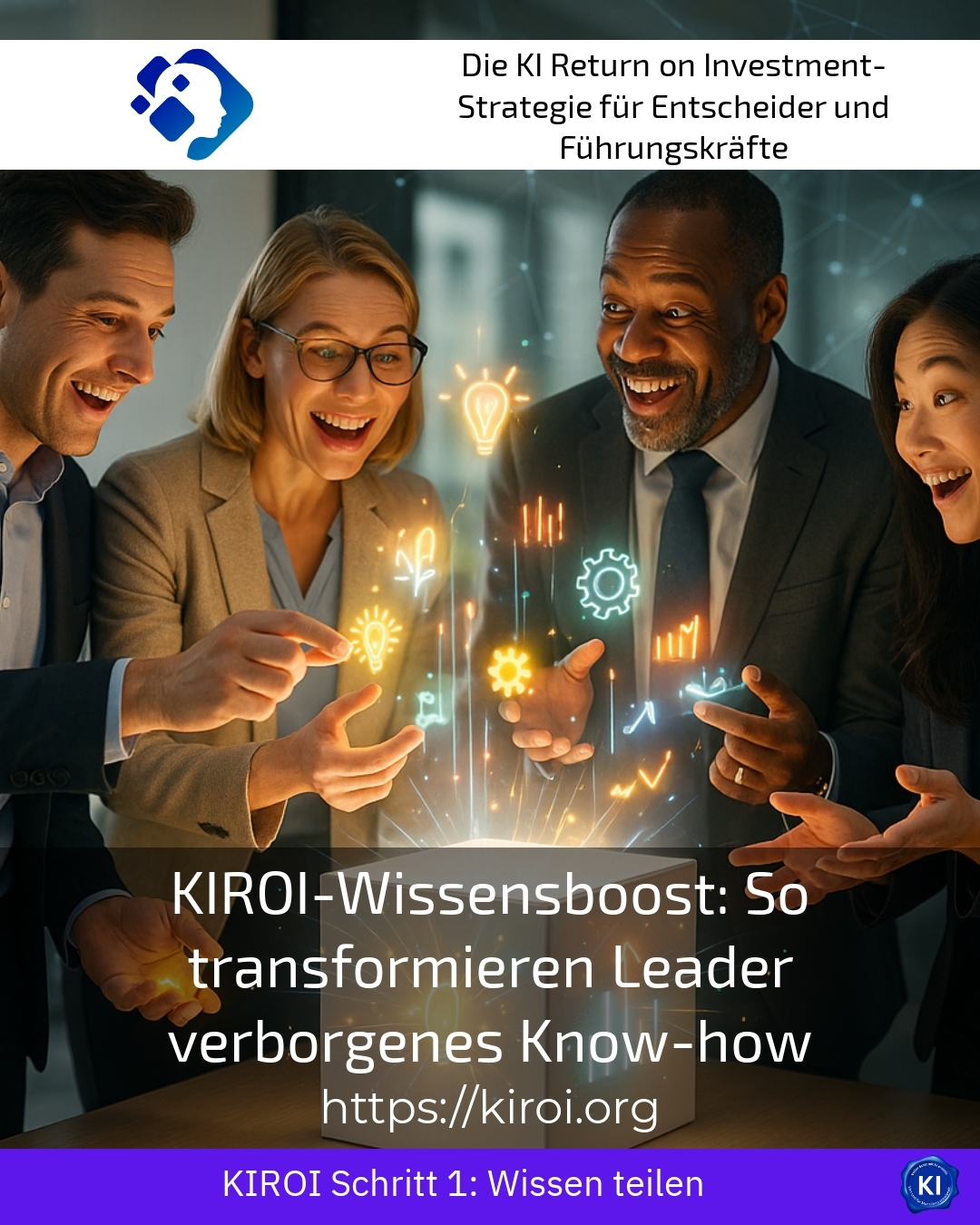
Have you ever wondered why some leaders seemingly effortlessly drive innovation while others, despite enormous efforts, stagnate? The crucial difference often lies not in the obvious resources but in the ability to systematically unlock hidden knowledge and make it usable for the entire organization. AIROI Knowledge Boost offers a structured approach here that helps leadership figures achieve exactly this transformation and turn tacit expertise into visible results.
Why traditional knowledge management approaches often fail
In many companies, immense repositories of knowledge lie dormant in the minds of experienced employees who are never systematically captured or shared. These tacit knowledge arise over the years through practical experience, intuitive problem solving, and countless challenges overcome. Traditional documentation systems barely capture this valuable information because they are oriented towards explicit, easily articulable knowledge. Many executives report that despite extensive knowledge databases, they repeatedly observe the same mistakes. The gap between what people know and what they can share remains. Here, the AIROI Knowledge Boost it creates bridges between implicit and explicit knowledge.
For example, a medium-sized machine engineering company lost its most experienced toolmaker to retirement. Although he had been creating documentation for years, successors were unable to reproduce certain precision work. In a shipyard, a similar pattern emerged when a welding specialist left the company and critical manufacturing knowledge disappeared. In food production, companies regularly experience that recipes are documented, but certain hand-holding techniques and timing decisions cannot be transferred.
The psychological dimension of knowledge transfer
For many people, sharing knowledge means giving up part of their professional identity and irreplaceable value. This emotional component is often underestimated or completely ignored in traditional management approaches [1]. Therefore, leaders must create environments where sharing expertise is seen as strength rather than a sign of self-deprecation. Recognition and appreciation play a central role in this. People are more willing to share their knowledge when they receive visible recognition for it.
In the automotive supply industry, companies have had positive experiences with mentor programs that systematically transfer experienced professionals into new roles. Chemical companies are increasingly relying on cross-generational teams that work together on complex projects. Pharmaceutical companies are now developing their own academies where long-time researchers can pass on their knowledge to younger colleagues.
The AIROI knowledge boost as a strategic leadership tool
Unlike traditional knowledge management tools, this approach focuses on the active role of the leader as a catalyst for knowledge transformation. Leadership personalities learn to ask the right questions, identify hidden expertise, and create structures that promote organic knowledge exchange [2]. The process begins with a thorough analysis of the existing knowledge landscape within the organization. This includes not only capturing obvious competencies but also mapping the invisible networks and informal flows of knowledge.
Through this analysis, a logistics company discovered that key optimization knowledge lay with dispatchers who had never formally documented it. In the textile industry, it was revealed that machine operators possessed intuitive knowledge about material behavior that was not taught in any training. Hospitals also benefit from such analyses when experienced caregivers pass on their observational skills to younger team members.
Best practice with a AIROI customer An internationally operating manufacturing company faced the challenge that several key personnel would be retiring at the same time and critical process knowledge was at risk of being lost. As part of a transruptive coaching process, we supported the senior management team in creating a comprehensive knowledge map that went far beyond formal job descriptions. Together, we identified hidden experts in various departments whose knowledge had never been officially acknowledged. The coaching supported the management team in developing new formats for knowledge exchange, including so-called story sessions, in which experienced employees reported on critical situations and their resolution. These stories were recorded, prepared, and integrated into onboarding programs for new team members. Within nine months, the leaders reported a noticeably improved error prevention and faster onboarding of new colleagues. The project also showed that employees were significantly more motivated to share their knowledge when they received public recognition and their expertise was valued as a valuable contribution to the company culture.
Practical methods for knowledge extraction in the AIROI-Wissensboost
The extraction of implicit knowledge requires specific techniques that go beyond traditional interviews or documentation requirements. Shadowing programs, in which learners accompany experienced colleagues for extended periods of time, have proven particularly effective [3]. Retrospective analyses, in which teams collectively review past projects, also reveal hidden knowledge. These methods require time and resources, but they yield lasting and valuable results.
In software development, teams use code reviews as an opportunity to explain implicit architectural knowledge. Banks rely on structured handover processes in which outgoing relationship managers systematically transfer their customer knowledge to their successors. In architecture firms, joint project reflection has established itself, where teams compile and document their findings after completing a construction project.
Technological support for modern knowledge transformation
Digital tools can significantly support knowledge transfer when used correctly. Artificial intelligence today enables the automatic analysis of communication patterns to identify knowledge clusters and informal experts [4]. Modern platforms not only capture explicit knowledge but also context, relationships, and usage patterns. However, leaders must understand that technology is only a tool and cannot replace the human factor.
Insurance companies are experimenting with chatbots that can simulate the knowledge of experienced agents. Energy providers are using digital twins to document operational knowledge from plant operators. Video libraries are also increasingly emerging in the trade sector, where craftsmen are capturing their techniques for future generations.
The role of the leader as a knowledge moderator
Modern leaders increasingly see themselves as facilitators and moderators of knowledge flows rather than as central repositories of knowledge. This change in roles requires new competencies and a changed self-perception [5]. Leaders create spaces for exchange, ask the right questions, and connect people with complementary knowledge. They foster a culture of curiosity and continuous learning. Informal meeting formats also play an important role in this process.
In consulting firms, regular knowledge breakfasts have become established, where project teams share their findings. Engineering firms organize monthly technology talks where internal experts present their specialized fields. Interdisciplinary case discussions are also increasingly taking place in hospitals, which go far beyond medical needs to promote knowledge exchange.
Best practice with a AIROI customer A leader from the research and development department came to transruptive coaching with the request that her team, despite high individual competence, was repeatedly encountering difficulties in complex projects and knowledge was not flowing effectively. In the coaching sessions, we first identified which implicit assumptions and expectations shaped the communication within the team and where invisible barriers hindered the exchange of knowledge. The leader recognized that she herself unconsciously acted as a bottleneck, as all important information had to flow through her desk. Together, we developed a new communication structure that enabled and encouraged direct knowledge flows between team members. The leader implemented weekly knowledge sprints in which team members shared their current insights and challenges in short formats. After about four months, she reported a significantly improved project completion time and a noticeably higher rate of innovation within the team. Particularly noteworthy was that younger team members now actively sought knowledge from experienced colleagues, because the culture of sharing had become commonplace.
Sustainable integration into the company culture
Knowledge transformation must not remain a one-time project; it must be deeply embedded in the organizational culture. This is only possible if appropriate behaviors are rewarded and taken into account in performance evaluations. Leaders must act as role models themselves and generously share their own knowledge. Integrating existing processes and routines ensures that knowledge exchange is not perceived as an additional burden.
Technology companies are integrating knowledge documentation directly into their development processes, so that it is automatically generated. Manufacturing companies are linking shift changes with structured handover formats. Retail companies are also experimenting with digital learning platforms where employees can share their sales tips and product knowledge.
My AIROI Analysis
The transformation of hidden knowledge represents one of the most important leadership challenges of our time, and the AIROI Knowledge Boost Here, it offers a valuable framework for a systematic approach. My experience from numerous mentoring projects shows that the decisive success factor lies not in the technology or methods, but in the attitude of the leadership itself. Anyone who views knowledge sharing as a weakness will never be able to establish an appropriate culture in their organization. However, anyone who understands that shared knowledge multiplies and strengthens the entire organization can inspire impressive transformations.
The examples from various industries illustrate that this topic is universally relevant and shows similar patterns across industries. Whether in manufacturing, the service sector, or knowledge-intensive industries – untapped reserves of implicit knowledge lie dormant everywhere, waiting to be activated. Leaders who recognize and harness this leverage provide their organizations with lasting competitive advantages that cannot be simply copied. Investing in knowledge transformation pays off manifold, as it not only increases operational efficiency but also fosters employee satisfaction and innovation.
Transruptive coaching can provide valuable insights during this transformation process and help leaders recognize their personal barriers and develop new behaviors. Clients often report that through the coaching, they have not only developed their organizations but also themselves as leaders. It is this dual transformation that makes the difference between superficial changes and lasting impact.
Further links from the text above:
[1] Harvard Business Review – Knowledge Management
[2] McKinsey – Insights on People and Organisational Performance
[3] APQC – Best Practices in Knowledge Management
[4] Gartner – Artificial Intelligence in Business
[5] MIT Sloan Management Review – Leadership
For more information and if you have any questions, please contact Contact us or read more blog posts on the topic Artificial intelligence here.






 Deutsch
 English (UK)