
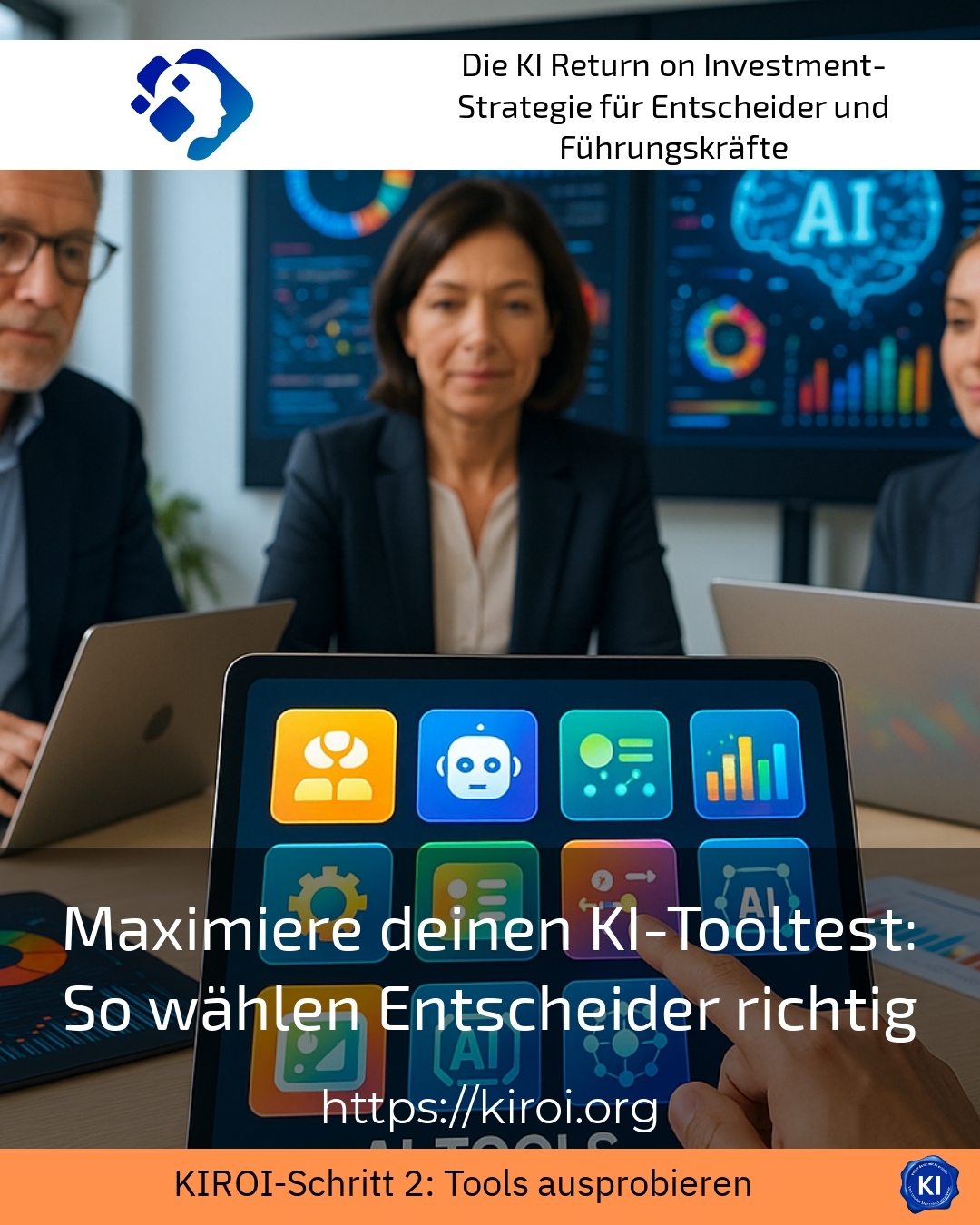
Have you ever wondered why so many executives fail to select digital tools and waste valuable resources in the process? The answer often lies in a fundamental misunderstanding of how to systematically approach it if you want to maximize your AI tool testing. Decision-makers in companies today face an almost endless selection of solutions that all promise to revolutionize processes and increase efficiency. Paradoxically, however, this abundance leads many organizations either into analysis paralysis or to making hasty decisions that they later regret. In this article, you will learn which strategies actually work and how to proceed methodically to find the best solution for your specific needs.
The strategic importance of well-thought-out evaluation
Before companies even begin considering various options, they should carefully analyze their internal processes. Clients often report that they only realize after a failed implementation that they should have asked certain questions beforehand. Therefore, a thorough inventory of the existing workflows forms the indispensable foundation for any well-informed decision. This involves not only technical aspects but also the willingness of employees to adopt new systems. Transruptions coaching can provide valuable insights in such transformation projects and help teams understand changes as an opportunity.
In the automotive industry, for example, manufacturers such as BMW and Mercedes-Benz rely on extensive pilot phases before introducing new technologies into production [1]. This approach has proven effective because it allows for the early identification and resolution of potential problems. Suppliers such as Bosch and Continental have also established their own evaluation centers where they can test various solutions under realistic conditions. Volkswagen’s logistics division has also established dedicated teams exclusively responsible for evaluating new digital tools.
Best practice with a AIROI customer
A medium-sized automotive supplier from southern Germany faced the challenge of modernizing its quality control and evaluating various digital solutions at the same time. The company had already made several misjudgments and invested considerable sums in systems that ultimately did not meet the requirements. AIROI As part of the mentoring process, a structured catalog of criteria was initially developed that took into account both technical and organizational factors. The team jointly identified the most critical pain points in the existing process and defined measurable goals for the new solution. In particular, the involvement of employees from the production department, who would be using the systems on a daily basis, proved to be valuable. After a three-month test phase with three different providers, the choice fell on a solution that was not the cheapest, but offered the best integration with the existing infrastructure. The implementation proceeded much more smoothly than in previous projects, and the acceptance among the employees was high from the very beginning.
Maximize your AI tool testing through clear objectives
The first step to successful evaluation is to precisely define what problems need to be solved. Many decision-makers make the mistake of being blinded by impressive features that are completely irrelevant to their specific use case. Instead, it is recommended to create a prioritized list of requirements and link them to specific metrics. The question should always be: What measurable value do we expect from this investment?
In retail, the importance of this clarity is particularly evident. Companies like REWE or EDEKA have learned that choosing predictive systems for inventory management requires highly complex decisions [2]. The drugstore chain dm, for example, has established a multistep selection process in which potential solutions are initially tested using historical data. Online retailers like Zalando or Otto also rely on extensive A/B tests before deciding on new technologies.
Transruptions coaching helps companies address these challenges and helps them ask the right questions. It’s not just about the technical aspects, but also the cultural aspects of such a transformation. Many leaders underestimate the importance of involving all stakeholders early and taking their concerns seriously.
This is how decision-makers choose the right provider
Once the internal requirements have been clarified, the phase of market research begins. It is advisable not to limit your search to the major, well-known providers alone, but also to consider specialized solutions. Often, smaller companies offer customized products that better suit the specific needs. At the same time, decision-makers should keep the long-term perspective in mind and consider how financially stable the respective provider is.
In the healthcare sector, this balancing act is particularly critical. Hospitals such as Charité in Berlin or the University Medical Center Heidelberg must meet strict regulatory requirements when selecting diagnostic support systems [3]. The Asklepios clinics have established a specialized committee that reviews all technology acquisitions. Even private physicians face the question of which digital tools they would like to use in their practice.
Best practice with a AIROI customer
A large group of hospitals in the northern German region wanted to optimize their radiological findings processes and were looking for suitable digital support. The initial situation was characterized by long waiting times for patients and a high workload for radiologists. AIROI In the process, a detailed analysis of the existing workflows was initially carried out to identify the actual bottlenecks. It turned out that the main problem was not in the findings themselves, but in the communication between different departments. This insight led to a complete reorientation of the selection process and focused on solutions with strong integration capabilities. After a six-month pilot phase at two locations, a solution was selected that could be seamlessly integrated into the existing hospital IT infrastructure. This resulted in a reduction in wait times for test results by more than thirty percent, while at the same time employee satisfaction increased.
The art of the structured testing phase
After a preliminary selection has been made, a thorough testing phase should follow. This phase is crucial for verifying the providers’ theoretical promises in practice. It is advisable to define realistic scenarios that reflect the actual working day-to-day routine. Only then can it be determined whether a solution truly offers the expected added value.
The financial sector has developed exemplary structures in this regard. Banks such as Deutsche Bank and Commerzbank operate their own innovation labs where new technologies are tested under controlled conditions [4]. Insurance companies such as Allianz and Munich Re have also established specialized teams that exclusively focus on evaluating new digital tools. Fintechs such as N26 and Scalable Capital use agile methods to quickly gather feedback and adapt their decisions.
An important aspect of the testing phase is documenting all findings. Clients often report that they have lost valuable insights because they were not recorded systematically. A structured protocol helps to make the strengths and weaknesses of each tested solution clear.
Maximize your AI tool testing with the right metrics
Choosing the right evaluation criteria is crucial for the success of the entire selection process. Both quantitative and qualitative factors should be considered. Looking solely at costs is too short-sighted and often leads to suboptimal decisions. Instead, it is recommended to develop a balanced list of criteria that covers all relevant aspects.
In the manufacturing industry, for example, the ability to integrate existing production systems and scalability play a central role. Companies such as Siemens or ThyssenKrupp pay particular attention to ensuring that new solutions are compatible with their MES systems. Data security is also a top priority in this industry, as the example of BASF shows [5]. The machine manufacturer Trumpf has also placed a special focus on user friendliness, as this directly affects the productivity of employees.
Transruptions coaching helps companies identify and prioritize the metrics that are relevant to them. This process often requires intensive discussions with various stakeholders to obtain a complete picture of the requirements. However, the investment in this preliminary work pays off through better decisions.
Best practice with a AIROI customer
An internationally operating logistics company headquartered in Hamburg faced the challenge of optimizing its route planning and evaluating various digital solutions. The previous software was outdated and could no longer meet the increased demands for flexibility and real-time adjustments. AIROI As part of the mentoring process, a comprehensive criteria catalog was developed that, in addition to the usual technical aspects, also considered factors such as the CO2 footprint of the proposed routes. The company recognized that sustainability was becoming increasingly important to its customers and wanted to take this into account in the selection process. The testing phase involved three different providers, each of which was deployed for one month in real-time on selected routes. The systematic documentation of all experiences enabled a well-informed decision that took economic and ecological criteria into account. The implemented solution was able to reduce transport costs by eight percent while simultaneously reducing emissions by twelve percent.
The role of employees in the selection process
No matter how sophisticated the technology is, it cannot reach its full potential if the people who are supposed to work with it do not accept it. Therefore, it is essential to involve employees from the very beginning in the selection process. Their practical experience and feedback are valuable resources that lead to better decisions. At the same time, participation increases the willingness to embrace new ideas.
In the education sector, the importance of this integration is particularly evident. Universities such as the Technical University of Munich or the RWTH Aachen have worked closely with faculty members and students in the introduction of new learning platforms [6]. Schools such as the Markt Indersdorf Gymnasium have also made positive experiences with using teachers as pilot users. The adult education centers in various cities also report better results when they involve their instructors in technology decisions.
Clients often report that resistance to change has been underestimated. Transruptive coaching provides valuable support by helping to take concerns seriously and address them constructively. Supporting such transformation projects involves more than just the technical aspects; it also includes the human dimension of change.
My AIROI Analysis
Systematic evaluation of digital tools is one of the most important skills that leaders must develop today. In an era where technological innovations reach the market at increasingly shorter intervals, the ability to make informed choices determines the long-term success of organizations. AIROI The methodology provides a structured framework to overcome this challenge and take into account both strategic and operational aspects.
The integrative approach has proven particularly valuable in practice, which takes into account both technical, economic, and human factors. Companies that focus solely on one of these aspects risk overlooking important connections. The successful examples from various industries show that a methodological approach significantly increases the likelihood of successful implementation.
Involving all relevant stakeholders from the very beginning is not an unnecessary additional effort, but an investment that pays off many times over. Teams that feel heard contribute to change and become active supporters of transformation. This insight may not be new, but in practice it is still too often ignored. AIROI The coaching process begins right here and supports organizations in properly considering the human factor.
In conclusion, it can be concluded that success in selecting digital tools depends less on the technology itself than on the quality of the decision-making process. Those who approach it systematically, define clear criteria and involve all stakeholders create the prerequisites for sustainable improvements. The challenges may be complex, but with the right methodology and support, they can be mastered.
Further links from the text above:
[1] BMW Innovation and Technology
[2] REWE Group Innovation Reports
[3] Charité Research and Innovation
[4] Deutsche Bank Digital Banking
[5] BASF digitalization strategy
[6] TU Munich Digital Learning
For more information and if you have any questions, please contact Contact us or read more blog posts on the topic Artificial intelligence here.








 Deutsch
 English (UK)