
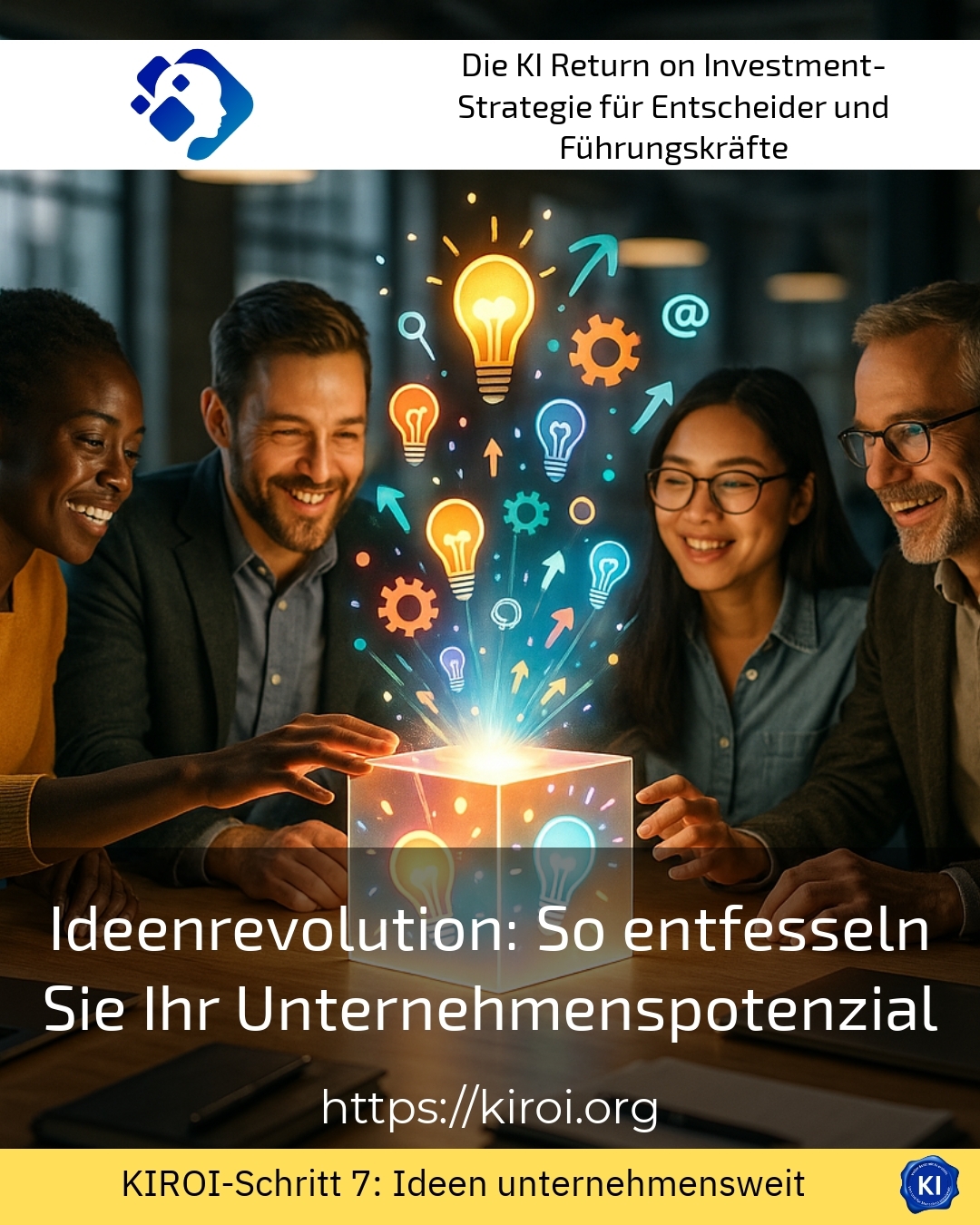
Have you ever wondered why some companies seemingly achieve innovative breakthroughs effortlessly, whilst others tread water despite enormous efforts and can never fully realise their true potential? The answer is frequently hidden within a phenomenon that we call Idea revolution be able to call, and this revolution does not begin in research laboratories or boardrooms, but in the minds of every single employee who is confronted with challenges on a daily basis and in the process gathers valuable insights that are just waiting to be unlocked.
Unleashing the hidden power of collective intelligence
In almost every organisation, a huge reservoir of unused knowledge lies dormant, which can and should be systematically tapped. Frontline employees observe behavioural patterns and needs every day that would never appear in any market research study. Production staff recognise potential for optimisation long before these could appear in official reports. Service staff intuitively understand which offerings are missing and which processes generate frustration among the people they serve.
For example, a medium-sized mechanical engineering company realised that its fitters possessed decades of empirical knowledge that was nowhere documented. A logistics company discovered through systematic surveying of its drivers completely new route optimisations that algorithmic systems had overlooked. A retail company used the observations of its sales staff to fundamentally rethink and realign its entire product range.
Best practice with a AIROI customer
A long-established family-run manufacturing business approached our transruptions coaching team with a specific challenge that will be familiar to many companies. The management reported an increasing stagnation in product innovation, even though the company had highly qualified specialists. As part of our support, we initially implemented structured idea-generation processes across all hierarchical levels. We introduced regular innovation workshops where employees from various departments came together and shared their observations. Within six months, this resulted in three completely new product lines derived directly from the workforce's wealth of experience. What was particularly remarkable was the fact that an apprentice provided the crucial impetus for a process improvement that has enabled significant annual savings. The Idea revolution started at this company because all voices were heard equally and hierarchies were deliberately dismantled.
Creating structures that unlock creative potential
Creativity does not thrive in a vacuum, but requires supportive conditions that can and must be purposefully shaped. Many companies stifle innovative impulses in the bud through excessive bureaucracy and rigid approval processes. The fear of making mistakes paralyses employees and prevents the experimental thinking that is essential for breakthroughs.
A technology company introduced so-called free spaces, in which employees were allowed to use a set percentage of their working time for their own projects. A financial services provider set up cross-departmental innovation teams that were deliberately composed of people with different backgrounds. A healthcare provider established a reward system for implemented suggestions for improvement that went far beyond symbolic recognition and conveyed genuine appreciation.
The physical working environment plays an often underestimated role in fostering creative processes. Open meeting zones enable serendipitous conversations between employees from different departments. Retreat spaces allow for focused thinking away from the hustle and bustle of daily work and constant interruptions. Visualisation areas make ideas visible and invite others to develop them further, which accelerates the collective innovation process.
The ideas revolution begins with the right mindset
Technical structures alone are not enough if the underlying attitude within the company blocks and discourages innovative thoughts. Leaders must demonstrate that questions are more important than supposedly safe answers that cement the status quo. A culture of psychological safety allows people to express unfinished thoughts without having to fear ridicule or sanctions.
A consulting firm systematically trained its managers to respond to proposals with interest rather than scepticism first. An industrial company explicitly celebrated failed experiments because these often yielded the most valuable insights for future successes. A service company abolished traditional suggestion schemes and replaced them with direct dialogues between originators and decision-makers.
Best practice with a AIROI customer
An internationally active consumer goods company sought support in transforming its corporate culture and turned to our team. The challenge was that, despite extensive investments in innovation programmes, hardly any market-ready innovations had been produced. Our transruptions coaching support began with a comprehensive analysis of existing communication channels and decision-making processes across the entire company. During this process, we discovered that ideas had to pass through an average of seven hierarchical levels before they were even seriously evaluated. Together with the executive board, we developed a radically simplified system that established direct connections between idea generators and resource decision-makers. We also established monthly innovation forums where employees at all levels could present their concepts without prior filtering by superiors. The result of these measures significantly exceeded all expectations, as the number of submitted and implemented improvement suggestions quadrupled within a year. Employee satisfaction increased measurably because people developed the feeling of truly being heard and taken seriously in their daily work environment.
Harnessing technology as a catalyst for the ideas revolution
Digital tools can significantly accelerate and democratise creative processes when used correctly. Collaboration platforms enable geographically dispersed teams to work together on ideas and develop them further. Artificial intelligence can recognise patterns in large amounts of data and thereby reveal directions for innovation that would remain hidden from human intuition [1].
A pharmaceutical company uses machine learning to identify promising research directions and deploy resources more effectively. An automotive supplier employs virtual reality so that teams can experience prototypes together before physical models are built. A media company uses algorithms to spot trends early and tailor content accordingly to changing audience needs.
In doing so, technology must never become an end in itself, but must always serve and support the human creative process. The best digital tools are those that break down barriers between people and facilitate exchange without introducing new complexities. Companies that find this balance secure significant competitive advantages in an increasingly dynamic economic world [2].
From the idea revolution to a sustainable culture of innovation
Isolated flashes of brilliance are not enough to secure long-term competitiveness and permanently unleash corporate potential. Rather, it is about developing a continuous capacity for renewal that is deeply anchored within the organisation. This capability must be systematically built and nurtured through consistent action at all levels.
An energy supplier set up an internal accelerator programme that brings promising employee ideas to market maturity. A retail company systematically cooperates with start-ups to bring external impulses into its own organisation. An insurance group established rotation programmes so that employees regularly gain new perspectives through insights into other areas [3].
Measuring innovation success presents many organisations with challenges that are not trivial to resolve. Quantitative metrics such as patent applications or the revenue share of new products capture only a part of reality. Qualitative indicators such as employee engagement, willingness to experiment and learning speed likewise deserve attention when evaluating innovation progress.
Best practice with a AIROI customer
A fast-growing technology company recognised the need to professionalise its innovation processes without losing its original startup dynamism. As part of our transruption coaching support, we first analysed the existing informal networks and communication channels within the company. We identified key individuals who acted as natural idea multipliers and frequently established connections between different departments. On this basis, we developed a hybrid innovation system that combined formal structures with informal opportunities for exchange. We introduced structured idea evaluation processes that ensured transparency and fairness without stifling creativity. At the same time, we established protected experimentation spaces where teams could test new concepts without immediate pressure to succeed. The company now reports a significantly increased speed of innovation coupled with an improved quality of implemented projects. The Idea revolution thus became a permanent part of the corporate identity and not just a one-off initiative.
Overcoming resistance and shaping change
Every profound change meets resistance that must be taken seriously and addressed constructively without ignoring it. People fear the loss of routines, security and established positions of power, which is completely understandable. At the same time, processes of change offer opportunities for personal growth and new possibilities for development that should be communicated.
A traditional textile company overcame internal resistance through the intensive involvement of its workforce in strategy development. A telecommunications provider relied on internal change ambassadors who explained changes and addressed fears at eye level. A construction company carried out gradual pilot projects, the visible successes of which convinced sceptics and inspired imitators.
Leaders play a crucial role in overcoming resistance through personal example and consistent action. They must credibly communicate why change is necessary and what benefits it brings for all involved. Authentic communication, honest engagement with concerns and visible commitment create the trust that makes transformation possible in the first place.
My AIROI Analysis
The systematic development of innovation potential in organisations represents one of the central challenges of our time, as my experience shows. Companies that manage to mobilise the collective intelligence of their employees develop an adaptability that can be decisive in dynamic markets. However, this capability cannot be decreed or bought, but must grow organically through consistent work on culture, structures and processes.
In my consulting practice, I regularly observe that the biggest obstacles to innovation are rarely technical in nature, but lie in human factors. Fear of failure, a lack of psychological safety and hierarchical barriers often block creative potential more effectively than missing budgets or technologies. Therefore, sustainable promotion of innovation always begins with working on the corporate culture and interpersonal relationships.
The Idea revolution, which I write about in this post, is not a one-off event, but a continuous process of renewal and adaptation. Companies that embark on this path frequently report positive side effects such as increased employee satisfaction, lower staff turnover and an enhanced employer brand. Investing in the capacity for innovation therefore pays off in a variety of ways and, in the long term, can make the decisive difference between merely surviving and truly thriving in an increasingly competitive environment.
Further links from the text above:
[1] McKinsey: The economic potential of generative AI
[2] Harvard Business Review: The Hard Truth About Innovative Cultures
[3] BCG: Advantages of Investing in Innovation
For more information and if you have any questions, please contact Contact us or read more blog posts on the topic Artificial intelligence here.







 Deutsch
 English (UK)