
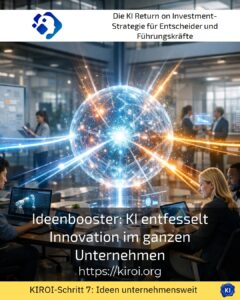
Why do so many brilliant ideas fail in their infancy, even though managers actually know full well how important fresh impetus is to business success? The answer often lies not in a lack of creativity, but in the way organisations structure and accompany the ideation process. A well-structured ideas workshop can make all the decisive difference, because it creates space for genuine innovative strength while simultaneously setting the necessary guardrails. Leaders face the challenge of enabling creative freedom whilst still not losing sight of strategic goals. In this article, you will learn how you, as a decision-maker, can provide genuine impetus for innovation.
The hidden power of structured creativity
Many companies underestimate the importance of a well-conceived framework for creative processes. They assume that innovation arises spontaneously and cannot be planned. However, this assumption often leads to frustration and wasted resources. Instead, experience shows that structured formats deliver significantly better results. For example, a manufacturing company in the mechanical engineering sector shortened its development cycles by several months. The key lay in regular creative sessions with clear methodological guidelines. A medium-sized automotive supplier also reports similar successes in product development. There, cross-functional teams were put together to work on solutions collaboratively. A third example is provided by a chemical corporation that completely reorganised its research department. The results speak for themselves and show that creativity and structure are not opposites.
Why the ideation workshop is becoming the beating heart of successful teams
A professionally managed ideas workshop provides the safe environment that innovative ideas need. Here, employees can think freely without having to fear immediate evaluation. This psychological safety is crucial for the success of creative processes. A logistics company significantly increased its efficiency in route planning through regular workshops. The ideas didn't come from the management, but from the drivers themselves. An energy supplier used similar formats to develop new business models in the field of renewable energies. Particularly noteworthy is also the example of a pharmaceutical company that was able to accelerate its clinical trials through creative approaches. All these cases show that the right framework conditions make the difference. Managers act as enablers rather than controllers.
Best practice with a AIROI customer
An internationally active industrial enterprise came to us with the challenge that, despite high investments in research and development, hardly any marketable innovations were emerging. The management team felt that valuable ideas were getting lost in day-to-day business or were never voiced. As part of our transruptions coaching accompaniment, we jointly developed a multi-stage concept for regular creative formats. First, we analysed the existing communication channels and identified bottlenecks in the flow of ideas. Subsequently, we established monthly sessions in which employees from various departments came together. These meetings followed a clear methodology that offered both creative freedom and structure. After six months, the company already had three promising product concepts in the pipeline. Employee satisfaction increased measurably because people finally felt heard. The managers reported a completely transformed innovation culture throughout the entire company. This example impressively demonstrates how professional accompaniment can support transformation processes.
The role of the leader as an innovation catalyst
Through their behaviour, leaders significantly shape a company's culture of innovation. Their attitude towards new ideas sends important signals to the entire workforce. Anyone who punishes mistakes stifles creativity right in the bud. A technology company in the field of semiconductor manufacturing has therefore deliberately established a culture of error. There, failed experiments are not viewed as failure, but as valuable learning opportunities. A medical technology manufacturer goes a step even further and even rewards the most educational failures. A textile company also reports positive experiences with this approach. The management level there regularly takes part in creative workshops themselves. This shows the employees that innovation really is a priority.
Methods and tools for the successful ideas workshop
Choosing the right methods determines the success or failure of creative processes. Design Thinking has proven particularly effective in many industries. This method consistently places the user at the centre of all considerations. A consumer goods manufacturer uses Design Thinking successfully to develop new packaging solutions. The SCAMPER method also frequently delivers surprising results in product improvement. A construction company has fundamentally revised and optimised its standard processes with it. Edward de Bono's Six Thinking Hats technique is also widely used. A financial services provider regularly employs this method in strategic planning sessions. Professional facilitation by experienced facilitators is always crucial in this regard.
Digital tools meaningfully complement traditional creative methods. Virtual whiteboards enable location-independent collaboration in real time. A globally operating electronics group uses such tools for cross-location innovation projects. Artificial intelligence can assist in recognising patterns in large volumes of data. An insurance company has thus identified completely new customer needs. Interesting potential applications are also emerging in the food industry. There, AI-supported analyses are used for trend research. The combination of human creativity and technological support offers enormous potential.
Overcoming obstacles and creating sustainable structures
The path to a genuine culture of innovation is rarely straightforward and requires perseverance. Resistance often arises from a fear of change or loss of control. Managers frequently report concerns about supposedly unproductive creative time. However, these reservations can be dispelled through clear measurement of success. For example, a steel producer demonstrated a direct correlation between the frequency of workshops and suggestions for improvement. The figures convinced even sceptical controlling departments. A telecommunications provider systematically measures the return on innovation of its creative formats [1]. A retail company has also developed meaningful key performance indicators for its innovation activities. This data-driven approach creates acceptance across all hierarchical levels.
Best practice with a AIROI customer
A medium-sized plant engineering company approached us with a classic problem. The management team had already tried several times to establish innovation workshops. Each time, however, these attempts fizzled out after a few months. The employees showed initial enthusiasm, which quickly waned. During the transruptions coaching, we worked together to uncover the causes of this pattern. It turned out that the managers themselves were subconsciously sabotaging the innovation efforts. They regularly interrupted creative phases for supposedly urgent day-to-day tasks. Moreover, promising ideas were rarely followed through consistently. We subsequently developed a binding commitment from the executive board. Fixed time slots were blocked out in the calendar and defined as inviolable. In addition, we established a structured process for tracking ideas. Every idea was assigned a sponsor who was responsible for its further development. After one year, the innovation culture had fundamentally changed. Several patents were registered and new business areas opened up. Today, the managers report a completely different energy within the company.
Embed the ideas workshop as part of the corporate strategy
Sustainable innovation requires strategic embedding within the entire organisation. Individual workshops are not enough to bring about lasting change. A cosmetics company has therefore defined innovation as an integral part of its corporate objectives. Every department must regularly report and document innovation metrics. A furniture manufacturer has created its own department for future development. Employees from all specialist areas work there on long-term innovation projects. A sporting goods manufacturer also pursues a similar approach with great success [2]. The ideas workshop is understood there as a strategic instrument and prioritised accordingly. These companies show that systematic innovation is indeed plannable.
Combining short-term results and a long-term vision presents many organisations with challenges. A beverage manufacturer has developed a two-stage system for this. Quick ideas for improvement are implemented immediately, while larger innovations go through a separate process. An aerospace company uses similar structures. There, a conscious distinction is made between incremental and disruptive innovation. An agricultural machinery company has also differentiated its innovation processes accordingly. This separation enables both quick wins and groundbreaking breakthroughs. Leaders must constantly find and maintain the right balance.
The human dimension of innovation
Technology and methodology are important, but ultimately people make the difference. Motivation and commitment are not created by order, but through genuine appreciation. An electronics manufacturer has recognised that recognition is the most important driver for a readiness to innovate. There, originators of ideas are regularly honored in front of the entire workforce. A paper manufacturer has established its own reward system for implemented suggestions for improvement. Intangible recognition also plays a significant role in the overall concept. A machine tool manufacturer invites particularly innovative employees to customer meetings. This direct connection between idea and customer benefit is extremely motivating.
Diversity in teams has been proven to promote the quality and variety of the ideas generated [3]. Different perspectives lead to more comprehensive solutions and better results. A pharmaceutical company therefore deliberately pays attention to the heterogeneous composition of its project teams. Age, gender, academic discipline and cultural background are taken into account. A car manufacturer has had similar experiences in the development of new mobility concepts. There, engineers, designers, sociologists and marketing experts work closely together. A software company also reports better products thanks to diverse development teams. The ideas workshop benefits enormously from this diversity of participants.
My AIROI Analysis
The examination of numerous companies across various sectors reveals a clear pattern. Successful innovation does not happen by chance, but through the deliberate shaping of the framework conditions. Leaders play a central role in this as enablers and role models. They must muster the courage to relinquish control and create leeway. At the same time, they must not lose sight of the strategic direction. Finding this balance requires practice and often also external support.
Investing in structured creative formats pays off measurably. Companies with established innovation processes report shorter development cycles and higher employee satisfaction. They respond more quickly to market changes and open up new business areas. The ideas workshop is not an end in itself, but a strategic tool. It combines human creativity with business goals in a meaningful way.
Particularly remarkable is the realisation that many obstacles lie within the minds of the executives themselves. Unconscious behavioural patterns can sabotage innovation efforts without this being intended. Professional guidance through transruption coaching can provide valuable impetus here. It helps to identify blind spots and establish new behaviours. The transformation into an innovative organisation is a process that requires time and patience. However, those who are willing to walk this path will be rewarded with sustainable competitive advantages.
Further links from the text above:
[1] Harvard Business Review: Innovation Management
[2] McKinsey: Insights on Innovation Strategy
[3] Forbes: How Diversity Drives Innovation
For more information and if you have any questions, please contact Contact us or read more blog posts on the topic Artificial intelligence here.









 Deutsch
 English (UK)