
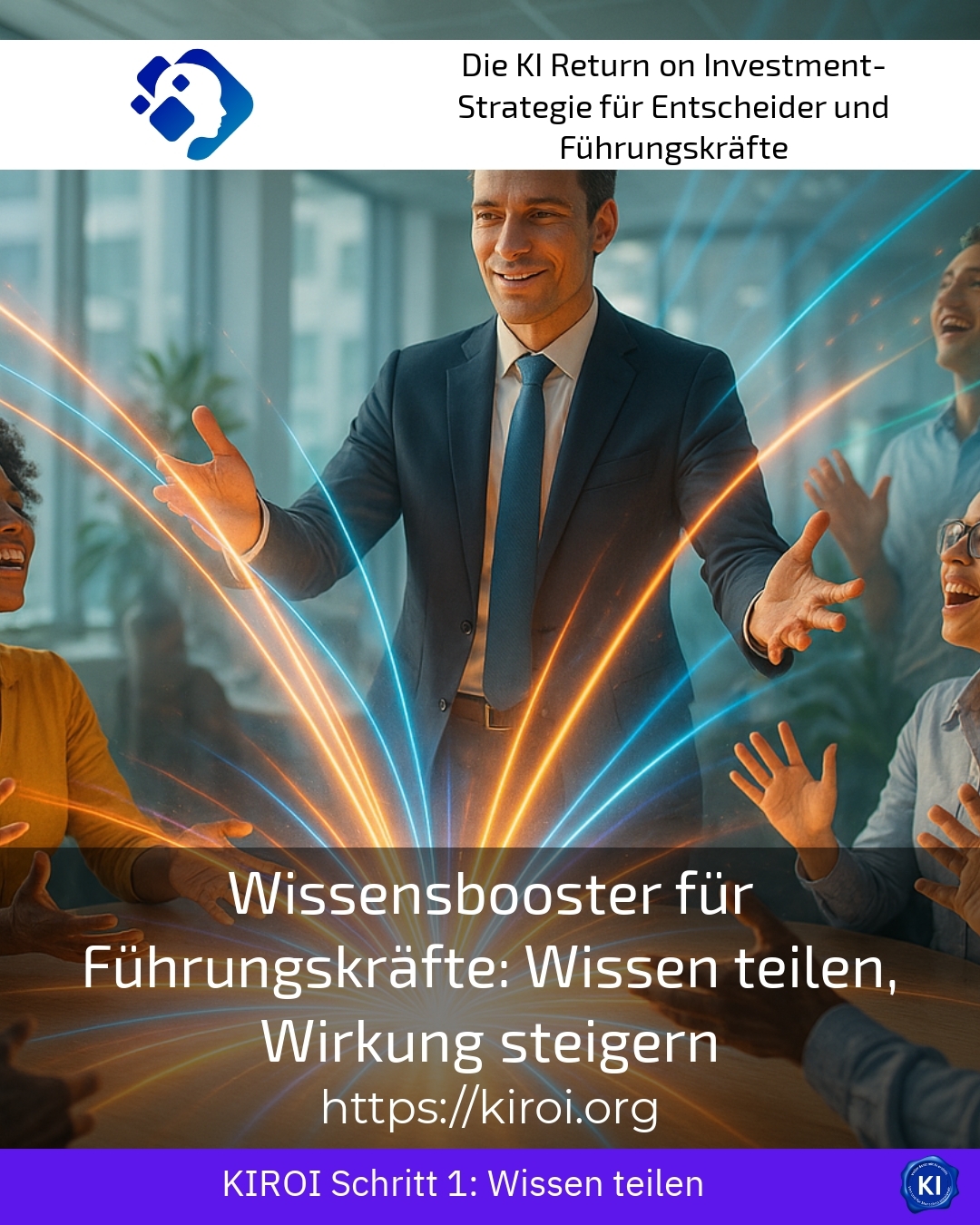
Imagine that you enter your office in the morning and immediately feel that your entire team is imbued with a collective energy based on shared expertise that drives every single employee to their best performance. This is exactly where the Knowledge booster for managers Because in a rapidly changing world where information has become the most valuable asset, the way organizations cultivate and disseminate their internal expertise determines the success or failure of entire enterprises. The following lines will show you why people in leadership positions play a key role, especially when it comes to not hoarding knowledge but systematically sharing it, thereby creating a multiplier effect that goes far beyond traditional management approaches.
The transformative power of knowledge exchange in modern organizations
In almost every industry, we are currently experiencing a fundamental change. This change affects the way companies manage their most valuable asset: the collective knowledge of all employees. In healthcare, for example, clinic managers often report that new treatment methods only reach their full potential when all professionals have access to the latest findings and can integrate them into their daily practice [1]. In the financial sector, things are similar, where compliance requirements are constantly increasing and only then are they effectively implemented when the appropriate expertise flows through all levels of the hierarchy quickly and precisely. In the manufacturing sector, too, it is repeatedly shown that production errors significantly decrease once shift managers begin systematically passing on their experiences to new colleagues, rather than viewing their knowledge as a personal competitive advantage.
The challenge, however, lies in establishing a culture that not only enables this exchange but actively encourages and rewards it. Many leaders come to the consultation with this exact goal in mind. They feel that enormous potential lies dormant within their teams. At the same time, they lack the tools to unleash this potential. Transruptions coaching offers valuable support for projects that specifically aim to achieve this transformation. Clients often report that after intensive coaching sessions, they develop completely new perspectives on their role as a knowledge disseminator.
The knowledge booster for executives as a strategic tool
When we talk about effective knowledge sharing, we must first understand that it involves much more than simply passing on information; truly effective knowledge transfer requires a deep consideration of the individual learning needs of each team member, as well as a fine sense of which insights are relevant for which tasks. In retail, for example, this is particularly evident when experienced store managers pass on their knowledge about customer behavior to younger colleagues, thereby enabling them to conduct sales conversations more purposefully [2]. In the IT sector, however, a single developer who systematically documents their debugging strategies and shares them with the team can significantly reduce the time it takes to solve problems for the entire department.
Best practice with a AIROI customer
A medium-sized logistics company faced the challenge that important process knowledge was stored almost exclusively in the minds of fewer long-serving employees, which frequently led to significant bottlenecks and quality losses in case of illness or vacation time. As part of the coaching process, we developed a multi-stage program together that initially included the identification of critical knowledge holders and subsequently established structures through which this valuable know-how could be systematically captured and made accessible to all relevant employees. Particularly noteworthy was the management’s realization that the experienced employees did not hold their expertise for their own personal gain, but simply never had the opportunity or the appropriate formats to effectively pass on their knowledge. After implementing weekly knowledge rounds and introducing a digital knowledge management system, the error rate in order processing decreased by significant amounts, while at the same time employee satisfaction increased measurably, as the long-standing professionals now felt recognized as valuable mentors for the first time. This transformation illustrates impressively how targeted knowledge exchange not only leads to operational improvements but can also sustainably strengthen the employees’ emotional attachment to the company.
Practical approaches for implementing knowledge transfer programs
The theoretical understanding of the importance of knowledge transfer is only the first step in a long journey. What is crucial is its practical implementation in day-to-day business operations. In the pharmaceutical industry, for example, leading companies have introduced so-called Knowledge Circles. These circles regularly bring together researchers from different departments. This way, new insights are generated through the combination of different disciplines. In the banking sector, innovative institutions, on the other hand, rely on peer-learning programs. Experienced consultants pass on their knowledge to newcomers in the workforce. These programs support the personal development of both parties in a sustainable way [3].
One Knowledge booster for managers These can take various forms. Some organizations prefer formalized mentoring programs with clear structures. Others rely on informal formats such as regular lunch-and-learn sessions. In the construction industry, for example, morning short briefings have proven effective. Experienced construction managers share their knowledge about safety aspects here. This practice has significantly reduced accident rates in many companies. In the educational sector, on the other hand, school principals are increasingly experimenting with peer-to-peer residencies. Teachers observe each other in class and then exchange constructive feedback.
Sharing knowledge to increase impact: The role of corporate culture
No knowledge management system, no matter how sophisticated, will have a lasting effect if the underlying corporate culture does not actively promote or even hinder open exchange of information. Therefore, leaders should first conduct an honest assessment of the cultural barriers that may be hindering the free flow of knowledge. In the insurance industry, department heads often report a competitive mindset among different sales channels, which makes the exchange of successful sales strategies more difficult. In the automotive industry, rigid hierarchies have traditionally led to valuable improvement proposals from production workers not reaching the decision-making levels.
Transruptions coaching can provide valuable insights here. It helps leaders reflect on their own attitude towards knowledge transfer. Often, clients report unconscious patterns in their leadership behavior. These patterns can unintentionally block the exchange of knowledge. Guiding projects towards cultural transformation requires patience and perseverance. At the same time, experiences from various industries show that the effort pays off in the long run.
Best practice with a AIROI customer
An international consulting firm struggled with the problem that project teams broke apart after completing their assignments without the gained insights being systematically captured for future projects, which led to similar errors recurring and having to be developed new solutions every time. Together with the management, we developed an innovative concept that made so-called project retrospectives mandatory and at the same time established a digital knowledge database in which all lessons learned are documented for all employees. However, the decisive breakthrough only came when we discussed the compensation structure in coaching and showed that the previous incentives primarily rewarded individual performance and that sharing knowledge had no positive consequences. After the introduction of a team bonus system that explicitly also took into account contributions to the knowledge database, the dynamics changed fundamentally, and employees began actively seeking ways to share their expertise with colleagues, which not only improved the quality of the consulting services but also shortened the onboarding time for new consultants by several weeks.
Technological support for effective knowledge transfer
Digitalization has created completely new possibilities for knowledge exchange. It expands the horizons of what is possible in organizations. In healthcare, telemedicine platforms today enable the exchange between specialists from different clinics [4]. This allows patients to benefit from pooled expertise. In agriculture, agricultural businesses share their experiences through digital networks regarding sustainable cultivation methods. This collective intelligence accelerates the transformation of the entire industry. Online learning platforms are also gaining increasing importance in the craft sector. Master craftsmen document complex work techniques in video formats there.
At the same time, experienced executives call for a balanced approach. Technology alone cannot replace human interaction. It can only support and facilitate the exchange of knowledge. In the hotel industry, for example, chains have found that digital training tools are most effective when complemented by personal mentoring relationships. In the energy sector, successful companies combine virtual reality training for complex technical systems with regular in-person workshops. This hybrid approach takes advantage of the strengths of both worlds. It takes into account different learning styles and generations alike.
The knowledge booster for executives in practical application
To a sustainable Knowledge booster for managers Establishing a structured approach within one’s own organization requires a structured process that takes into account both the strategic level and everyday practice, while remaining flexible enough to be able to react to unforeseen obstacles. In the media industry, editorial departments have made positive experiences with so-called story circles, where experienced journalists share their research methods with younger colleagues, not only imparting technical knowledge but also passing on ethical principles and professional standards. In mechanical engineering, plant managers have found that involving employees in continuous improvement processes not only increases production efficiency but also creates an environment in which knowledge sharing becomes a natural practice.
The topics that management leaders come to us for advice on are diverse. Some are looking for concrete methods for effective knowledge sharing. Others need support in overcoming cultural resistance. Still others want to learn how to act as role models for open knowledge exchange themselves. Transruptive coaching supports all of these projects individually. It provides guidance without imposing ready-made solutions. This approach respects the leadership’s own responsibility. It promotes sustainable change from within.
My AIROI Analysis
After intensive discussion of the various aspects of organizational knowledge transfer, several key insights have emerged that are of immediate relevance to executives in all industries and can serve as the foundation for future-oriented strategies. First, it is clear that systematic exchange of expertise is not a luxury that only large corporations can afford; rather, it represents an existential necessity for organizations of all sizes that want to survive in an increasingly volatile market environment. The examples from different sectors illustrate that successful knowledge transfer initiatives must always take into account several dimensions: the technological infrastructure, the cultural framework, the individual competencies of the leaders, and the concrete incentive systems that reward appropriate behavior. What is particularly remarkable to me is the realization that many perceived obstacles to open knowledge exchange are not due to malicious hoarding of information but simply to the lack of structures and opportunities that would enable such exchange. This holds enormous potential that can be unlocked with relatively little effort if leaders provide the right impulses and lead by example. The AIROI-methodology provides a valuable framework for systematically addressing these complex transformation processes and for appropriately taking into account both the rational and the emotional aspects of change.
Further links from the text above:
[1] McKinsey: The Critical Importance of Knowledge Management
[2] Harvard Business Review: Insights on Knowledge Management
[3] Forbes: Knowledge Sharing and Leadership
[4] Gartner: Knowledge Management Best Practices
For more information and if you have any questions, please contact Contact us or read more blog posts on the topic Artificial intelligence here.









 Deutsch
  English (UK)