
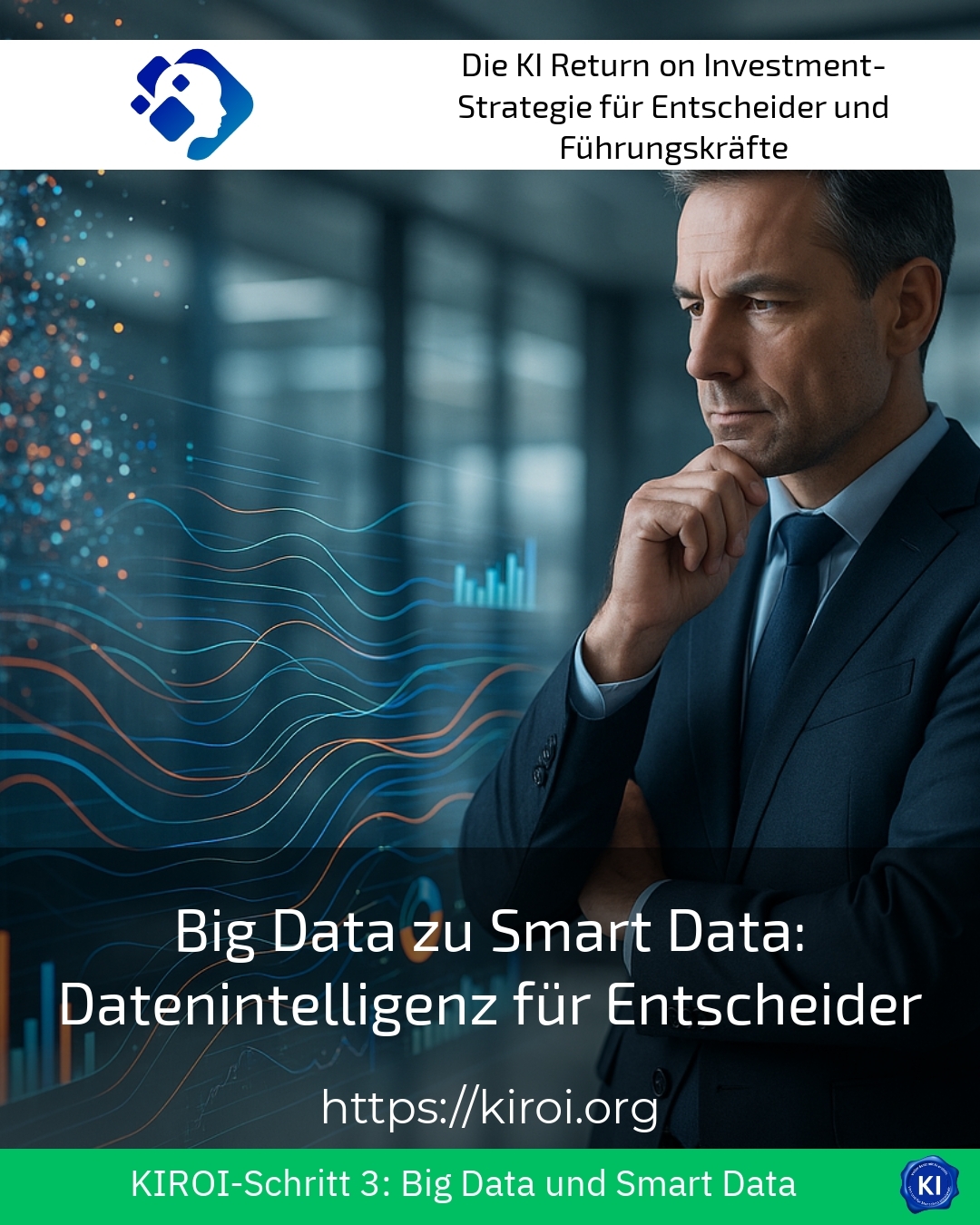
The flood of information pouring in on executives every day can feel overwhelming and frequently leads to analysis paralysis rather than clear courses of action. This is precisely where the shift from big data to smart data comes in, because it is no longer about gathering as much data as possible, but rather about making the right insights available at the right time. Companies that understand and implement this paradigm shift secure decisive competitive advantages in an increasingly complex business world. This article examines how data intelligence transforms decision-making processes and which concrete approaches are already being successfully applied across various industries.
The transition from data volumes to intelligent insights
The sheer volume of available information has increased exponentially in recent years. Companies today store more data than ever before in human history. Yet this abundance alone does not create added value. Rather, the opposite frequently occurs, namely confusion and overload for those who have to make decisions. The decisive step consists in distilling actionable insights from raw data sets. This transformation requires sophisticated analysis methods and a deep understanding of the respective business processes. For example, logistics companies use sensor data from their vehicle fleets to precisely predict maintenance intervals and minimise downtime. Retailers, in turn, analyse their customers' purchasing behaviour to intelligently manage product ranges and optimise inventory levels. Financial service providers rely on pattern recognition to identify fraudulent transactions in real time.
The challenge lies not only in the technical implementation, but also in organisational embedding. Many leaders report difficulties when integrating data-driven decision-making into their existing structures. This is precisely where transruptions coaching offers valuable guidance for projects involving digital transformation. The support helps to overcome resistance and establish new mindsets within the company.
Big Data to Smart Data: quality over quantity as the new paradigm
The term quality takes on a completely new meaning in this context and no longer refers exclusively to the faultlessness of products. Rather, it is about the relevance and informational value of the processed data. A manufacturing company generates millions of data points at its production facilities every day. Yet only a fraction of this data actually contributes to the optimisation of production processes. The skill lies in filtering precisely these relevant signals out of the noise. Pharmaceutical manufacturers use similar approaches in the quality control of their active ingredients. Food producers monitor supply chains in real time to detect contamination at an early stage. Energy suppliers forecast peak loads more precisely and manage their grids accordingly more efficiently.
Best practice with a AIROI customer
A medium-sized mechanical engineering company faced the challenge of fundamentally modernising its service processes while sustainably increasing customer satisfaction. The previous approach was based on rigid maintenance intervals that took into account neither the actual condition of the machines nor the individual operating conditions at the customer's site. As part of the AIROI project, the company implemented intelligent sensors on its delivered systems, which continuously record relevant operating parameters and transmit them to a central analysis platform. The decisive innovation was not to evaluate all available data, but to specifically identify those parameters that reliably indicate upcoming signs of wear. Machine learning algorithms were trained to derive precise predictions from historical failure patterns. The result surprised even the most sceptical managers in the company, as unplanned downtimes at customer systems were significantly reduced. At the same time, service costs fell because technicians could now be deployed in a targeted and proactive manner. Customer loyalty improved measurably, and today the company successfully differentiates itself from the competition through this data-driven service offering.
Data intelligence for decision-makers: From gut feeling to evidence-based analysis
Experienced managers traditionally rely on their intuition and many years of industry experience when making important decisions [1]. These skills will continue to remain valuable and indispensable. However, they can be sensibly supplemented and validated by data-driven insights. The combination of human expertise and machine analysis creates a new quality of decision-making. Insurance companies use this approach when assessing the risks of complex major projects. Real estate developers analyse location factors with a precision that would previously have been unthinkable. Media companies understand their audience better and can deliver content more precisely.
However, the transformation from big data to smart data requires more than just technical investment. It demands a cultural shift within the organisation. Employees at all levels must learn to handle data and critically question its findings. Leaders are faced with the task of establishing a culture of data-driven decision-making without losing sight of the human component. Clients frequently report that this very cultural aspect represents the biggest challenge.
Technological Foundations of Intelligent Data Processing
The technical infrastructure for intelligent data processing has developed rapidly in recent years [2]. Today, cloud platforms enable even smaller companies to access powerful analysis tools. Machine learning algorithms are now so sophisticated that they can be deployed without deep specialist knowledge. Visualisation tools make complex relationships understandable even to non-experts. Telecommunications providers use these technologies to predict network utilisation and dynamically allocate resources. Transport service providers optimise their route planning in real time and react flexibly to traffic disruptions. Retail chains personalise the shopping experience, thereby demonstrably increasing sales and customer loyalty.
Integrating various data sources presents a particular technical challenge. Companies typically have organically grown system landscapes with differing data formats and interfaces. Consolidating these heterogeneous holdings requires well-thought-out architectural concepts and often substantial investment in modernising the IT infrastructure.
Practical fields of application and industry examples
The range of possible applications extends across virtually all economic sectors and company sizes. In the healthcare sector, intelligent analysis systems support diagnostics and help identify optimal treatment approaches. Hospitals are optimising their bed occupancy planning and noticeably reducing waiting times for patients. Pharmaceutical companies are accelerating the development of new active ingredients through the systematic evaluation of clinical trial data. In agriculture, sensor networks enable precise irrigation and fertilisation, which conserves resources and increases yields. Industrial manufacturers rely on digital twins to virtually simulate and optimise production processes before they are implemented physically.
Best practice with a AIROI customer
An internationally active retail group was looking for ways to manage its branch network more efficiently while simultaneously improving the shopping experience for its customers. Although traditional metrics such as sales per square metre and customer footfall provided basic insights, they only scratched the surface of what was actually happening. As part of a comprehensive digitalisation initiative with AIROI support, a system was implemented that intelligently combines data from a wide variety of sources. Receipt analyses, movement patterns in the store, weather data, local event calendars and social media trends now flow into an integrated analysis platform. The results provide store managers with concrete recommendations for action that can be implemented directly. For example, the system recognises when certain product combinations are in particularly high demand in a region and suggests appropriate range adjustments. Staff planning now takes predicted footfall peaks into account, ensuring that customers receive sufficient advice during peak times. The group was able to measurably increase its customer satisfaction scores while simultaneously optimising stock levels. Management particularly appreciate the fact that the complexity of data analysis remains in the background and they receive clear, comprehensible recommendations.
Challenges and critical success factors in big data to smart data
The path to intelligent data utilisation is paved with numerous challenges that should not be underestimated [3]. Data protection requirements set narrow limits for the processing of personal information. Ensuring data quality requires continuous attention and systematic processes. Professionals with the necessary analytical skills are highly sought after on the job market and correspondingly difficult to recruit. Chemical companies additionally face the challenge of complying with safety regulations during data transmission. Automotive manufacturers must coordinate the interests of various stakeholders along complex supply chains. Financial institutions operate in an area of tension between innovation pressure and regulatory requirements.
Transruption coaching provides impetus on how companies can systematically tackle these challenges. The guidance supports the development of tailored strategies that take into account both technical and organisational aspects. Clients frequently report that the external perspective in particular has opened up valuable new viewpoints.
Ethical Dimensions and Responsible Handling
The growing importance of data-driven decisions raises important ethical questions that companies should proactively address. Algorithms can unintentionally reinforce biases if they are fed with unbalanced training data. The transparency of automated decision-making processes is gaining social significance and is also being demanded by regulators. Recruitment agencies, for example, must ensure that their selection processes do not reproduce discrimination. Credit institutions face the challenge of making their scoring models comprehensible. Insurers must not create risk profiles on the basis of sensitive characteristics.
Responsible handling of data intelligence requires clear governance structures and ethical guidelines. Companies should define which decisions may be fully automated and where human oversight remains indispensable. The documentation of data flows and analytical methods creates the necessary transparency for internal and external stakeholders.
My AIROI Analysis
The transformation of mass data volumes into usable intelligence represents a fundamental change for many organisations that goes far beyond technical aspects. In my estimation, based on numerous accompanying projects, the key to success lies in a holistic approach that equally considers people, processes and technology. Companies that merely invest in software and neglect cultural dimensions frequently achieve disappointing results. The most successful projects are characterised by a clear vision supported and communicated by the management level. Employees are involved at an early stage and qualified to handle data-driven insights. The technical infrastructure grows organically with the requirements and is not implemented as a one-off major project.
I find approaches that focus on quick, visible successes and convince sceptics within the company through concrete results particularly promising. Pilot projects in manageable areas create learning opportunities and build competence before larger investments are made. The continuous development of analytical skills is more important here than the one-off implementation of a perfect solution. For decision-makers, I recommend starting with an honest inventory of existing data sets and analytical capabilities. Building on this, realistic goals can be defined and prioritised. The shift from big data to smart data is not a sprint, but a marathon that requires stamina and continuous commitment.
Further links from the text above:
[1] Harvard Business Review: Decision Making
[2] Gartner: Data & Analytics Insights
[3] McKinsey Digital: Insights on digital transformation
For more information and if you have any questions, please contact Contact us or read more blog posts on the topic Artificial intelligence here.









 Deutsch
 English (UK)