
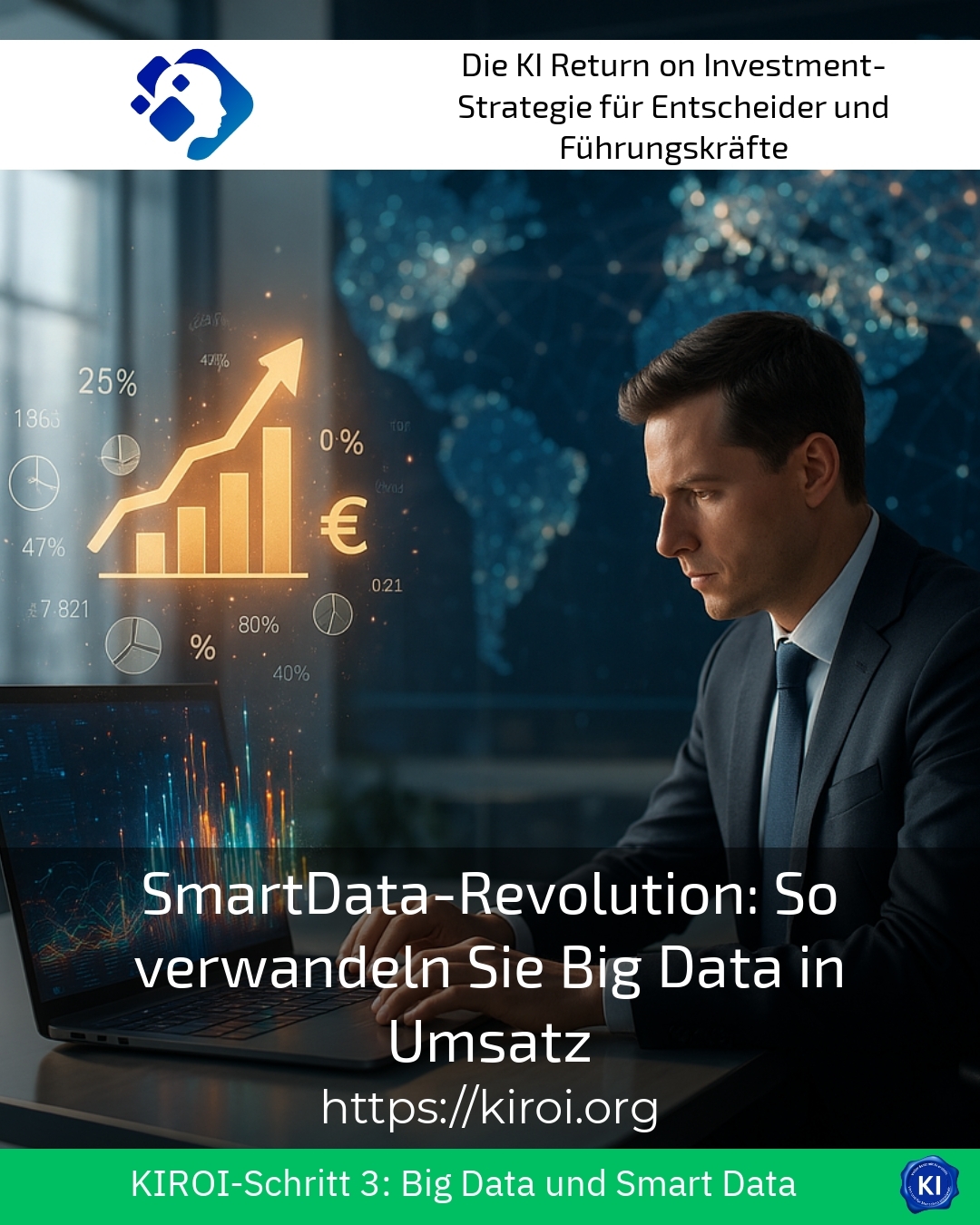
Imagine your company sitting on a mountain of information, yet making decisions in a fog. This is exactly where the SmartData revolution comes in. While many organisations collect massive amounts of data, they fail to generate real value from it. Transforming raw information stocks into tangible revenue increases requires more than just technology. It demands strategic thinking, clear processes, and a new corporate culture. In the following sections, you will learn how leading companies are already successfully shaping this transformation.
Understanding the SmartData Revolution: From Data Chaos to Strategic Clarity
Many companies today collect information on a scale that would have been unthinkable just a few years ago. Sensors in production facilities, click behaviour on websites, and transaction data from sales continuously generate new data points. However, simply accumulating these information reserves does not automatically lead to better business results. On the contrary: without clear structure and objectives, the flood of data can even slow down decision-making processes. The SmartData revolution therefore describes the paradigm shift from pure data accumulation to intelligent utilisation [1].
For instance, a medium-sized mechanical engineering firm realised that its maintenance logs contained valuable patterns. By systematically evaluating this information, the company was able to reduce downtime by more than thirty percent. In turn, a logistics company used route data to significantly cut fuel costs. And a retailer optimised its inventory levels by analysing purchasing behaviour and seasonal fluctuations. These examples show that the potential exists across all industries.
Clients often report feeling overwhelmed by the technical possibilities at first. They don't know where to begin. Transruption coaching supports companies precisely in this phase of orientation. It's about jointly setting priorities and identifying initial pilot projects. This creates a foundation for sustainable change, step by step.
Why the SmartData Revolution Requires More Than Technology
Technical solutions alone are not enough to create real added value from information. Instead, a culture is needed in which data-based decisions are encouraged and accepted. Employees must understand why changes are necessary. Leaders must lead the way and demonstrate by example how data helps in everyday life. Only then will acceptance be created at all levels of the organisation.
For example, a financial services provider implemented a dashboard for real-time monitoring of customer interactions. The technology worked flawlessly, but employees hardly used it at first. Only through targeted training and communication did a real change in behaviour occur. A pharmaceutical company experienced something similar when introducing predictive analytics in research. And an energy supplier had to rethink its entire reporting structure before the new analysis tools were accepted.
Best practice with a KIROI customer
An internationally active trading company faced the challenge of consolidating its fragmented information sources. The various national subsidiaries worked with different systems and standards. As part of a KIROI project, we first analysed the existing data landscape and identified the most relevant sources for business-critical decisions. Together, we developed a roadmap that linked technical integration with change management. The involvement of local teams from the outset was particularly important. Through regular workshops and transparent communication, a common understanding of the project's goals was fostered. After six months, the company was able to produce consolidated analyses across all markets for the first time. Management now uses these insights for strategic decisions on product range design. Sales in the affected product categories demonstrably increased, and customer satisfaction also improved.
Practical implementation: How to make change happen in your company
The path from recognition to concrete implementation requires a structured approach. First, companies should systematically record and evaluate their existing information sources [2]. This involves not only technical aspects but also legal and ethical questions. Which data may be used? Where are the sensitive areas? These questions must be clarified early on.
An insurance company began by analysing its claims and discovered fraud patterns. An automotive supplier evaluated quality data and significantly reduced scrap rates. And a media house used usage statistics to better tailor its content to target audiences. All these projects started with a clear question and a defined pilot area.
Transruptions-Coaching helps companies ask the right questions. It's not about conducting as many analyses as possible. Rather, the relevance of the insights gained is what matters. Impulses from the coaching help to sharpen focus and deploy resources efficiently.
The role of leaders in the Smart Data revolution
Leaders bear a special responsibility in transforming their organisations. They must not only make strategic decisions but also act as role models. If management itself works in a data-driven manner, teams usually follow this example. Conversely, many initiatives fail due to a lack of support from above [3].
A telecommunications provider experienced precisely this dynamic when introducing new analysis tools. The management actively used the dashboards in meetings and presentations, thereby signalling the importance of the topic for the entire organisation. In contrast, a consumer goods manufacturer struggled with acceptance issues for a long time. It wasn't until the board personally demonstrated the benefits that the workforce's attitude changed. Finally, a construction company integrated data-based decision-making into its leadership development.
Best practice with a KIROI customer
A service company in the healthcare sector wanted to increase its process efficiency through better use of information. The initial situation was characterised by manual evaluations and isolated data silos in various departments. As part of the KIROI coaching, we first developed a shared vision with senior management. We then identified key individuals in the specialist departments as ambassadors for change. These multipliers received intensive training and supported their colleagues in their daily work. The realisation that small successes can have a big impact was particularly valuable. After a pilot project in patient administration brought about visible improvements, the willingness to participate in other areas increased significantly. Today, the company works with integrated analyses across all relevant processes. Waiting times for patients have measurably decreased, and employee satisfaction has also improved.
From Analysis to Action: Specifically Increase Sales
Ultimately, every transformation must deliver measurable results. The link between analytical insights and operational actions determines success. Many companies fail precisely at this interface. They produce meaningful reports, but the implementation into concrete actions is lacking.
An e-commerce company used purchase histories for personalised product recommendations, increasing the average basket value. A manufacturing company optimised its pricing through competitor analysis and improved its margins. And a tourism provider dynamically adapted its offerings to demand, leading to higher occupancy rates.
The SmartData revolution is most evident where insights flow directly into business processes. Automated decision support can help to increase reaction speed. At the same time, humans remain responsible for strategic decisions. Finding this balance is one of the central challenges.
Typical challenges and how support helps
Many organisations come to coaching with similar issues. They report fragmented system landscapes and a lack of skills. They struggle with resistance within the workforce and unclear responsibilities. These challenges are widespread and can be effectively addressed.
For example, a chemical company had difficulties linking its laboratory information with production. Through systematic process analysis and technical integration, a continuous data chain was created. A trading company, in turn, first had to improve its master data quality before meaningful analyses were possible. And a software provider realised that its customer data contained valuable insights for product development.
Transruptions-Coaching offers structured guidance in such situations. It’s not about ready-made solutions, but about collaboratively developing suitable approaches. Outside input often helps to break through entrenched thought patterns. This creates new perspectives on familiar problems.
My KIROI Analysis
The transformation of information holdings into concrete business results remains one of the most important tasks for companies across all industries. My experience from numerous projects shows that technical solutions alone rarely lead to the desired outcome. Rather, a holistic approach is needed that considers people, processes, and technology equally. The companies that transform most successfully are characterised by three features. Firstly, they have clear strategic objectives for their data utilisation. Secondly, they invest continuously in the skills development of their employees. Thirdly, they create a culture where experimentation is permitted and lessons are learned from mistakes. These factors cannot be established overnight. They require perseverance and consistent action over longer periods. Coaching can offer valuable support in this process by enabling reflection and uncovering blind spots. The journey to intelligent information utilisation is unique for every company. However, the fundamental principles of successful transformation are similar across industries. Those who understand and consistently apply these principles create the conditions for sustainable business success.
Further links from the text above:
[1] McKinsey: The Data-Driven Enterprise
[2] Harvard Business Review: Data Management Insights
[3] Gartner: Data and Analytics Leadership Insights
For more information and if you have any questions, please contact Contact us or read more blog posts on the topic Artificial intelligence here.









 Deutsch
  English (UK)