
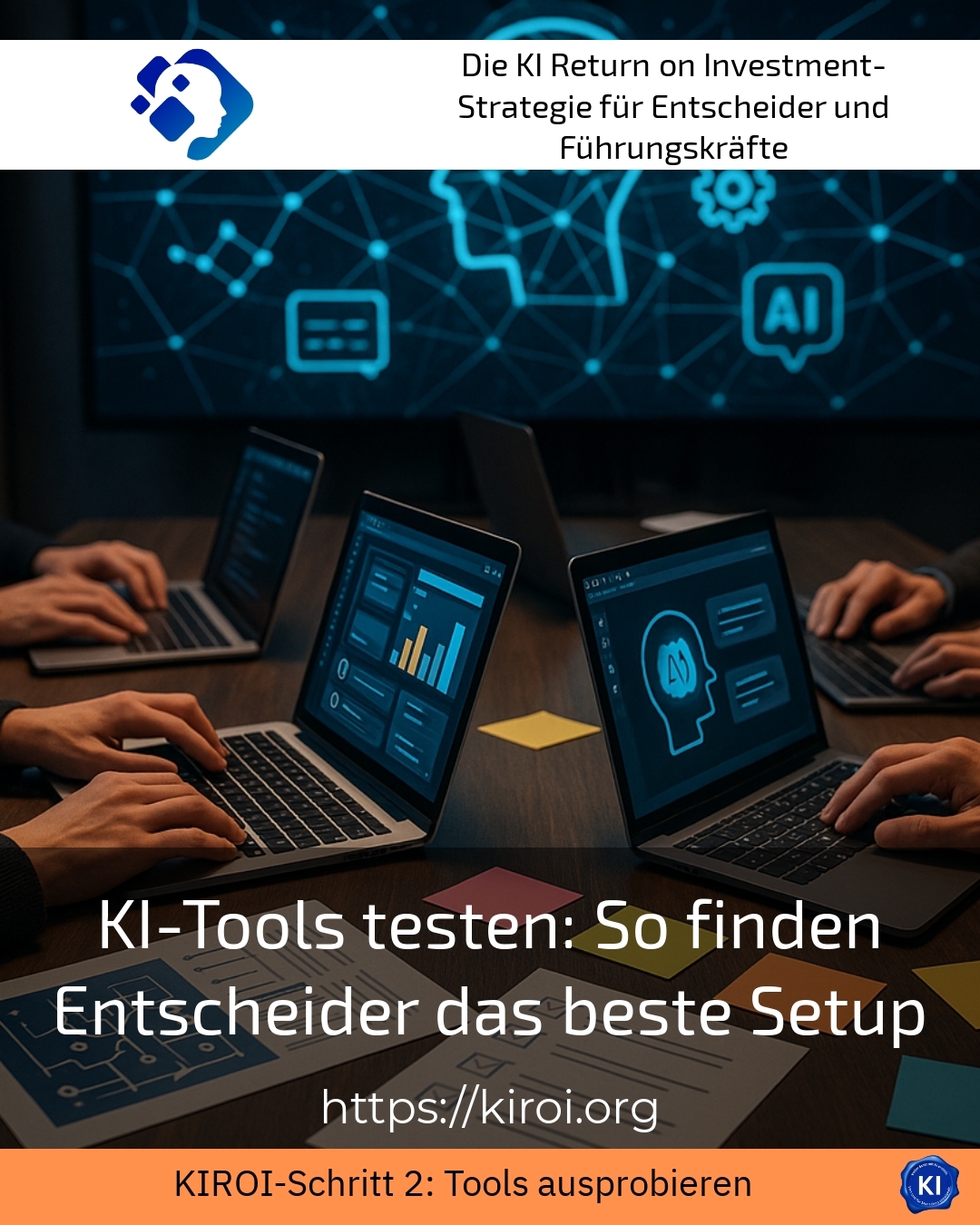
Digital transformation presents leaders with a central challenge. Which intelligent systems truly suit one's own organisation? New solutions appear on the market every day. This makes the choice increasingly complex. At the same time, the pressure to make processes more efficient is increasing. This involves AI Tools to Test: How Decision-Makers Can Find the Best Setup not about blind faith in technology. It's about strategic decisions with foresight. This post will show you a structured way through the jungle of possibilities. You will learn how to proceed systematically and avoid common mistakes.
Why systematic testing has become indispensable
Many companies invest considerable budgets in new technologies. This often happens without sufficient groundwork. The consequences are sobering and place a significant burden on the balance sheet. Projects fail or do not deliver the hoped-for results. Employees lose faith in further innovation initiatives. This downward spiral can be broken, but it requires methodology. A structured testing process creates clarity before the final decision. It reduces risks and increases acceptance throughout the company.
Let's first consider the current situation in various areas. In customer service, for example, many organisations are already using chatbots. However, the quality of these systems varies greatly. Some understand complex requests and solve problems independently. Others frustrate customers with standardised answers that offer no real added value. Similar differences exist in the field of data analysis. Some tools reliably recognise patterns in large volumes of data. Others produce results that are practically unusable. This is why careful evaluation is so important.
AI Tools Testing: How decision-makers find the best setup through clear requirements
The first step leads to the definition of concrete requirements. What exactly should the system be able to do? Which processes are to be optimised? These questions sound simple, but they require deep reflection. Managers often underestimate the effort involved in this phase. They jump straight to product comparisons, overlooking essential aspects. Requirements definition should involve various perspectives. IT managers think differently from specialist departments or senior management.
In the realm of text creation, for example, there are numerous use cases. Marketing teams require assistance with content production. Legal departments seek help with contract review. HR managers want to screen application documents more efficiently. Each of these use cases places different demands on the systems. A tool that excels at formulating creative advertising copy may fail with legal documents. Therefore, precision in defining requirements is crucial.
Best practice with a AIROI customer
A medium-sized manufacturing company faced the challenge of modernising its quality control. Management had heard about image recognition systems and wanted to implement them quickly. As part of the transruption coaching support, a comprehensive requirements analysis was initially carried out. This revealed that the actual challenge did not lie in image analysis. Rather, the problem was the inadequate documentation of the quality criteria themselves. The existing standards had been interpreted differently in various departments. Only by clarifying these fundamentals could a meaningful testing process begin. The company subsequently defined uniform quality standards with measurable criteria. Three different systems were then tested in parallel. The result was a well-founded decision that was supported by all parties involved. The implementation therefore proceeded much more smoothly than with previous technology projects. Clients often report similar experiences in their organisations.
Develop and weight test criteria
Following the requirements definition, the development of concrete test criteria follows. These should be formulated in a measurable and understandable way. Vague criteria such as „user-friendly“ or „high-performance“ are not helpful. Instead, precise definitions of what is meant are needed. User-friendliness, for example, can be measured by the time to the first successful use. High performance can be verified through comparative tests with defined tasks.
In the field of process automation, there are typical criteria. The error rate for recurring tasks is an important indicator. Processing speed also plays a central role. However, adaptability to changing conditions also deserves attention. How does the system react to unusual inputs or special cases? Can it handle exceptions or does it then crash?
In addition, soft factors should be considered. Integration into existing system landscapes is often crucial. The training effort for employees significantly impacts the overall costs. The quality of provider support can also become important in the long term. All these aspects are incorporated into an evaluation matrix.
The right test strategy for AI tools: how decision-makers can find the best setup
The choice of testing strategy depends on various factors. Resource availability, timescales and risk appetite all play a part. Generally, a multi-stage approach with increasing complexity is recommended. In the first phase, potential solutions are reviewed and pre-selected. Product demonstrations and research are often sufficient here. The second phase then involves practical tests with selected candidates.
For practical tests, there are various approaches. Proof-of-concept projects enable intensive testing under realistic conditions. However, they require substantial resources and upfront investment. Pilot projects in delimited areas offer a middle ground. They deliver meaningful results with manageable effort. A/B tests compare different solutions in parallel in live operation. This method is particularly suitable for customer-facing applications.
In the field of language processing, a three-stage test has proven effective. First, standardised benchmark tasks are carried out. Then, tests with company-specific content and technical terms follow. Finally, edge cases and stress scenarios are played out. This combination reliably reveals strengths and weaknesses.
Best practice with a AIROI customer
A service company wanted to speed up and professionalise its quotation process. Previously, employees needed several hours for an individual quote. Management hoped for significant time savings through technological support. As part of the transruption coaching accompaniment, a structured testing process was set up. Five different tools were initially pre-selected based on a list of criteria. Three candidates were shortlisted for practical tests. The company defined ten representative quotation scenarios of varying complexity. Each system had to go through these scenarios and was evaluated accordingly. The evaluation covered aspects such as content quality and time spent. The need for post-processing was also included in the overall assessment. The transruption coaching accompanied the evaluation and interpretation of the results. In the end, a clear picture of the strengths and weaknesses of each solution emerged. The decision was made for a system that was not initially considered a favourite. The structured process had brought surprising insights to light.
Engage stakeholders and support change
Technological decisions always involve people too. The best solution fails if it's not accepted by users. That's why stakeholder engagement is central to every evaluation process. Different groups have different perspectives and concerns. IT managers focus on security and integration capabilities. End-users are interested in practical usability in their daily work. Management focuses on cost-benefit ratios and strategic alignment.
Early involvement of all relevant groups pays off. Concerns can be addressed before they develop into resistance. Practical knowledge from users is incorporated into the requirements definition. The later implementation benefits significantly from this preparatory work. In the best case, critical employees become ambassadors for the change. They have helped shape the process and can represent it authentically.
In the field of data analysis, the importance of this integration is particularly evident. Analysts know which data sources are relevant and reliable. They are aware of the pitfalls in interpreting certain metrics. Without their knowledge, a seemingly perfect system can deliver completely useless results. Therefore, they should be part of the evaluation team from the outset.
Avoiding typical pitfalls when testing AI tools
Experience shows that certain mistakes occur time and time again. A common mistake is the overestimation of product presentations. Providers show their solutions under optimal conditions and with selected examples. However, the reality in day-to-day business operations often looks different. Therefore, tests should always be carried out with one's own data and scenarios. Only in this way can the actual performance be assessed.
Another pitfall is the failure to consider follow-up costs. The licence fee is often only part of the total costs. Training effort, custom developments and ongoing maintenance quickly add up. Internal resources for operation are also frequently underestimated. A complete cost consideration over the entire lifecycle is essential.
In the field of automation, many companies underestimate the complexity of integration [1]. Existing systems need to be connected, and this requires interfaces. Data formats need to be harmonised, and this means adaptation effort. Processes may need to be rethought, and this demands a willingness to change. All of this should already be taken into account during the testing phase.
From the test phase to successful implementation
The test phase provides valuable insights for the subsequent rollout. Document all experiences carefully and in a structured manner. What challenges arose, and how were they resolved? What questions did the test users have, and what misunderstandings occurred? This information is worth its weight in gold for training planning.
The results of the tests should be communicated transparently. All stakeholders have a right to understand the basis for the decisions. This transparency increases acceptance and reduces later resistance, even if the final choice does not align with everyone's preferences. A comprehensible process creates trust in the decision.
Best practice with a AIROI customer
A trading company evaluated various demand forecasting tools. Previous planning had relied heavily on the experience of individual employees. Management wanted to supplement and strengthen this expertise with data-based predictions. The transruptions-coaching support helped structure the entire evaluation process. Initially, historical data was prepared to enable comparative tests. Three different forecasting tools were then tested with the same datasets. The results were compared with the actual outcomes. This revealed significant differences in forecasting accuracy across different product categories. No single system was consistently superior, but one demonstrated the best overall performance. Particularly valuable was understanding where the systems systematically failed. These weaknesses could be compensated for by supplementary expert assessments. The transruptions-coaching also supported the development of a hybrid approach. Machine predictions and human expertise were meaningfully combined. The outcome significantly exceeded the expectations of all involved.
My AIROI Analysis
The systematic evaluation of intelligent systems is not an optional chore. It is a strategic necessity in an increasingly complex technological landscape. Leaders who take this process seriously gain real competitive advantages. They make informed decisions instead of hoping and speculating. They involve their employees, thereby significantly reducing implementation risks.
The methods and examples presented outline a proven path. Requirements definition, development of criteria, and multi-stage testing form the foundation. Stakeholder involvement and careful documentation ensure long-term success. Each evaluation process is individual and must be adapted to the specific situation. There is no universal solution that fits all organisations.
From my consulting experience, I know that many companies want to act too quickly [2]. The pressure not to fall behind with technological developments is enormous. But speed must not come at the expense of thoroughness. A well-prepared testing process ultimately saves time and resources. It prevents costly wrong decisions and frustrating implementation attempts. The investment in careful evaluation pays for itself many times over.
Professional support can make all the difference. External expertise brings experience from many different projects. It helps to identify blind spots and avoid typical mistakes. Transruption coaching provides impetus and accompanies the entire process in a structured way. It supports decision-makers in finding the best solution for their organisation.
Further links from the text above:
[1] McKinsey Digital – The Top Trends in Tech
[2] Harvard Business Review – Technology Topics
For more information and if you have any questions, please contact Contact us or read more blog posts on the topic Artificial intelligence here.









 Deutsch
  English (UK)