
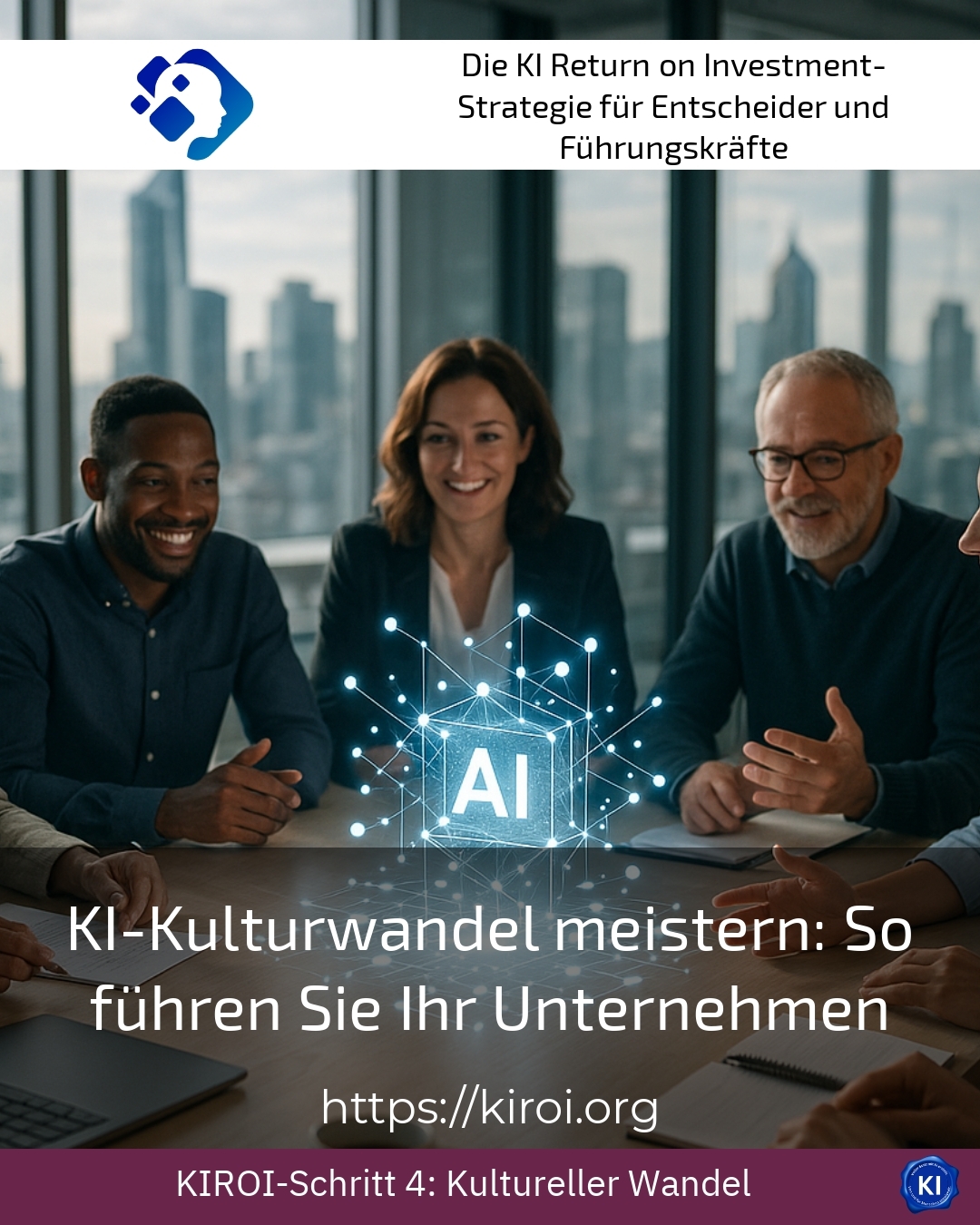
Digital transformation is fundamentally changing companies. However, technology alone is not enough. The real key lies in Mastering AI cultural change. Leaders face an unprecedented challenge. They must bring people along while driving innovation. Many organisations fail not because of technology. They fail due to a lack of willingness to change. How can resistance be overcome? How can an atmosphere of openness be created? These questions occupy decision-makers across all sectors. This article offers concrete inspiration and presents proven approaches.
Why mastering the AI culture shift is crucial for your success
Companies are investing millions in new systems. Yet, the desired results often fail to materialise. The reason rarely lies in the technology itself. Rather, there is a lack of a lived innovation culture. Employees fear for their jobs. Managers hesitate when making difficult decisions. Departments work against each other instead of with each other. These challenges require a fundamental rethink.
This problem is particularly evident in the financial sector. Banks are introducing automated advisory systems. However, customer advisors feel bypassed. They subtly obstruct the new processes. Similar dynamics are emerging in insurance companies. Clerks see intelligent systems as a threat. They use the tools only reluctantly. Investment firms are also struggling with this resistance. Analysts constantly question algorithmic recommendations. This scepticism significantly delays important decisions.
The solution doesn't lie in pressure or coercion. Instead, it requires an accompanying transformation. Leaders must take fears seriously. They should create spaces for open discussions. Transruption coaching specifically supports these processes. It guides teams through uncertain phases. It provides impetus for new ways of thinking.
The role of the leader in change
Leaders significantly shape company culture. Their behaviour sends strong signals to all employees. If they themselves show uncertainty, it spreads. If they model openness, others follow. Their own attitude towards change is crucial.
This connection was impressively demonstrated at a large private bank. The executive board communicated the digitalisation strategy clearly. However, the middle management unconsciously put the brakes on. They protected their teams from perceived overload. The result was a paralysis of the entire organisation. The dynamic only changed when the managers themselves received training.
In asset management firms, we often observe similar patterns. Senior partners view new technologies with scepticism. They rely on decades of experience. Younger employees, on the other hand, are pushing for modernisation. These tensions can paralyse companies. Professional guidance helps to work through these conflicts constructively.
Best practice with a KIROI customer
A medium-sized fund management company faced a major challenge, as the introduction of a new portfolio management system threatened to fail. The experienced fund managers categorically rejected the algorithmic recommendations. They felt their expertise was not valued. Management responded with additional pressure, which exacerbated the situation. As part of transruptive coaching, we developed a new approach together. Initially, we conducted individual discussions with key personnel. This revealed that the anxieties ran deeper than anticipated. It wasn't just about technology. It was about identity and self-worth. In facilitated workshops, the teams developed a new understanding of their roles. The fund managers became critical reviewers of the algorithms. Their experience served as a quality filter. The system provided suggestions, and people made the decisions. This repositioning led to significantly higher acceptance. The implementation time was considerably shortened. Today, all employees actively use the system.
Concrete steps to mastering AI culture change in your organisation
Change requires structure and clear direction. At the same time, there must be room for individual development. Finding this balance is the greatest art. The following approaches have proven effective in practice.
Transparent Communication as the Foundation
Employees need information to build trust. Unclear messages create uncertainty and rumours. That's why open communication is essential. It should be regular and honest. Even uncomfortable truths should be included.
A large direct bank successfully implemented this approach. The management established monthly dialogue sessions. All employees were able to ask questions. No question was considered inappropriate. This openness noticeably reduced anxieties. Similar formats also work in other contexts.
We conducted communication workshops at a credit institution. The managers learned to deliver difficult messages clearly. They practised responding to emotional reactions. These skills proved to be valuable. The change projects gained significant momentum.
Involvement creates acceptance
People support what they can help shape. This principle is particularly important in change processes. Early involvement significantly reduces resistance. It also makes use of employees' knowledge.
A wealth management firm focused on broad participation. All levels were involved in the selection of new analysis tools. Client advisors tested various systems. Their feedback was incorporated into the decision. The result was a significantly higher rate of use.
This approach also proves its worth in process design. A building society developed new workflows together with the teams. The administrative staff contributed their practical experience. This resulted in solutions that actually worked. The implementation phase went almost smoothly.
Best practice with a KIROI customer
An internationally active financial services company wanted to automate its compliance processes. Previous attempts had failed due to a lack of cooperation from the business departments. Compliance specialists feared a loss of importance. As part of our support, we initially organised a future workshop. All stakeholders jointly developed scenarios for their work. It became clear that automated checks would free up capacity. This time could be used by experts for more complex cases. This realisation fundamentally changed their perspective. The compliance specialists became active participants in shaping the new system. They defined the rules for the automated checks. Their expertise became the core of the solution. Implementation proceeded within the planned timeframe. The quality of compliance work improved significantly. Employees today often report greater job satisfaction.
Typical obstacles and how to overcome them
The path to an innovative company culture is rarely straightforward. Setbacks and resistance are part of it. How you deal with them is crucial. We regularly encounter the following challenges.
Taking the fear of job loss seriously
This concern is understandable and widespread. Many employees wonder if they are still needed. Ignoring these fears would be a mistake. Instead, you should address them proactively.
This dynamic became very pronounced at a co-operative bank. The introduction of chatbots for customer inquiries unsettled the service team. The employees wondered what tasks would remain for them. Together, we developed a qualification programme. The service staff became specialists for complex issues. The chatbot took over standard queries. The people dealt with demanding cases.
Life insurance followed a similar path. The automation of claims processing threatened jobs. However, the company focused on further development. Clerks were trained as customer advisors. Personal support in difficult situations became more important.
Overcome silo mentality
Departmental boundaries often hinder collaboration. Each department optimises for itself. The overall optimum is lost. Breaking this pattern requires conscious effort.
A retail bank was struggling with exactly this problem. The IT department developed solutions without customer proximity. The sales department ignored technical possibilities. Marketing worked independently of both. It was only cross-functional project teams that brought about the turnaround. People from all areas worked together on solutions.
Transruption coaching actively supports such transformations. It guides teams in developing new forms of collaboration. It provides impetus for effective communication. It helps to process conflicts constructively.
Mastering the sustainable anchoring of AI-driven cultural change
One-off measures are not enough. The cultural change must be permanently embedded. This requires suitable structures and processes. In addition, people need to be continuously supported.
A large fund management company established regular reflection rounds. Teams shared their experiences monthly. What is working well? Where are the obstacles? These discussions kept change alive. They enabled continuous adjustments.
Internal communities emerged at a FinTech company. Employees with similar interests connected with each other. They shared best practices and supported one another. These peer networks proved to be very effective.
A mortgage bank introduced a mentoring programme. Experienced employees supported colleagues through the change. This personal support made a big difference. Acceptance of new ways of working increased significantly.
My KIROI Analysis
The observations from numerous projects paint a clear picture. Technological innovation alone rarely leads to success. The human factor is decisive for success or failure. Companies that bring their employees along achieve their goals faster. They avoid costly failures and frustrating delays.
The financial sector faces particular challenges [1]. Regulatory requirements and competitive pressure are enormous. At the same time, customers expect modern digital services. This balancing act is only achievable with a culture that embraces innovation. Leaders must show courage in the face of change. They must create space for experimentation. At the same time, they must not ignore the fears of their employees.
Transruption coaching positions itself as support for precisely these kinds of projects. It does not replace entrepreneurial decisions. Rather, it supports the implementation process. Clients often report new clarity and confidence. The collaboration provides impetus for creative solutions and helps to overcome entrenched situations [2].
The future belongs to companies that combine technology and humanity. They use intelligent systems as tools, but continue to keep people at the centre. Finding and maintaining this balance is the central leadership task of our time.
Further links from the text above:
[1] BaFin – Digitalisation in the Financial Sector
[2] transruptions-Coaching – Support for Digital Transformation
For more information and if you have any questions, please contact Contact us or read more blog posts on the topic Artificial intelligence here.









 Deutsch
  English (UK)