
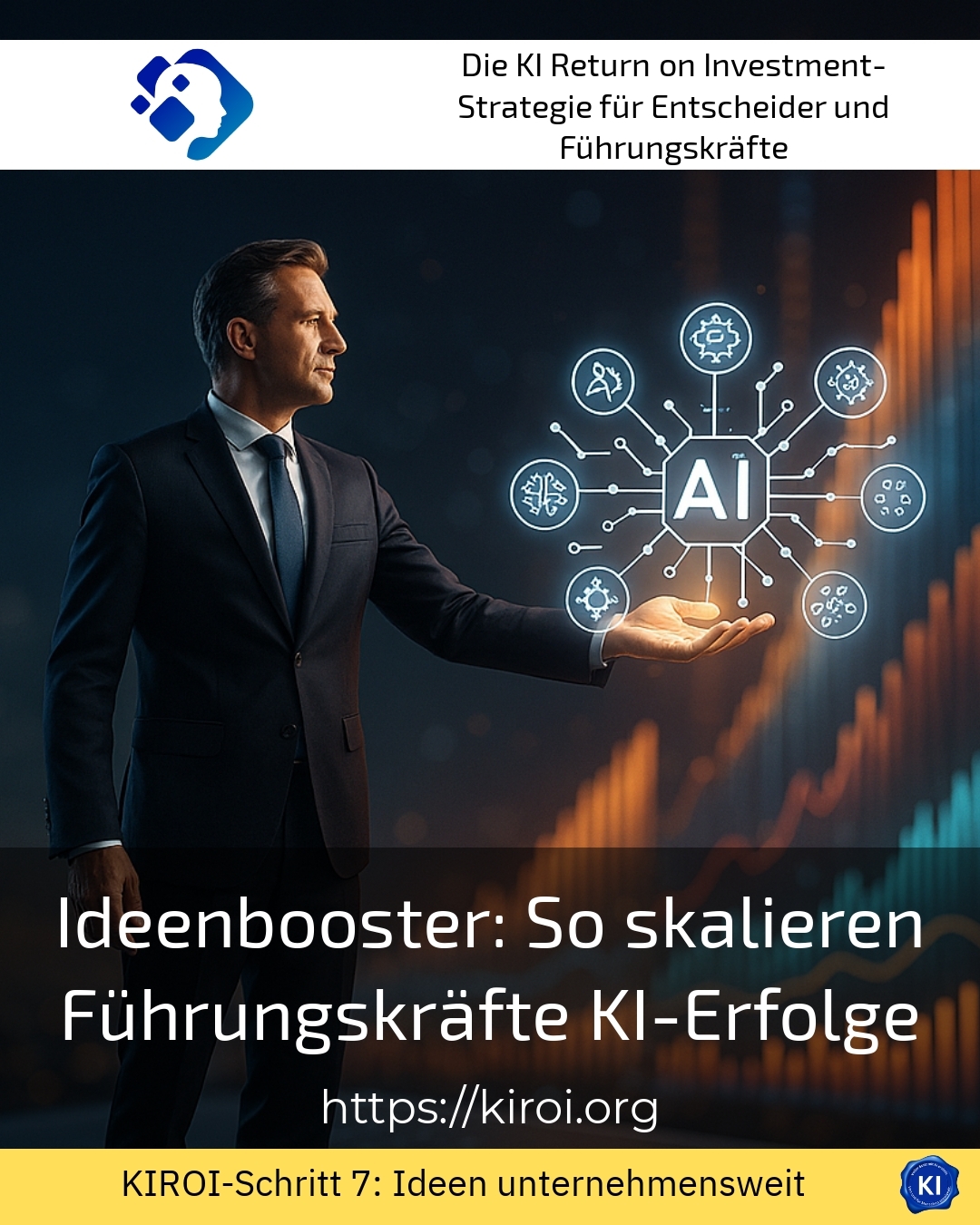
Imagine your organisation could systematically transform every creative impulse into measurable results. That's precisely what visionary decision-makers achieve when they leverage the "Ideenbooster" correctly and strategically scale AI-powered processes across teams and departments. The question is no longer whether intelligent systems create added value, but how leaders can sustainably scale these successes. In a world where technological disruption has become commonplace, this is precisely where the wheat is separated from the chaff. Those who understand that the "Ideenbooster" is far more than a tool unlock unknown potentials for growth and innovation.
Understanding the strategic dimension of the idea booster
Successful leaders recognise that technological innovation alone does not drive transformation. A systematic approach is needed, combining creative impetus with data-driven insights while honouring the human element. The key lies in the ability to scale individual pilot projects into enterprise-wide initiatives without losing the original innovative drive. Leaders often report that initial experiments are promising, but scaling them up fails. This phenomenon has profound causes, rooted in both organisational culture and technical infrastructure.
For example, a medium-sized manufacturing company implemented a predictive maintenance system for its production facilities. The results in a single production hall were impressive, reducing unplanned downtime by almost forty percent. However, the attempt to roll this success out to all twelve locations failed due to inconsistent data formats and resistance from local plant managers. It was only after a fundamental reorientation of the data strategy and intensive training measures that company-wide implementation was achieved. A logistics company experienced something similar with the route optimisation of its vehicle fleet, while a financial services provider faced comparable challenges with automated risk assessment.
Best practice with a AIROI customer
An internationally operating company in the industrial manufacturing sector approached transruptions-Coaching because initial automation projects, while showing promising results, failed to scale company-wide. The initial situation was characterised by isolated successes in individual departments that did not, however, have a positive impact on other areas. As part of the guidance provided by the AIROI model, existing data silos were first identified and systematically dismantled, creating an important foundation for further steps. Together, we developed a governance framework that defined clear responsibilities for the maintenance and use of data stocks and created transparency across departmental boundaries. The involvement of middle management proved particularly valuable, as they acted as multipliers for the new way of working and were able to overcome resistance. After six months of intensive collaboration, the company had not only extended the original automation successes to all relevant locations but had also established a culture of innovation that continuously identifies and systematically exploits new fields of application.
Ideas Booster: How Leaders Scale AI Success Through Cultural Change
Technology is only as effective as the people who use it. This realisation may sound banal, but it is surprisingly often ignored or underestimated in practice. Leaders who successfully use the idea booster invest significant resources in the development of their employees and create framework conditions that reward rather than punish a spirit of experimentation. Cultural change begins at the top and requires visible commitment from the highest leadership level, which manifests itself in concrete actions. Words alone are not enough to change deeply ingrained behaviours.
A trading company introduced weekly innovation hours, where teams could explore new application possibilities without the pressure of success [1]. These protected spaces proved to be a catalyst for creative problem-solving, which was later integrated into operational business. An insurance group established an internal certification programme that empowered employees at all hierarchical levels to independently conceive and implement data-driven projects. A pharmaceutical company went a step further and created its own academy, which links specialist knowledge with strategic thinking and specifically prepares junior management for the challenges of digital transformation.
The role of governance and ethics in scaling
As the reach of technological systems grows, so too do the demands for responsible action exponentially. Leaders must ensure that scaled solutions not only function efficiently but also meet ethical standards and comply with regulatory requirements. This aspect becomes particularly important when automated decisions have a direct impact on people, whether in human resources, customer service, or healthcare. The establishment of an ethics council or the appointment of dedicated individuals responsible for algorithmic fairness are measures that forward-thinking organisations have already implemented.
A telecommunications provider developed an internal audit process that examines each use case for potential discrimination risks before scaling [2]. An energy supplier established transparent reporting that regularly informs about the functionality and impact of automated systems and systematically incorporates feedback from those affected. A technology group introduced mandatory training on ethical issues that all project participants must complete before they can be involved in sensitive developments.
Practical approaches for sustainable growth through the Idea Booster
Scaling successes requires more than just replicating best practices in other contexts. It's about creating adaptive systems that can adjust to changing conditions and continuously improve. Leaders who internalise this approach establish feedback loops that systematically feed insights from operational activities back into further development. The 'ideas booster' only fully unleashes its potential when embedded within a learning organism that understands change as the norm.
An automotive supplier implemented a system that analyses quality data from production in real-time and automatically transmits suggestions for improvement to the responsible engineers. The integration with the existing continuous improvement process significantly accelerated innovation cycles and measurably increased the company's competitiveness. A retail group uses predictive analytics to optimise assortment decisions at store level and better reflect local preferences, leading to significant increases in revenue. A construction company relied on digital twins of its projects to identify planning errors early and avoid costly rework.
Best practice with a AIROI customer
A healthcare company was seeking support in scaling up a pilot appointment scheduling project that had achieved excellent results in one clinic, drastically reducing waiting times. The challenge was to adapt the system to the diverse processes and specialisations of over twenty other facilities without diluting the core of the solution. Through guidance within the scope of transruption coaching, we collectively developed a modular concept that combines standard components with flexible extensions, enabling local customisation. The involvement of medical professionals was particularly important; they contributed their specific requirements, thereby ensuring the solution's acceptance. We established regular exchange formats between the facilities, where best practices were shared and common challenges were addressed. The result significantly exceeded expectations, as not only were the original efficiency gains replicated, but the institutionalised knowledge exchange also sparked additional innovations that further developed the initial project in several dimensions and sustainably increased patient satisfaction.
Allocate resources intelligently and prioritise investments
Not every promising initiative deserves immediate scaling, and experienced leaders are aware of the importance of strategic prioritisation. The art lies in identifying those projects with the greatest potential for disproportionate impact, while also being realistically achievable. A structured evaluation process, considering both quantitative and qualitative criteria, significantly aids in this complex decision-making. Leaders should not only consider immediate benefits but also factor in synergy effects and strategic optionalities.
A media company developed a scoring matrix that evaluates projects based on the degree of innovation, complexity of implementation, and strategic relevance [3]. This system helped to concentrate limited resources on the most impactful initiatives and avoid spreading efforts too thinly. A mechanical engineering firm established an internal marketplace for project ideas, where teams can bid for support and resources, creating transparency over ongoing initiatives. A chemical group conducted regular portfolio reviews, where the progress of scaled projects was checked and adjustments were made as necessary.
Typical challenges of scaling and how to overcome them
The issues that leaders approach us with are often similar in nature and concern central aspects of organisational transformation. Clients frequently report difficulties securing the necessary support at board level and gaining long-term commitment for ambitious transformation projects. Others struggle with siloed thinking and a lack of willingness to cooperate between departments, which significantly hinders horizontal scaling and causes friction. Some find themselves confronted with technical debt that impedes the rapid expansion of successful pilots and requires fundamental modernisation measures.
A consumer goods manufacturer overcame cross-departmental resistance by establishing an interdisciplinary centre of excellence that functions as a neutral service provider for all company divisions. A transport and logistics company resolved technical integration problems through consistent modernisation of its system landscape and the establishment of uniform interfaces. A financial services provider secured the necessary top management commitment by systematically documenting the successes of earlier initiatives and presenting them in compelling narratives that could convince even sceptics.
My AIROI Analysis
Accompanying numerous organisations in scaling their technological successes has provided me with valuable insights, which I wish to share here. The central insight is that technology must never be viewed in isolation, but rather always understood within the context of human, cultural, and structural factors. Leaders who wish to leverage the "Idea Booster" sustainably must be prepared to question fundamental assumptions about their organisation and, if necessary, initiate profound changes. The path from successful individual projects to company-wide transformation is rarely linear and requires patience, perseverance, and a willingness to learn from setbacks.
From my experience in disruption coaching, it's consistently shown that the most successful scaling initiatives are those that put the people involved at the centre from the outset and take their needs seriously. Technical excellence alone is not enough if the workforce isn't brought along and perceives changes as a threat rather than an opportunity. At the same time, the human dimension cannot be an excuse for a lack of speed, as competitive pressure does not wait for hesitant organisations. Finding the balance between persistence and agility, between visionary thinking and pragmatic action, is the real leadership challenge of our time. Organisations that master this balance and strategically employ the 'idea booster' will be the winners of the coming waves of transformation and will be able to shape their markets sustainably.
Further links from the text above:
[1] Harvard Business Review: Innovation Management
[2] McKinsey: State of AI Report
[3] MIT Sloan: Artificial Intelligence Insights
For more information and if you have any questions, please contact Contact us or read more blog posts on the topic Artificial intelligence here.










 Deutsch
  English (UK)