
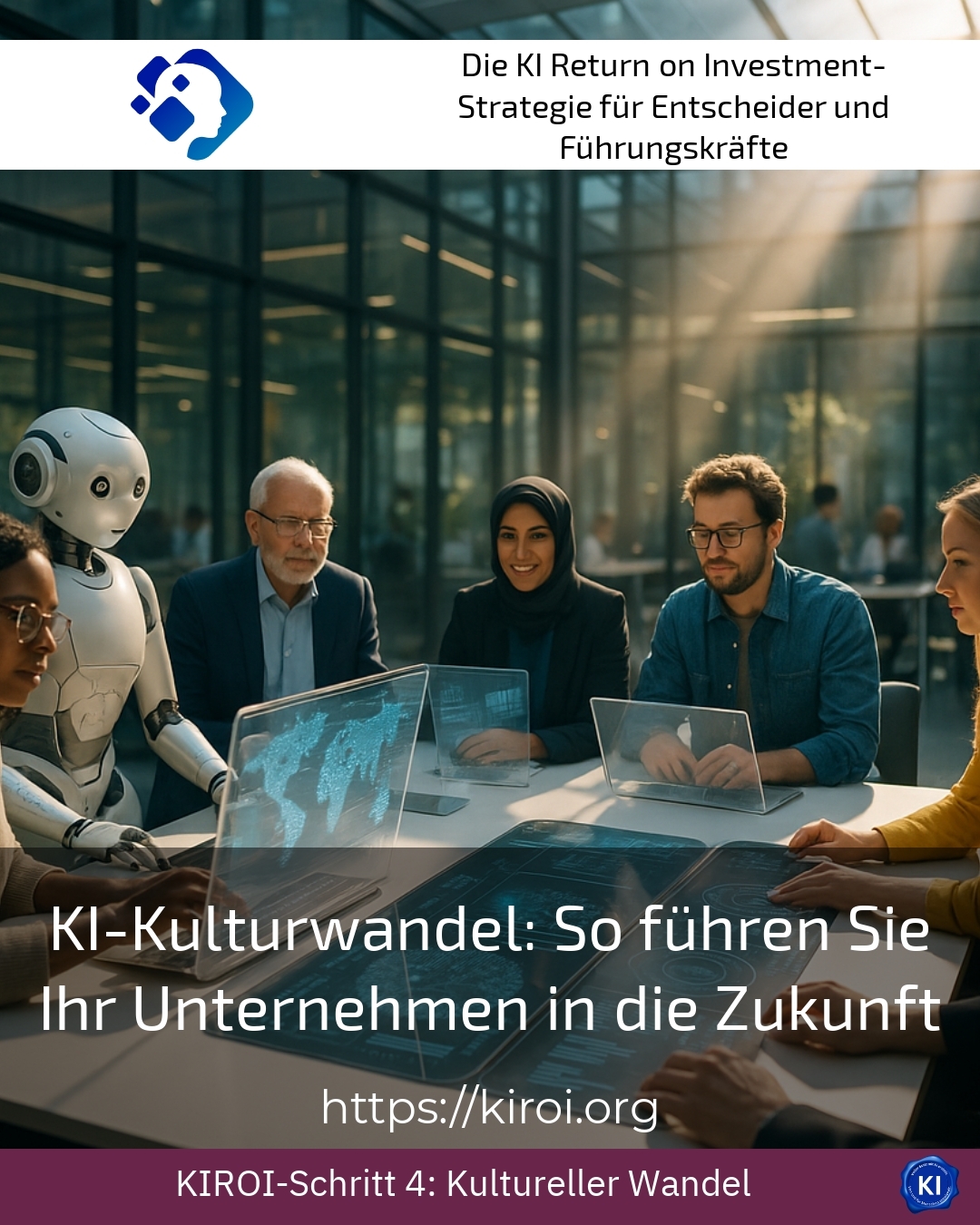
Imagine your organisation stands at a turning point that eclipses all that has gone before. The AI cultural change challenges companies today in a way that goes far beyond technical implementations. Executives often report uncertainties, resistance, and questions about how to bring their teams along. This is precisely where transruption coaching comes in, supporting organisations through this profound transformation. But how can organisations not only modernise systems but also establish an entirely new mindset?
The starting point: Why traditional approaches are no longer sufficient
Many organisations invest significant sums in new technologies and are surprised by the lack of success. The reason often lies deeper than assumed, as the real challenge concerns the people behind the processes. Employees feel overwhelmed, managers underestimate the emotional components of change, and established structures prove astonishingly resistant to change. This dynamic is particularly evident in areas that have relied on proven methods for decades.
For example, a financial services provider had invested significant resources in automated analysis tools over a period of three years. Nevertheless, the usage rate remained alarmingly low. Clerks continued to rely on manual checks and Excel spreadsheets, even though the new systems delivered significantly more precise results. We observe similar patterns in insurance companies, where claims assessment is dominated by sceptical adjusters, despite intelligent assistance systems. Banks are also struggling to modernise their credit assessment processes because long-serving employees value their experience more highly than algorithmic recommendations.
Best practice with a KIROI customer
A medium-sized private bank with over two hundred employees faced the challenge of fundamentally transforming its wealth management services. Management had already invested significant sums in an intelligent portfolio management system, but its utilisation fell far short of expectations. As part of our transruption support, we first identified the emotional barriers of experienced advisors who feared for their expertise and, ultimately, their professional identity. Together, we developed a mentoring programme where tech-savvy younger colleagues formed partnerships with experienced advisors. These partnerships worked on real client cases and documented their findings for the entire team. After six months of intensive support, the utilisation rate had tripled, and advisors reported significantly higher quality of advice. Particularly noteworthy was the development of a senior advisor, who initially appeared as the biggest critic and eventually became an internal ambassador for the new possibilities.
The human factor in AI cultural change
Transformation only succeeds through people and with people. This seemingly trivial realisation is often neglected in practice. Managers focus on implementation plans, budgets, and technical specifications, while the emotional dimension remains underdeveloped. However, experience from numerous support projects shows that this is precisely where the crucial levers lie.
Within the financial institution sector, we regularly encounter employees who fundamentally question their roles. A corporate client advisor articulated this perfectly: he wondered what need there was for him if algorithms could assess creditworthiness better. Such existential questions require more than superficial training measures. They demand genuine dialogue, space for uncertainty, and a clear vision that offers people a perspective. In investment companies, we observe similar dynamics when fund managers are confronted with automated trading strategies. And in building societies, the digitisation of customer advice leads to comparable confusion among experienced field staff.
Understanding and constructively using resistance
Resistance is not a sign of inability or unwillingness. Rather, it is a valuable signal that should be taken seriously. Often, behind the rejection of innovations lies the fear of losing control, of losing status, or simply of the unknown. If organisations learn to use this resistance as a source of information, they gain valuable insights into their own culture.
For example, a co-operative bank introduced regular dialogue sessions where employees could openly voice their concerns. Initially met with scepticism, these sessions nevertheless became a key element in managing change. A direct insurance company had similar positive experiences, actively involving its call centre staff in the design of new support systems. A leasing company also benefited from involving its field staff in the development of a mobile advisory application, rather than presenting them with ready-made solutions.
Rethinking Leadership: The Key to Successful AI Cultural Change
The role of leaders is fundamentally changing as a result of the transformation. Traditional leadership models, which rely on control and hierarchy, are reaching their limits. Instead, skills such as empathy, tolerance of ambiguity, and a willingness to learn continuously are becoming more important. Leaders are becoming enablers, coaches, and role models for a new way of working.
In one fintech company, we observed how the managing director themselves became a learner. They attended training sessions together with their teams, openly admitted their own knowledge gaps, and thereby created an atmosphere where learning was not seen as a weakness. This attitude had a positive impact on the entire organisation. Similar developments were seen at an investment fund company, whose board of directors regularly observed the analysts at their workstations. A factoring company also benefited from its executives actively participating in pilot projects and transparently communicating their experiences.
Best practice with a KIROI customer
An insurance group with several thousand employees wanted to realign its claims processing. The technical solution had already been selected, but implementation stalled at all levels. Our KIROI analysis revealed a deep chasm between the executive level and operational teams. Middle management felt neither involved nor competent enough to support the change. We developed a multi-stage programme that initially enabled team leaders and department heads to act as change agents themselves. To achieve this, we combined professional qualification with intensive work on their own attitudes and communication skills. After nine months, not only had the usage rates of the new systems improved, but employee satisfaction had also measurably increased. Particularly pleasing was the feedback from a team leader who reported that, for the first time, she felt she could truly lead rather than just manage.
Communication as a Key Competence
The way in which change is communicated is a major determinant of its success. Abstract announcements and technocratic project plans do not reach people's hearts. Instead, it requires stories, concrete examples, and honest dialogues about both opportunities and risks. Leaders who master this form of communication gain trust and followership.
A payment service provider developed an internal podcast format in which employees from different departments shared their experiences. These authentic voices were more persuasive than any polished presentation by management. A building society had similar success by introducing an internal wiki where teams documented and shared their learnings. A reinsurance company also benefited from regular town hall meetings where the executive board answered critical questions and no topics were taboo.
Adjust structures and processes
The AI cultural change This requires not only new ways of thinking but also adapted structures. Rigid hierarchies and fragmented responsibilities hinder change. Organisations that successfully transform create spaces for experimentation, promote cross-departmental collaboration, and establish new forms of decision-making.
For example, a mortgage bank introduced interdisciplinary squads that worked independently of the line organisation on specific challenges. These squads combined specialist expertise from lending, technology, and customer service and achieved significantly faster results than traditional project structures. Comparable approaches were seen at an asset manager that established innovation labs where new ideas could be tested without the pressure of day-to-day business. A savings bank also benefited from the introduction of agile methods in its product development, despite considerable initial scepticism.
Establish and foster a learning culture
In a rapidly changing world, continuous learning is becoming a crucial competitive advantage. Organisations must create environments where learning is not perceived as an added burden, but as an integral part of daily work. This requires time, resources and, above all, the right attitude at all levels.
An asset management firm introduced so-called "Learning Fridays", where part of the afternoon was set aside for self-organised learning. Employees could use this time for online courses, professional reading, or peer-to-peer exchange. Similar initiatives were launched by a credit card company with internal Barcamps and a life insurance company with an extensive mentoring programme. In all three organisations, we observed a significantly increased willingness to experiment and innovate after a few months.
Best practice with a KIROI customer
An international debt collection company faced significant resistance to new analytical tools. Employees felt their autonomy was being curtailed by the automated prioritisation of cases and reacted with passive resistance. As part of our support, we first conducted a comprehensive assessment, speaking with employees at all hierarchical levels. It became clear that the new tools had been introduced without adequate explanation of their added value. Together with a pilot team, we developed a workshop approach that demonstrated the benefits using concrete examples while also allowing for customisation requests. These workshops were progressively rolled out to all teams. After a year, the situation had completely changed, as employees now appreciated the relief from routine decisions and used the saved time for complex negotiations where their experience was truly in demand.
Ensuring the sustainability of AI-driven cultural change
Change is not a project with a defined endpoint, but a continuous process. Organisations that revert to business as usual after a successful implementation risk slipping back into old patterns. Instead, mechanisms are needed that embed change and adapt it to new developments.
A retail bank established a permanent transformation team, which acted as an internal service provider for all divisions and drove new impulses throughout the organisation. A health insurance company proceeded similarly, creating a dedicated role for digital transformation and equipping it with the necessary competencies. A leasing provider also benefited from regular reviews, during which the status of change was critically reflected upon and adjustments were made. These examples show that sustainable transformation requires institutional anchoring.
My KIROI Analysis
The support of numerous organisations in the financial services sector has made it clear to me that the AI cultural change encompasses far more than the introduction of new technologies. It is a fundamental transformation of how people collaborate, make decisions, and understand their own roles. I observe the greatest successes where leaders have the courage to admit their own uncertainties and learn together with their teams.
At the same time, it repeatedly becomes clear that there is no blueprint for successful transformation. Each organisation brings its own history, its own culture, and its own challenges. Transruption coaching can provide valuable impetus and support processes, but the actual work must be done by the people within the organisation themselves. What personally impresses me the most is the resilience and adaptability I observe in many employees, as soon as they feel taken seriously and can see a clear perspective. The coming years will show which organisations master this transformation successfully and which fall behind [1]. The foundations for this are being laid today, and I am convinced that companies that invest in their people will be the long-term winners [2].
Further links from the text above:
[1] McKinsey: The Economic Potential of Generative AI
[2] World Economic Forum: Future of Jobs Report
For more information and if you have any questions, please contact Contact us or read more blog posts on the topic Artificial intelligence here.









 Deutsch
  English (UK)