
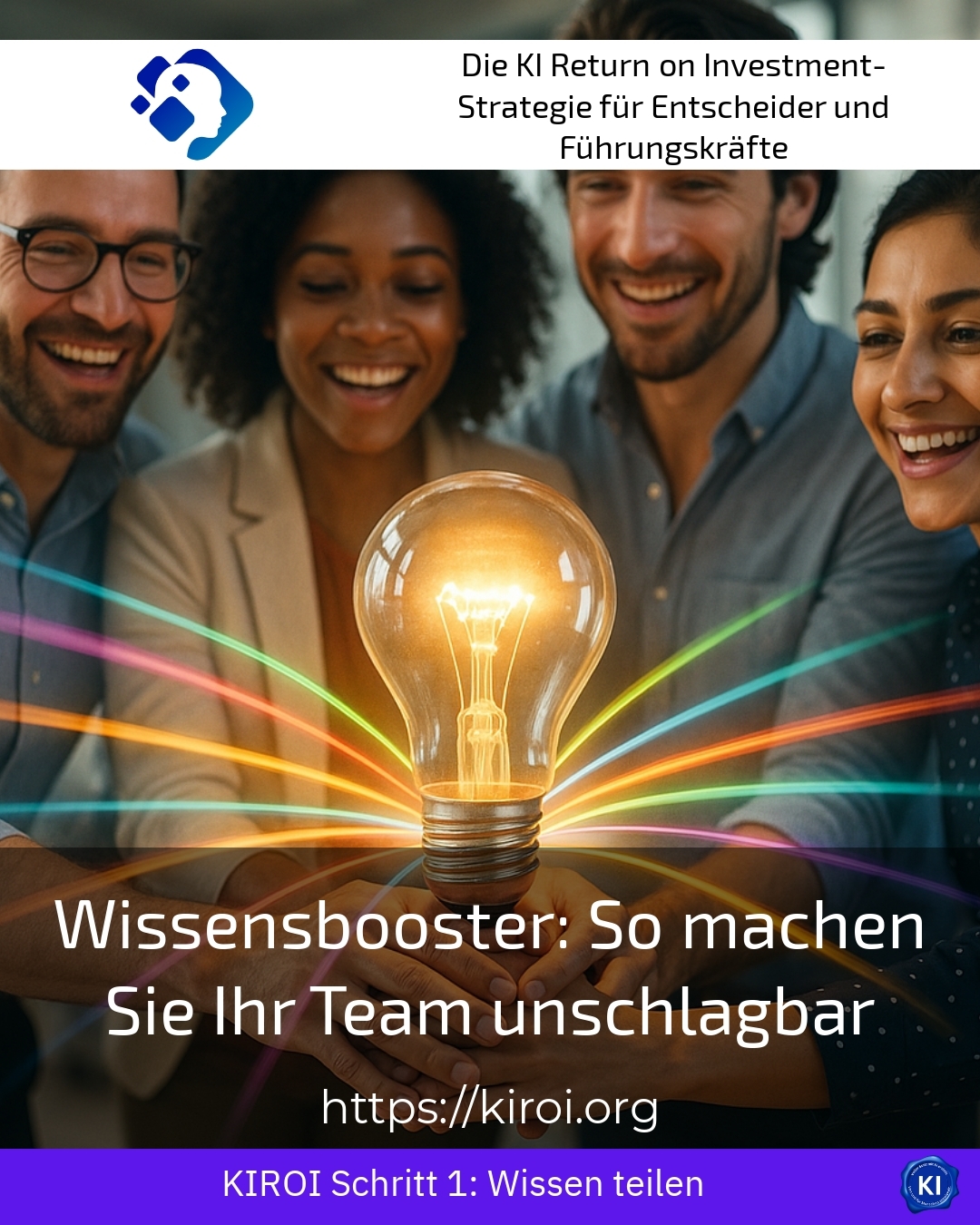
Imagine your team could tackle any challenge with ease, while working faster and more efficiently than ever before. The key difference between average and outstanding teams lies not in the number of employees or the budget, but rather in the targeted development of skills and the systematic build-up of expertise. Knowledge booster can make the crucial difference because it helps your team to unlock existing potential and develop new skills. In a rapidly changing world with ever-increasing demands, continuous learning is becoming an indispensable success factor for companies of all sizes. This article shows you practical, tried-and-tested ways to strategically drive competence development in your company.
Understanding the Foundations of the Knowledge Booster Approach
Before you begin implementation, you should understand the theoretical foundations. Knowledge alone is no longer enough to remain competitive these days. Teams need the ability to link information and apply it creatively. A structured approach to knowledge transfer takes into account different learning types and working methods. Some employees learn better through practical exercises, while others prefer theoretical foundations. The art lies in addressing and promoting both groups simultaneously.
This approach is particularly evident in the manufacturing industry with the introduction of new production processes. Here, machine operators must not only understand the technical procedures but also recognise interdependencies. A similar situation applies in the healthcare sector, where nursing staff must constantly learn new treatment methods. Continuous professional development is also essential in the finance sector due to changing regulations. These examples clearly show that similar challenges exist across different industries.
Best practice with a AIROI customer
A medium-sized manufacturing company faced the challenge of upskilling its workforce for digital transformation. Management recognised early on that traditional training formats would not be sufficient to build the necessary skills. Together with transruptions-coaching, a tailored learning concept was developed that took into account the specific needs of different departments. Production employees received practical workshops directly on the machines, while administrative staff were trained in interactive online modules. The support provided by experienced coaches, who assisted employees in applying what they had learned, was particularly valuable. After six months, management reported a significantly improved problem-solving competence within their teams. Employees felt more confident in using new technologies and showed greater initiative in process optimisation. This example impressively demonstrates how targeted skills development can strengthen a company's competitiveness.
Implementing knowledge boosters in practice
The successful implementation of a skills development programme requires careful planning and clear objectives. First, you should systematically assess and document your team's current knowledge base. Building on this, you can define learning objectives that are both ambitious and realistically achievable. The selection of appropriate learning formats plays a crucial role in subsequent success. Combine different methods to address diverse learning preferences.
For example, in retail, microlearning content has proven effective, allowing employees to complete it between customer interactions [1]. In the logistics sector, leading companies are relying on virtual reality training for complex processes. The construction industry is increasingly experimenting with augmented reality applications that display step-by-step instructions directly in craftsmen's field of vision. These technological innovations are making learning more efficient and practical than ever before.
Boost knowledge through peer learning
A particularly effective method for knowledge transfer is learning from colleagues. People often learn best from individuals who have already overcome similar challenges. Peer-learning programmes create a structured framework for this informal knowledge exchange. In these programmes, experienced employees take on the role of mentors for their less experienced team members. This form of learning simultaneously strengthens team cohesion and corporate culture.
In the catering industry, successful restaurant chains use this approach to quickly train new service staff. The hotel industry relies on experienced concierges who pass on their knowledge of local specialities to new team members [2]. Pair-programming sessions have also established themselves as an effective learning method in software development. These examples illustrate how diverse peer-learning formats can be designed.
Overcoming obstacles and creating sustainable change
When introducing new learning programmes, companies frequently encounter various forms of resistance and obstacles. A lack of time is the most commonly cited argument against training measures. Employees feel so tied up with their day-to-day business that learning is perceived as an additional burden. It is crucial here to integrate learning times firmly into the daily work routine. Managers must recognise these times as valuable and actively support them.
Clients also frequently report a lack of motivation within their teams. Transruption coaching can provide valuable impetus here to resolve blockages. Accompanying the change of learning cultures requires patience and stamina. It is important to make small successes visible and celebrate them. This creates a positive dynamic that carries further team members along.
Best practice with a AIROI customer
A service company with multiple locations struggled with widely varying skill levels within its teams. The challenge was to establish a uniform level of knowledge without overwhelming or under-challenging individual employees. In collaboration with transruptions-Coaching, a comprehensive skills analysis was initially carried out, which recorded the individual strengths and development areas of each team member. Based on this, personalised learning paths were developed, taking into account the respective starting point and the desired target level. The coaches supported both managers and employees throughout the entire process, offering assistance with questions and uncertainties. The introduction of learning partnerships, where employees from different locations could learn from each other, was particularly positive. After the implementation of the programme, the team leaders reported improved collaboration and increased service quality. Customer satisfaction increased measurably, and employee turnover in the company significantly decreased.
Using digital tools as a knowledge booster
Modern technologies are opening up entirely new possibilities for skills development in companies. Learning management systems allow training content to be managed centrally and learning progress to be tracked. Artificial intelligence can provide personalised learning recommendations and identify knowledge gaps [3]. Chatbots support employees in quickly finding answers to technical questions. These tools make learning more flexible and individual than traditional training formats.
The insurance industry is already making increasing use of digital learning platforms to inform field staff about new products. Banks are using gamification elements to make dry compliance training more attractive. In the telecommunications industry, video tutorials have proven effective, explaining technical installations step-by-step. These digital approaches complement traditional training and increase its effectiveness.
The Role of Leaders in Knowledge Development
Leaders play a key role in the successful establishment of a learning organisation. They must act as role models themselves and make their own learning visible. Only when employees see that their superiors are also continuously working on themselves will they become motivated. Leaders should regularly provide feedback on learning progress and highlight development opportunities. The creation of a culture that tolerates mistakes is of central importance.
In craftsmanship, the importance of leadership is particularly evident in the training of apprentices. Masters and mistresses who generously share their knowledge shape the next generation of skilled workers. In the care sector, ward managers play an important role in inducting new colleagues. In the IT sector too, team leads are challenged to keep up with technological trends and train their teams accordingly.
My AIROI Analysis
Following intensive consideration of the various aspects of competence development in companies, it becomes clear that systematic learning is not a luxury but a strategic necessity. The successful implementation of a Knowledge boosterThis approach requires the interplay of various equally important factors. Firstly, companies need a clear vision of which competencies will be required in the future. Secondly, suitable structures and resources must be provided to enable learning in everyday work. Thirdly, support from management is indispensable for sustained success.
Experience from various industries shows that there is no one-size-fits-all solution for all companies. Rather, each organisation must find its own way and adapt available methods and tools to its specific needs. Transruption coaching can provide valuable impetus and support companies on this journey. Investing in employee development pays off in the long term through increased productivity, reduced turnover, and better innovation capabilities. Companies that invest in skills development today secure a decisive competitive advantage for the future. The most important step is to simply get started and gain initial experience that can be built upon later.
Further links from the text above:
[1] McKinsey: Building workforce skills at scale
[2] Harvard Business Review: Learning and Development
[3] World Economic Forum: Future of Learning
For more information and if you have any questions, please contact Contact us or read more blog posts on the topic Artificial intelligence here.







 Deutsch
  English (UK)