
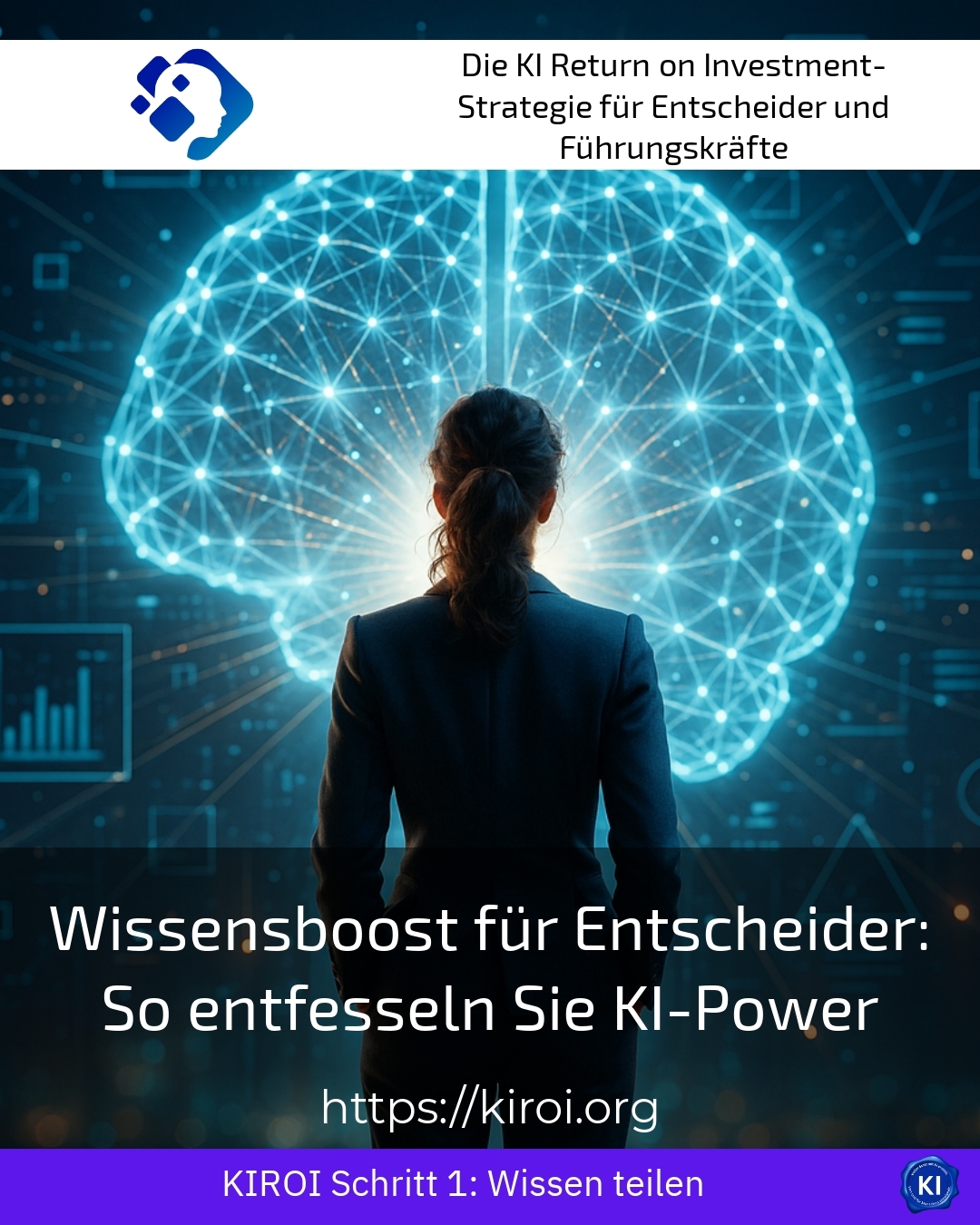
Imagine you're in a meeting and you sense that your competitors have a significant head start because they're using intelligent technologies that still seem unfamiliar to you. Knowledge Boost for Decision-Makers: Unleash AI Power it begins right here, at this point of realisation, that a grounded understanding of machine learning and automated processes is no longer an option today, but a fundamental necessity for anyone in a position of responsibility. Many leaders report a degree of uncertainty when it comes to the practical application of these technologies, and it is precisely this uncertainty that can be transformed into genuine competence through targeted knowledge acquisition into tangible action.
Why strategic understanding has become indispensable today
The business world is changing at a pace that presents significant challenges for many decision-makers, and this dynamic is set to accelerate further in the coming years. Those who hesitate today to engage intensively with the possibilities of intelligent systems risk not only falling behind the competition but also missing out on opportunities that may not present themselves again. Clients often report that they were initially sceptical about whether this topic was truly relevant to their specific situation, until they realised how fundamentally these technologies are already permeating their industry today [1].
In the manufacturing industry, for example, companies are already using intelligent systems for predictive machine maintenance. Logistics companies are optimising their routes through self-learning algorithms. Financial service providers are relying on automated risk analyses. These examples impressively demonstrate how the transformation is taking place across industries. The central question therefore is no longer whether you should be addressing these developments, but how you can do so most effectively.
The knowledge boost for decision-makers as a strategic competitive advantage
A profound understanding of how intelligent technologies work and their potential will enable you to make informed decisions that can sustainably strengthen your business. This isn't about becoming a programmer yourself or delving into every technical detail. Rather, it's about strategic competence. You need to understand which questions to ask. You need to recognise which projects deserve priority. And you need to be able to assess which resources are necessary for successful implementation.
Transruptions-Coaching supports executives with precisely these types of projects. It helps to find orientation in a complex field. In retail, leading companies rely on personalised recommendation systems. These systems analyse purchasing behaviour and predict future needs. Intelligent diagnostic systems are also finding ever-wider application in healthcare. They support medical professionals in the early detection of diseases.
Best practice with a AIROI customer
A medium-sized manufacturing company in the mechanical engineering sector faced the challenge of making its quality control more efficient while significantly reducing the error rate. Management had heard about the possibilities of image recognition systems but was unsure how to approach such a project specifically. Within the framework of an AIROI coaching session, we jointly developed a roadmap that initially included an assessment of existing data, then the identification of suitable use cases, and finally defined a realistic timeline for implementation. The decision-making body received not only theoretical knowledge but also practical impulses on how to ask the right questions internally and competently brief external service providers. After six months, the company reported a noticeable improvement in product quality and a significantly lower rejection rate, with it being particularly noteworthy that the management level is now confidently holding discussions with technology providers and making well-informed decisions about further digitalisation projects.
Understanding the basics and placing them strategically
Before embarking on specific projects, it is essential to understand the fundamental concepts on which modern intelligent systems are based, as only with this foundation can you assess which expectations are realistic and which may appear exaggerated [2]. Machine learning, neural networks and natural language processing are no longer abstract concepts. They are concrete tools with specific strengths and limitations. A knowledge boost for decision-makers therefore always includes the ability to differentiate between different approaches.
In the insurance industry, companies use text-analysing systems for the automatic processing of claim reports. In human resources, intelligent tools support the pre-selection of applications. Marketing departments rely on sentiment analyses to capture customer sentiment on social media. All these applications are based on different technological approaches. And each approach has its own requirements and limitations.
Identify and prioritise practical fields of application
Identifying suitable use cases within your own company often presents the biggest challenge, as the possibilities can seem almost limitless while resources are finite, making careful prioritisation essential. Many decision-makers report that they were initially overwhelmed by the sheer number of options. However, through structured analysis, they were able to quickly identify those areas where intelligent systems promise the greatest added value.
For example, a construction company used an analytics system to optimise its project planning. An energy supplier implemented forecasting models for electricity consumption. A media company opted for automated content curation. These different applications show that every sector holds its own potential. It is important to systematically unlock this.
Transruptions-Coaching can help you carry out this analysis. It provides a structured framework for evaluating various options. It's not about perfection on the first try. Rather, it's about an iterative process of learning and adapting [3].
Unleash AI power in your company
Unlocking the potential of intelligent technologies requires far more than just purchasing software or engaging an external service provider, as the true success factor lies in your company's cultural and organisational readiness to actively shape and support this transformation. Leaders play a key role in this. They set the framework for experiments. They create spaces for innovation. And they communicate the vision behind the technological initiatives.
In the automotive industry, manufacturers are investing in autonomous vehicle technologies. Pharmaceutical corporations are using intelligent systems to accelerate drug development. Telecommunications companies are optimising their networks through self-learning algorithms. All these initiatives require not only technical expertise. They also require a corporate culture that welcomes change.
Best practice with a AIROI customer
A facility management services company recognised that its competitors were increasingly using data-driven decision-making processes, enabling them to create more efficient proposals, while the company itself still relied largely on manual calculations and its own experience. Management decided on an intensive coaching programme to first familiarise the leadership team with the basics and potential of intelligent systems before starting specific implementation projects. In several workshops, we collaboratively developed an understanding of what data the company already possessed, how it would need to be prepared, and which specific business processes could benefit from automation. The result was a clear strategy that is now being implemented step by step, with managers able to critically monitor progress and make adjustments as needed, rather than having to blindly trust external consultants. The newly acquired ability to formulate realistic expectations while setting ambitious goals proved to be particularly valuable.
Overcoming obstacles and achieving sustainable success
On the path to the successful integration of intelligent systems, companies regularly encounter various obstacles, which can range from a lack of data quality and insufficient expertise to cultural resistance, hence the need for a holistic approach that considers these different dimensions [4]. Leaders often underestimate the effort required for data preparation. Or they overestimate the speed at which results become visible. Both misjudgments can lead to frustration.
A trading company struggled with inconsistent product data. A bank had difficulties integrating legacy systems. A manufacturing company experienced staff resistance. These examples illustrate typical challenges. However, they also show that these obstacles are surmountable.
Transruptions-Coaching offers inspiration for dealing with such situations. It accompanies you through difficult phases. It helps to develop realistic expectations. And it supports communication with everyone involved.
Don't forget the human element
Amidst all the enthusiasm for technological possibilities, it must never be forgotten that intelligent systems are ultimately tools developed, implemented, and used by humans, which is why the focus on the human component remains crucial for the sustainable success of any technological initiative. Employees must be involved. Fears must be taken seriously. And training measures must be planned in good time.
In a hospital, involving nursing staff led to better acceptance of new systems. A financial institution trained its consultants in the use of intelligent analysis tools. A logistics company developed new job profiles for collaboration with automated systems. These examples highlight the importance of change management.
Knowledge boost for decision-makers as a continuous process
The development in this field is progressing so rapidly that acquiring knowledge once is no longer sufficient to make consistently competent decisions; therefore, continuous learning and regular updating of one's knowledge base have become a central leadership task. You should therefore establish formats that enable regular knowledge transfer. This could include internal knowledge circles, external conferences, or structured coaching programmes [5].
A technology company established monthly innovation meetings. An insurance company set up an internal expert network. A retail group collaborated with universities. These different approaches demonstrate the variety of possibilities. They also show that there isn't one single correct way.
My AIROI Analysis
Following intensive consideration of the challenges and opportunities presented to leaders in the context of intelligent technologies, a clear picture emerges that should both encourage and caution. The central finding is that technological competence at the decision-making level is no longer an optional additional qualification, but rather a core competence of modern leadership, without which well-founded strategic decisions are hardly possible anymore.
The AIROI analysis clearly shows that companies whose leaders actively engage in their own knowledge development are significantly more successful in implementing technological projects than those that delegate this responsibility entirely to specialist departments or external consultants. This does not mean that decision-makers must become technology experts themselves, but they must be able to ask the right questions, formulate realistic expectations, and critically monitor progress.
At the same time, the analysis shows that exaggerated expectations are one of the most common reasons for project failure, which is why a realistic assessment of the capabilities and limitations of intelligent systems is of central importance. Transruption coaching can provide valuable impetus here and serve as support in finding one's own way through the complexity of this transformation. The most successful companies are characterised by a combination of technological openness, strategic clarity and human-centred implementation.
Further links from the text above:
[1] McKinsey Digital Insights on Digital Transformation
[2] Gartner Research on Artificial Intelligence
[3] Bitkom Topic Page on Intelligent Technologies
[4] Harvard Business Review articles on AI implementation
[5] MIT Research on Current Developments
For more information and if you have any questions, please contact Contact us or read more blog posts on the topic Artificial intelligence here.










 Deutsch
  English (UK)