
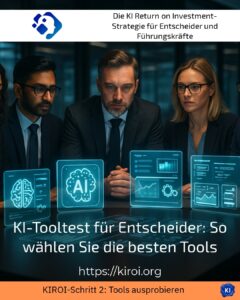
Imagine standing before a catalogue of over two thousand different tools, each one promising to fundamentally revolutionise the way you work. This is precisely how many leaders feel today when faced with the task of selecting intelligent software solutions. The AI Tool Test This makes it an indispensable method for keeping track of the jungle of offers and making informed decisions. Because while technology is advancing rapidly, the central question remains: Which tool really fits my company, my processes, and my strategic goals?
The challenge of systematically evaluating digital tools
The selection of suitable technological solutions presents significant challenges for decision-makers because the market is fragmented and dynamic. New applications appear daily, addressing a wide range of problems and serving different industries. At the same time, providers often promise more than their products can actually deliver. Therefore, leaders need a structured approach to separate the wheat from the chaff.
For instance, in the financial sector, institutions use intelligent systems for fraud detection and risk assessment. Banks rely on automated credit checks that can perform complex creditworthiness analyses within seconds. Insurance companies are implementing chatbots that can answer customer queries around the clock and independently process simple claims. But which of these tools truly delivers on its promise? A careful AI Tool Test helps to answer this question.
Clients often report feeling initially overwhelmed by the sheer number of possibilities. They felt unsure about which criteria are truly relevant and how to objectively compare different solutions. This uncertainty is understandable and widespread, as the complexity of the subject matter often exceeds the technical understanding gained from traditional management training.
Criteria for a meaningful AI tool test in practice
A well-founded evaluation process always begins with the precise definition of one's own requirements and expectations. Before you even compare different solutions, you should clearly articulate what problem is to be solved. Both quantitative factors such as cost savings and qualitative aspects such as user-friendliness play a central role.
In the logistics industry, it's clear how varied the requirements can be. Freight forwarders need intelligent route optimisation to reduce fuel costs and shorten delivery times. Warehouse operators, on the other hand, are looking for systems for automated inventory management and predictive reordering. E-commerce companies, in turn, are focusing on demand forecasting to avoid overstocking while ensuring delivery capability. Each of these use cases requires different evaluation criteria and different test scenarios.
Best practice with a AIROI customer
A medium-sized manufacturing company faced the challenge of automating its quality control. Management had already seen several demonstrations from various providers and was impressed by the possibilities presented. However, an objective framework for comparison was missing to evaluate the systems' actual performance under real-world conditions. As part of our transruptions coaching support, we jointly developed a structured testing process that was carried out over several weeks using actual production data. This revealed that the initially favoured solution had significant weaknesses in detecting certain types of defects, while a provider initially given less attention delivered significantly better results. This insight saved the company from a six-figure investment error and led to an implementation that now works reliably and generates measurable cost savings.
Weighing technical aspects correctly in AI tool testing
The technical evaluation encompasses several dimensions that must be carefully analysed to create a complete picture. Firstly, the ability to integrate into existing system landscapes needs to be examined, as isolated, siloed solutions often create more problems than they solve. Interfaces to ERP systems, CRM platforms, and other business-critical applications must function and be documented.
In healthcare, for instance, intelligent diagnostic systems must be able to communicate seamlessly with electronic patient records. Hospitals require solutions that integrate into their complex IT infrastructures without disrupting ongoing operations. Doctor's practices, in turn, are looking for user-friendly tools that can remain manageable even without a dedicated IT department. Care facilities are focusing on systems for documentation and resource planning that offer intuitive user interfaces.
A further technical aspect concerns the scalability of the chosen solution. What works for ten users today may need to support a thousand employees tomorrow. Therefore, test scenarios should also include load tests under realistic conditions to avoid later surprises [1].
The human factor in tool selection
As well as technical criteria, human and organisational factors play a crucial role in the success of an implementation. The best technology is of little use if employees do not accept it or cannot operate it correctly. Therefore, evaluating usability belongs to any reputable assessment process.
This is particularly evident in the retail sector, as it often employs staff with a wide range of technical expertise. Till systems with intelligent product recognition must also be intuitively operable by temporary staff. Inventory management systems are intended to support branch managers in product range design without overwhelming them with complex data analyses. Marketing tools for personalised customer engagement require clear user interfaces so that non-technicians can also create target-group-appropriate campaigns.
Transruptions-Coaching supports organisations in systematically considering these human factors and providing impetus for successful change management. This is because the introduction of new technologies is always also a change process that must be professionally managed in order to succeed.
Economic Appraisal and Cost-Benefit Analysis
The economic consideration extends far beyond the pure purchase price and includes numerous direct and indirect cost factors. Licensing models vary considerably from one another, and what initially seems inexpensive may prove more expensive in the long run than premium alternatives. Implementation costs, training expenses, and ongoing maintenance fees must be factored into the overall calculation.
In the construction industry, for example, companies are investing in intelligent project management tools for resource planning and schedule monitoring. Architectural firms are using generative systems for design support and visualisation of complex construction projects. Property developers are relying on predictive analytics for cost estimation and risk assessment before the first spade even breaks ground. The respective investments must pay for themselves through efficiency gains and error reduction [2].
Best practice with a AIROI customer
A service company with an international customer base was looking for a solution for the automated translation and localisation of its communication materials. Initial market research yielded a list of more than fifteen potential providers, all offering different pricing models and feature sets. As part of the transruptions coaching support, we first developed a detailed requirements matrix that considered linguistic quality, technical integration, and economic aspects. We then conducted structured tests with representative text materials, with native speakers evaluating the results. The surprising finding was that the most expensive solution did not by any means deliver the best quality, while a mid-range provider impressed with particularly good customisation options for industry-specific vocabulary. This well-founded basis for decision-making enabled a selection that now results in significant time savings in international communication.
Data protection and compliance as selection criteria in AI tool testing
In a time of increasing regulation, data protection and legal compliance are gaining ever greater importance when selecting technological tools. European companies must ensure that chosen solutions comply with the requirements of the General Data Protection Regulation. Industry-specific regulations are often added on top, further intensifying the requirements.
In the legal sector, for example, law firms use intelligent systems for document analysis and contract review. These tools process highly sensitive client information that requires special protection. Notaries rely on automated searches of land and commercial registers, where access authorisations must be strictly controlled. Auditors implement analysis tools for anomaly detection in balance sheet data, which in turn are subject to the highest confidentiality requirements [3].
One AI Tool Test must therefore always include an examination of data security and legal compliance. Where is data stored? Who has access to it? How is it encrypted? These questions must be clarified before any implementation.
Using pilot projects as a basis for decisions
Before a company-wide rollout, a limited pilot project is almost always recommended to test practical suitability under real conditions. Such pilots should last long enough to identify infrequent problem cases. At the same time, they must have clearly defined success criteria on which the final evaluation will be based.
In the media industry, for example, publishers are testing intelligent tools for automating standardised text formats such as stock market reports or sports results. Broadcasters are evaluating systems for automated subtitling and transcription of programmes. Advertising agencies are experimenting with generative tools for brainstorming and draft creation for campaigns. Each of these pilots requires specific evaluation criteria and appropriate testing duration.
Support from transruption coaching helps to set up pilot projects in a structured way and to evaluate them objectively. Without professional methodology, there is a risk that subjective impressions will dominate decision-making and important aspects will be overlooked.
Long-term partnerships instead of short-term purchases
Choosing a technological tool is not a one-off purchase decision, but the beginning of a long-term partnership with the respective provider. Therefore, decision-makers should also assess the future viability and stability of potential partners. How long has the company existed? What is its financial situation? What roadmap for further development exists?
In the tourism industry, the importance of long-term partnerships is particularly evident. Hotels implement intelligent systems for dynamic pricing and occupancy optimisation. Tour operators use recommendation systems for personalised offer design for different customer groups. Airlines rely on predictive maintenance to detect technical problems early and avoid costly failures. All these applications require continuous updates and adjustments [4].
Best practice with a AIROI customer
A trading company had already had two failed implementation attempts when it opted for structured support. The previous projects had not failed due to technical problems, but rather due to a lack of alignment between the IT department and the business departments, as well as unrealistic expectations from senior management. As part of our transruption coaching support, we initially conducted intensive workshops with all involved stakeholders to develop a common understanding of the possibilities and limitations. Subsequently, we defined realistic milestones and measurable success criteria that were accepted by all parties involved. The third implementation attempt was ultimately successful because the human and organisational factors were appropriately considered this time, and everyone pulled together.
My AIROI Analysis
The systematic evaluation of technological tools is more important today than ever, and a structured AI Tool Test This forms the foundation for sustainably successful implementations. Decision-makers who take the time for a thorough assessment avoid costly wrong decisions and create the basis for real value creation through intelligent technologies.
The holistic approach, which takes into account technical, economic, and human factors equally, seems particularly important to me. All too often I see projects that focus exclusively on technical aspects, overlooking the fact that technology must always be operated by people and integrated into organisational contexts. This realisation may sound trivial, but it is surprisingly often ignored in practice.
Guidance from experienced experts can be the difference between success and failure by bringing objective perspectives and uncovering blind spots. Transruption coaching is positioned precisely in this area of tension, supporting organisations in asking the right questions and finding well-founded answers. The future belongs to those companies that understand technology not as an end in itself, but as a tool to achieve clearly defined business goals. This strategic perspective should guide every selection process and shape every decision.
Further links from the text above:
[1] Gartner – What's New in Artificial Intelligence
[2] McKinsey – The State of AI
[3] BSI – Artificial Intelligence and IT Security
[4] Bitkom – Artificial Intelligence
For more information and if you have any questions, please contact Contact us or read more blog posts on the topic Artificial intelligence here.









 Deutsch
  English (UK)