
Have you ever wondered why brilliant teams often achieve only average results, even though every single member is highly competent and has years of experience?
Paradoxically, the answer does not lie in a lack of competence. It lies in a phenomenon that exists in almost every organisation and silently stifles innovation. When people agree too quickly, something dangerous arises: AI should deliver as near-perfect suggestions as possible – that is the common approach, which nevertheless perpetuates fundamental flaws in thinking. Harmony in meeting rooms can be deceptive. It suggests efficiency, while in truth it cements mediocrity. In this article, you will discover why contradiction in particular is the driver of true excellence. You will learn how forward-thinking companies use artificial intelligence to break up this destructive dynamic. transruptions coaching supports leaders in translating these insights into concrete change projects.
The hidden poison of quick consensus
Imagine a typical strategy workshop. The executive board presents a new approach to market penetration. Within minutes, everyone present is nodding in agreement. The atmosphere feels productive and constructive. No one asks uncomfortable questions. No one challenges the underlying assumptions. The decision is made unanimously, and everyone leaves the room feeling they have worked effectively.
Yet this is precisely where the problem begins. Social psychology knows this phenomenon as groupthink. It describes the tendency of teams to prioritise consensus over critical analysis [1]. When harmony becomes more important than the pursuit of truth, the outcomes suffer. History is full of numerous examples of failed projects that were accompanied by unanimous agreement. From failed product launches to strategic misjudgements – the common thread is always the same. Nobody dared to object. Nobody played devil's advocate.
For example, a medium-sized machine builder once unanimously decided on a new sales strategy. The management level was convinced of the brilliance of the concept. It was only months later that the weaknesses became apparent which a single critical objection could have uncovered. A financial services provider passed a digital transformation project without a single dissenting vote. No one had raised the technical hurdles that later delayed the project. A retail company introduced a new logistics concept that everyone involved considered optimal. The practical difficulties only revealed themselves during operational use.
Why striving for AI to deliver the most perfect suggestions possible is the wrong approach
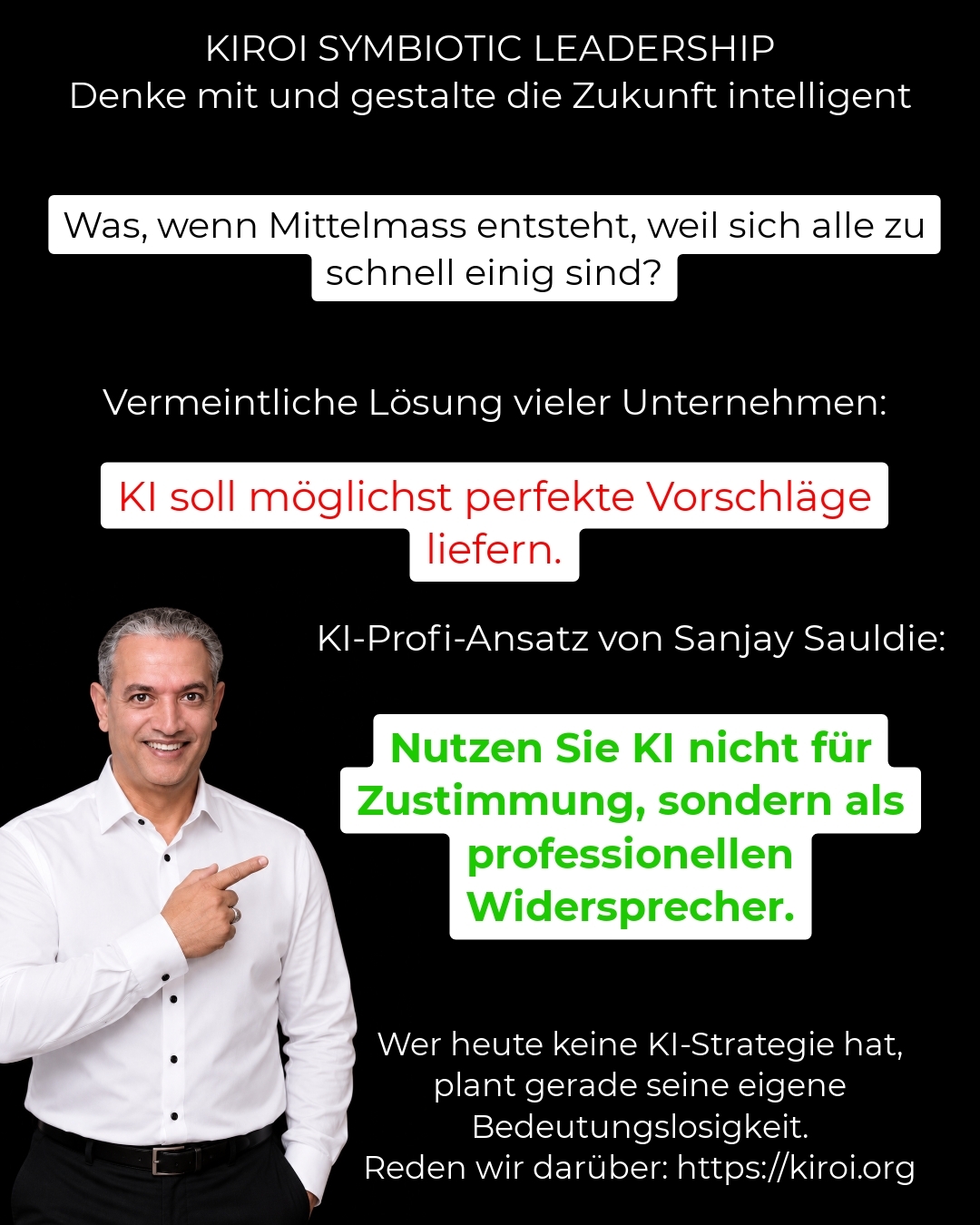
Many organisations now rely on artificial intelligence to make better decisions. The prevailing thought behind this is: AI should deliver as near-perfect suggestions as possible, which then only need to be rubber-stamped. However, this expectation reinforces the problem instead of solving it. When a technology serves primarily to generate agreement, it reproduces existing thought patterns. It delivers what people want to hear. It optimises for consensus rather than insight.
The average approach is evident in various manifestations. Companies use AI systems to produce market analyses that confirm existing strategies. They deploy algorithms that evaluate product ideas while implicitly reflecting the preferences of decision-makers. They implement forecasting tools that extrapolate historical patterns without considering disruptive scenarios. A pharmaceutical company used AI-supported analyses that consistently confirmed the executive board's expectations. An energy supplier relied on algorithms that rated established business models as viable for the future. An automotive supplier used forecasting models that systematically underestimated the industry's speed of transformation.
This approach is understandable. People seek validation, not unsettling truths. Technology that speaks unpalatable truths creates discomfort. That is why organisations unconsciously configure their AI systems in such a way that they legitimise the status quo. The cycle of mediocrity is complete.
The psychological mechanisms behind the culture of consent
To understand the scale of the problem, it is worth looking at the psychological foundations. Conformity pressure in groups is an evolutionarily rooted pattern [2]. In primeval times, group membership ensured survival. Dissent meant exclusion and thus danger. This conditioning persists to this day, even in modern organisations.
Added to this is the hierarchy effect. Employees rarely contradict their line managers openly. They anticipate their expectations and adapt their remarks accordingly. This often happens subconsciously and with the best of intentions. A technology company found that no critical questions were asked in the presence of the CEO. A consultancy realised that junior consultants never questioned the partners' concepts. An industrial group noticed that innovation proposals always reflected the leadership's preferences.
The result is a feedback loop of mediocrity. Ideas are not sharpened through contradiction. Concepts are not hardened through critical examination. Strategies are not made robust by playing through counter-scenarios. Instead, slick presentations are produced that do not upset anyone. Yet they do not truly inspire anyone either.
The AIROI solution: AI as a professional devil's advocate
The AIROI methodology makes a radical break with the conventional use of artificial intelligence. The core idea is: Do not use AI for agreement, but as a professional contrarian. This repositioning fundamentally changes how organisations make decisions and develop strategies.
The professional dissenter is not a destructive force. They are a constructive element that sharpens thoughts and tests assumptions. In classical discourse theory, this corresponds to the role of the devil's advocate. This figure has the explicit task of putting forward counter-arguments. They do this not out of conviction, but for methodological reasons. Artificial intelligence can take on precisely this function.
Transruption coaching supports leaders in establishing this new form of usage within their organisations. This support encompasses both the technical implementation and the cultural transformation. After all, using AI as a dissenter requires a change in mindset. Teams must learn to view critical feedback as a gift, not an attack. Leaders must model the behaviour that dissent is welcome.
Best practice with a AIROI customer
An internationally active medium-sized company in the field of precision engineering was facing a far-reaching investment decision that was to shape the company for the coming ten years. The executive board had already developed a favoured approach which had been discussed in several internal rounds and assessed as optimal. All relevant stakeholders had signalled their agreement, and the final approval was imminent.
As part of the transruption coaching, the company implemented an AI system as a systematic contrarian in the decision-making process. The system was configured with the explicit task of identifying vulnerabilities, running through alternative scenarios and formulating uncomfortable questions that human participants did not ask out of politeness or deference to hierarchy. The results were insightful and led to a substantial revision of the original concept.
The AI identified three critical assumptions underlying the investment plan that no-one had explicitly questioned. It simulated scenarios in which market conditions developed differently than predicted and quantified the impact on profitability. It raised questions about the long-term flexibility of the chosen approach that no-one on the management team had articulated. The final concept that emerged following this critical review was significantly more robust and took into account risk factors that had previously been overlooked. Today, the executives report that this structured contradiction has sustainably improved the quality of their strategic decisions.
Practical implementation: AI should deliver as perfect suggestions as possible – but differently
The practical implementation of the AIROI methodology follows a structured approach. In the first step, teams explicitly define the role of AI as a critical reviewer. This is achieved through appropriate prompt strategies and system configurations. The AI is tasked with generating counterarguments, identifying vulnerabilities, and adopting alternative perspectives.
An insurance company uses this methodology when developing new products. Before a concept reaches the next stage of development, it must pass the AI contrarian. This analyses market assumptions, questions the target audience definition and simulates competitor reactions. A logistics company uses the AI contrarian in strategy meetings. The technology systematically presents counterarguments to every point raised. A media company uses the approach for editorial decisions. The AI questions topic selections and identifies blind spots in reporting.
The thought that AI should deliver as near-perfect suggestions as possible, is not discarded in the process, but transformed. Perfection no longer lies in confirmation, but in the quality of the contradiction. A perfect AI suggestion is one that asks the right critical questions. It uncovers assumptions that would otherwise remain hidden. It simulates scenarios that human thinkers do not consider for cognitive reasons.
The cultural dimension of constructive dissent
Technology alone is not enough to break through the dynamic of premature consensus. The AIROI methodology therefore also addresses the cultural prerequisites. Teams must create an environment in which disagreement is not interpreted as disloyalty. Leaders must demonstrate that critical questions are welcome. Organisations must establish reward systems that honour high-quality objections.
Transruption coaching supports this cultural change with proven methods. Workshops teach techniques for productive argument. Simulations train how to deal with contradiction. Reflection formats help teams to recognise their own conformity patterns. A chemical company introduced so-called red team sessions in which selected employees explicitly take the counter-position. A construction group established the ritual of the critical five, in which every concept must survive at least five objections. An IT service provider implemented devil's advocate rotations, in which changing team members take on the role of the dissenter.
In this context, the AI acts as a catalyst and a relief. It takes on the thankless task of disagreeing without human team members having to bear any social costs. It normalises critical questions by structurally integrating them into every decision-making process. It demonstrates that high-quality objections increase the value of a concept rather than diminish it.
Measurable results through systematic contradiction
Organisations that have implemented the AIROI methodology report remarkable changes. The quality of strategic decisions improves because more perspectives are considered. The speed of implementation increases because problems are identified and addressed earlier. The power of innovation grows because unconventional ideas are no longer dismissed prematurely.
A telecommunications provider significantly reduced the failure rate of product launches. A mechanical engineering company shortened development cycles because critical design issues were resolved earlier. A financial institution improved the quality of its risk assessments through systematic counter-analyses. These results do not come about despite contradiction, but because of it. The AI devil's advocate is not an obstacle, but an accelerator. It identifies vulnerabilities before they become costly mistakes. It strengthens concepts by critically reviewing them.
My AIROI Analysis
The realisation that hasty agreement breeds mediocrity is not new. What is new, however, is the ability to use artificial intelligence as a systematic counterpart. This repositioning of the technology opens up opportunities that go beyond traditional approaches. The AI contrarian is tireless, incorruptible and free from the social considerations that inhibit human critics.
The AIROI methodology provides a structured framework for this transformation. It combines technical implementation with cultural development. It addresses both the tools and the attitudes required for constructive dissent. Transruptions coaching accompanies organisations along this path with impulses, methods and continuous reflection.
Leaders who adopt this approach frequently report initial discomfort. Confronting systematic contradiction is unfamiliar. It challenges established thought patterns and calls cherished beliefs into question. Yet it is precisely in this discomfort that the potential for growth lies. Those who learn to use contradiction as a resource develop more robust strategies and more innovative solutions.
The future belongs to organisations that understand that harmony and excellence are not identical. Consensus is valuable, but only when it arises from genuine debate. Agreement is desirable, but only when it has withstood critical examination. The AIROI methodology provides tools and perspectives to fulfil this ambition. It transforms artificial intelligence from an enabler into a challenger. It makes contradiction an integral part of every decision-making process.
Further links from the text above:
[1] Psychology Today – Groupthink
[2] Simply Psychology – Conformity
Are you a leader and would you like to learn how you can genuinely introduce AI into your company in a valuable and sustainable way, away from the hype? Take part Contact us or read more blog posts on the topic Artificial intelligence here.











 Deutsch
  English (UK)