
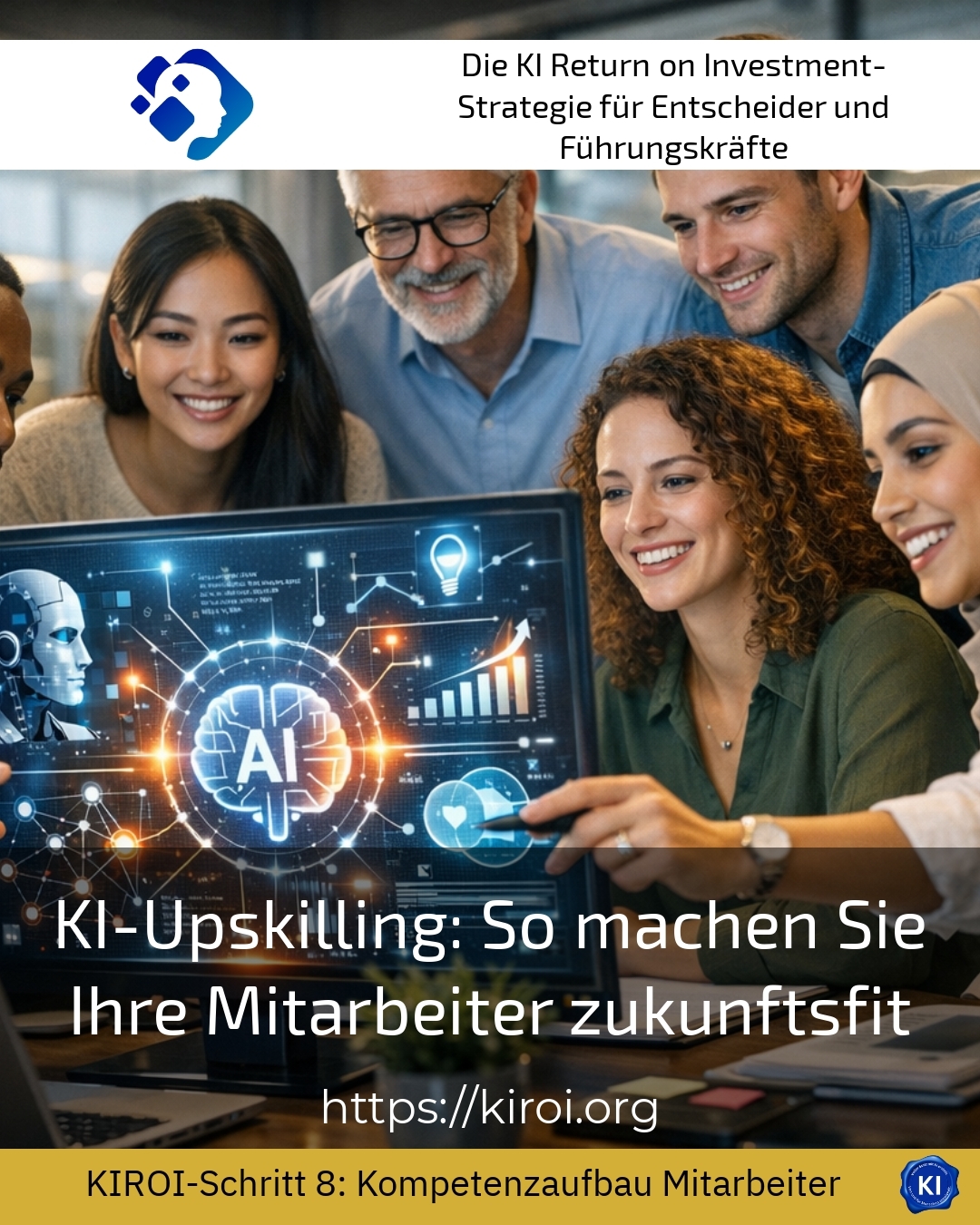
Are your teams already prepared for the digital challenges of tomorrow, or are you risking losing the edge? This question is on the minds of executives and HR managers worldwide. AI Upskilling Your workforce is becoming one of the crucial components for sustainable business success. Rapid technological development is fundamentally changing almost all areas of work. Those who do not actively invest in the development of their employees’ skills will increasingly find it difficult to remain competitive and retain qualified professionals in the long term.
Why strategic AI upskilling is becoming essential
The working world is undergoing a profound transformation. Automation, intelligent algorithms, and data-driven decision-making processes are changing traditional professional roles. At the same time, completely new fields of activity are emerging. Companies face the challenge of proactively shaping these developments. A reactive approach often leads to gaps in skills. This negatively impacts productivity and innovation.
In the manufacturing industry, advanced companies are already relying on intelligent production assistants. These support skilled workers in complex quality control processes. In healthcare, diagnostic support systems help analyze medical imaging. The financial sector uses algorithmic analyses for risk assessment and fraud detection. These examples illustrate how technological tools can complement human expertise.
The key is the right balance between technological support and human judgment. Employees need both technical understanding and critical thinking. They should understand how intelligent systems work and where their limits lie. Only then can they handle the new tools responsibly. Transruptive coaching can accompany organizations on this challenging transformation journey and provide valuable insights [1].
Best practice with a AIROI customer
A medium-sized company in the mechanical engineering sector faced the challenge of qualifying its experienced workforce for data-driven work processes. The average tenure of employees was over fifteen years, and many of the employees initially had reservations about new technologies. Together with the AIROI consulting approach, we developed a multi-stage qualification program. This took into account the different backgrounds and learning speeds of the teams. In moderated workshops, the participants first developed a fundamental understanding of intelligent systems. Subsequently, they applied this knowledge in practical exercises to their specific work tasks. The exchange between the various departments was particularly valuable. Experienced production staff brought their process knowledge, while younger colleagues provided technical input. After six months, the executives reported a significantly increased acceptance of new technologies. The employees felt better prepared and brought forward their own improvement suggestions independently.
The pillars of a successful AI upskilling program
A sustainable competence development program rests on several fundamental pillars. First, a careful assessment of existing skills is required. What digital competencies already exist? Where are the greatest development needs? This analysis should be carried out systematically and without evaluation. It forms the basis for all further measures.
In retail, for example, sales representatives increasingly need to understand personalized recommendation systems. In the logistics industry, dispatchers are increasingly using predictive planning tools. Marketing professionals use intelligent analysis tools to optimize campaigns. Each function requires specific focus areas of expertise. A uniform training program therefore often falls short.
Developing individual learning paths
People learn at different speeds and prefer different learning formats. Some benefit more from practical exercises. Others need theoretical foundations first. Successful continuing education programs take these individual differences into account. They offer different paths to the same learning goal. This way, employees can use their personal learning style.
In the insurance industry, for example, the combination of microlearning and practical projects has proven effective. Short learning units provide basic concepts. Subsequently, employees apply what they have learned in supervised projects. Customer support representatives learn how intelligent systems can support damage assessment. At the same time, they develop an understanding of situations that require human judgment.
The pharmaceutical industry is also investing more heavily in adaptive learning platforms. These automatically adapt to the knowledge level of the learners. Researchers receive different content than employees in production or sales. However, a fundamental understanding of data-driven working methods forms the common basis. AI Upskilling becomes an integral part of personnel development [2].
Creating psychological security
Technological change causes uncertainty among many people. These fears are understandable and should be taken seriously. A culture of psychological safety allows employees to ask questions and to see mistakes as learning opportunities. Leadership plays a central role here. Leaders should themselves demonstrate openness to new ideas and be able to admit knowledge gaps.
In the automotive industry, many companies report initial resistance to new technologies. Experienced engineers initially feared that their expertise could be devalued. However, through transparent communication and practical success stories, this attitude often changed. The professionals realized that intelligent tools can enrich their work. They became important multipliers for technological transformation.
Law firms and consulting firms are experiencing similar experiences. Intelligent research systems help them analyze large volumes of documents. Experienced consultants can thus focus their time more effectively on strategic tasks. However, this requires them to trust the systems and be able to critically evaluate their results. This ability develops through targeted training and practical experience.
Practical implementation of AI upskilling in everyday work
Theoretical knowledge alone is not enough. Employees must be able to apply new skills in the real work context. Therefore, the integration of learning moments into the work routine is recommended. Short daily exercises can be more effective than multi-day intensive seminars. The learned material is thus directly embedded and linked to practical experiences.
In the media industry, newsrooms are increasingly using intelligent tools for research and text production. Journalists are learning to use these systems as assistants. The editorial responsibility and creative output remain clearly in the hands of the human being. Similar developments are evident in the advertising industry. Creative teams are experimenting with generative systems for idea generation. However, the final decision on design is still made by experienced designers.
The energy sector is also undergoing profound changes. Network engineers are increasingly using predictive maintenance systems. Customer advisors are using intelligent chatbots as the first point of contact for standard inquiries. This allows them to focus on more complex consultations. The training required to master these new ways of working requires both technical and communication training [3].
Best practice with a AIROI customer
A large retail company wanted to qualify its Category Managers for data-driven assortment decisions. The previous way of working was heavily based on experience and personal assessments. New analytical tools were intended to complement this expertise with objective data analyses. As part of the AIROI project, we developed a blended learning program with three phases. The first phase included basic training in data analysis and statistical concepts. In the second phase, participants worked on real case studies within their area of responsibility. They learned to recognize patterns in sales data and derive actionable recommendations from them. The third phase consisted of regular reflection sessions and exchange of experiences. During the discussion, the category managers discussed how they could combine data analysis with their market knowledge. The participants particularly appreciated the practical approach of the program. They were able to immediately integrate what they learned into their work and to record initial successes. The management level observed a measurable improvement in product assortment optimization and a higher level of employee satisfaction.
The role of leaders in AI upskilling
Leaders bear a special responsibility for the development of their teams’ competencies. They do not necessarily have to become technical experts themselves. However, they should understand the strategic importance of training initiatives and actively support them. Their role as role models significantly influences how employees perceive new technologies. A skeptical attitude on the part of the leadership can significantly hinder transformation projects.
In the construction industry, interesting developments are emerging in the introduction of digital planning tools. Site managers who work with Building Information Modeling convey a different image than those who completely delegate this task. Similar observations are also being made in the banking sector. Managers who share their own experiences with intelligent analysis tools increase acceptance within their teams. They can credibly discuss the benefits and limitations of the technology.
The tourism industry is increasingly investing in the training of hotel managers and travel agency managers. These should understand how intelligent booking systems and personalized recommendations work. Only then can they competently guide their employees in the implementation of new systems. The transruptions coaching supports management in this demanding task with individual support [4].
Establish a sustainable learning culture
One-time training measures are no longer sufficient. Technological development is advancing continuously. Companies therefore need a permanent learning culture. Employees should receive time and resources for their ongoing development on a regular basis. Leaders should recognize and make visible learning achievements. This creates a positive dynamic of continuous improvement.
The telecommunications industry has already accumulated valuable experience in this area. Major providers have established internal learning platforms that are constantly updated. Employees can independently take courses and obtain certificates. These are taken into account when hiring internal staff. This creates incentives for self-directed learning.
In the food industry too, continuous learning is becoming increasingly important. Quality managers are increasingly using intelligent systems for process control. Product developers are experimenting with data-based recipe optimizations. The combination of traditional craftsmanship knowledge and modern technology requires new skills. These can only be built and maintained through continuous training.
Measurability and success control of qualification measures
Investments in further training should yield tangible results. Defining suitable success criteria requires careful consideration. Simple participation rates do not provide a good indication of actual competence development. Instead, indicators that measure the transfer to practice are recommended. How often are new tools actually used? What improvements can be measured?
In the logistics industry, companies, for example, measure the accuracy of demand forecasts before and after training courses. Supervisors who use predictive analysis tools competently often achieve better results. In customer service, processing times and customer satisfaction serve as indicators. Employees who effectively use intelligent assistance systems can often answer inquiries faster and better.
The chemical industry uses more complex metrics systems for its qualification programs. These include safety statistics, process efficiency, and innovation rates in the evaluation process. The connection between competence development and measurable business results also justifies larger investments in continuing education. This way, executives can demonstrate the value contribution of their actions to the company’s management [5].
My AIROI Analysis
The systematic development of employee competencies in the field of intelligent technologies is one of the most important strategic tasks of the coming years. From my consulting practice I know that successful transformations are never purely technical in nature. The human factor determines success or failure. Companies that involve and take their employees seriously achieve significantly better results.
The AI Upskilling It should not be seen as a one-time project. It is rather a continuous process that should be embedded into the corporate culture. The AIROI methodology provides a structured framework for this. It combines technological aspects with organizational and human dimensions. Clients often report that this holistic perspective is particularly valuable.
I find the emphasis on self-responsibility and self-efficacy particularly important. Employees should not be treated as passive recipients of training measures. Instead, they should be actively involved in shaping their learning journey. This increases motivation and leads to more sustainable learning outcomes. The role of leaders as facilitators and role models cannot be overestimated in this regard.
In conclusion, I would like to emphasize that technological competence alone is not enough. Critical thinking, ethical reflection, and communicative skills are also becoming increasingly important. Only those who understand which questions are meaningful for intelligent systems and where human judgment remains indispensable can use the new tools responsibly. I consider accompanying this comprehensive development of competencies to be an important task of transruptive coaching.
Further links from the text above:
[1] transruptions-Coaching for Digital Transformation
[2] AIROI-Master plan for systematic competence development
[3] McKinsey: The State of Organizations
[4] World Economic Forum: Future of Jobs Report
[5] Gartner: Future of Work Trends
For more information and if you have any questions, please contact Contact us or read more blog posts on the topic Artificial intelligence here.









 Deutsch
 English (UK)