
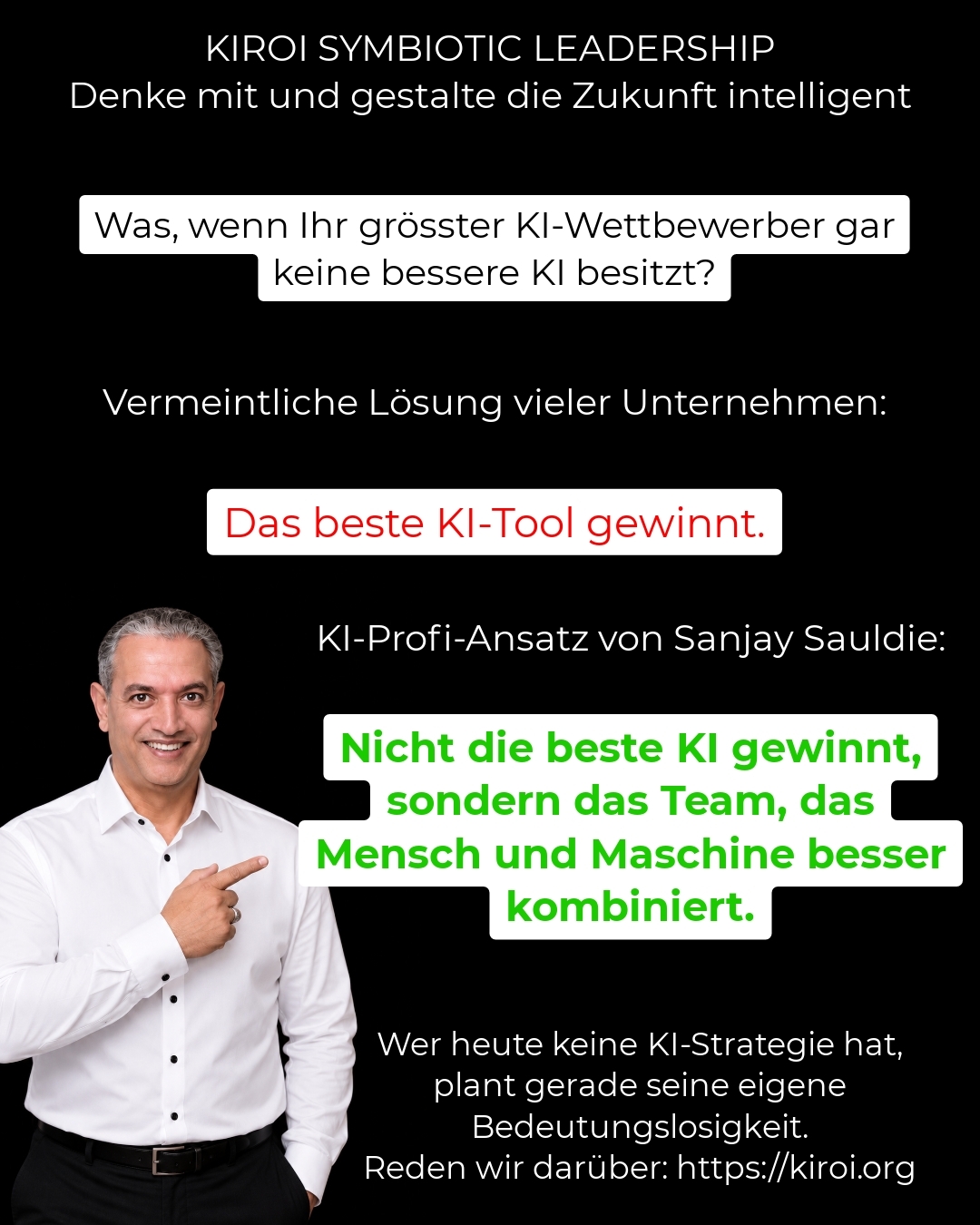
Have you ever wondered why some companies achieve completely different results with seemingly identical tools, even though they all have access to the same powerful technologies? This question currently concerns numerous executives who observe how their competitors achieve significantly better results despite comparable technical capabilities. The perceived advantage often does not lie where most would assume it would, and the realization that AI competitors While not necessarily possessing sophisticated algorithms, strategic thinking is revolutionizing many industries. In this context, human and machine interaction goes beyond mere technological investments and constitutes the real difference between success and mediocrity.
The illusion of technological superiority among AI competitors
Many decision-makers firmly believe that the key to success lies in acquiring ever more powerful systems, which is why they invest considerable sums in the latest available solutions. This conviction leads to a veritable arms race in which companies try to outdo their competitors through technical superiority. However, they overlook a crucial factor that often decides the outcome in practice. In the manufacturing industry, for example, almost all major players rely on comparable systems for quality control and process optimization. An automotive supplier uses the same image recognition systems as its direct competitors, yet the error rates differ significantly from one another. Similarly, logistics companies that use identical route planning software achieve completely different delivery times and customer satisfaction scores. This discrepancy cannot be explained by technical specifications but points to a more fundamental difference in the way organizations actually use their tools.
The financial sector provides further insightful examples of this phenomenon, as banks and insurance companies operate with virtually identical analysis platforms. Some institutions achieve remarkable improvements in risk assessment with these systems, while others can barely record measurable progress. This pattern is also evident in retail, where companies implement the same recommendation systems but achieve completely different conversion rates. The assumption that the AI competitors Although it may appear to possess secret, superior technologies on closer inspection, it often turns out to be a fallacy that diverts attention from the actual success factors and leads to erroneous strategic decisions.
The conventional approach: The best tool as the supposed path to success
Average companies typically pursue a strategy that focuses on selecting the supposedly best available tool, assuming that technical superiority automatically leads to business success. This approach manifests itself in extensive evaluation processes where various providers are compared based on technical criteria. In the pharmaceutical industry, for example, companies invest considerable resources in selecting the most efficient molecular analysis systems, without sufficiently considering how their research teams will actually use these systems. Manufacturing companies acquire advanced predictive maintenance solutions, but neglect to train their maintenance teams to operate these systems in everyday life. This one-dimensional focus on technical specifications regularly leads to disappointment, because the hoped-for improvements fail to materialize or fall significantly short of expectations.
The telecommunications sector illustrates this problem particularly vividly, as all major providers rely on comparable systems for network optimization and customer support. Nevertheless, customer satisfaction rates and churn rates vary significantly, which is not due to technology but to the way they are integrated into existing processes. Similarly, the healthcare sector is no different, where hospitals and clinics use identical diagnostic systems but achieve completely different treatment outcomes. The energy sector provides further examples, as utilities use the same predictive models for load distribution but achieve very different efficiency values in grid control. The mere availability of advanced tools does not guarantee their effective use, and this insight is slowly starting to take hold even among average companies.
Why focusing solely on technology fails
The exclusive focus on technical solutions fails for several reasons that are deeply rooted in the nature of organizations and human behavior. First of all, even the most intelligent systems require high-quality data, which must be collected, maintained, and interpreted by humans. In the food industry, this is particularly evident, where companies implement advanced quality control systems but find that the results depend heavily on the expertise of their quality engineers. Moreover, complex decisions often require a contextual understanding that automated systems cannot fully capture. An example from the construction industry illustrates this, where project planning systems can calculate optimal schedules, but fail to take into account local conditions and stakeholder dynamics, which experienced project managers intuitively incorporate into their planning. After all, business environments are constantly changing, and the ability to adapt and develop systems depends largely on the people who maintain and understand these systems.
Best practice with a AIROI customer
A medium-sized machine manufacturer from southern Germany faced the challenge that its newly implemented predictive maintenance solution did not deliver the expected results, even though the system functioned technically flawlessly and was provided by a renowned provider. The maintenance technicians did not trust the predictions of the system and continued to rely on their decades of experience, which led to a juxtaposition of two decision systems. As part of a transruptive approach, the company developed a completely new approach in which the technicians’ experience was systematically integrated into the system and the algorithms learned to take the intuitive assessments of the employees as an additional input factor. The technicians became active co-creators of the system by regularly providing feedback on the predictions and documenting special cases that the system could not capture. After a six-month collaboration phase, the prediction accuracy and acceptance among employees far exceeded all original expectations. The unplanned downtime decreased by more than forty percent, and the maintenance teams reported a significantly higher level of job satisfaction because they felt valued as valuable partners in the process. This example impressively demonstrates how the combination of human expertise and machine capabilities leads to results that neither component could achieve alone.
AIROI The perspective: Man and machine as an unbeatable team against any AI competitor
The AIROI-Ansatz is based on a fundamentally different premise: people are not considered appendages of technology but indispensable partners in a synergetic system. It is not the technical superiority of individual components that determines success, but the quality of collaboration between human intelligence and machine capabilities. This perspective fundamentally changes the way companies should think about their technological investments. In the chemical industry, for example, a company has recognized that its laboratory technicians possess implicit knowledge that is not contained in any manual and cannot be captured by any algorithm. By systematically integrating this experiential knowledge into digital analysis processes, the company achieved innovation rates that are far above the industry average. A trading company, in turn, found that the combination of algorithmic recommendations and the intuition of experienced buyers led to significantly better assortment decisions than either component alone. These examples illustrate that the true competitive advantage lies not in the technology itself, but in the ability to optimally align human and machine.
The practical implementation of the human-machine symbiosis
The successful implementation of a true human-machine symbiosis requires a systematic approach that considers multiple dimensions and goes beyond mere technological implementation. First, companies must understand which tasks machines are best suited to perform and where human judgment remains indispensable. In the insurance industry, this is evident in claims processing, where algorithms can efficiently handle simple cases, while complex situations require the empathy and context understanding of experienced claims handlers [1]. The media industry provides further examples where newsrooms use automated generation of standard messages, but consciously retain investigative research and opinion formation in human responsibility. In transportation, systems support route planning and fleet optimization, while dispatchers retain final decision-making authority in unforeseen situations and bring their experience to bear in emergency situations. This deliberate division of tasks requires a deep understanding of both the technical capabilities and the human strengths and limitations.
The transformation of corporate culture represents another crucial success factor that is often underestimated but essential for long-term success. Employees must learn to view technical systems as partners rather than as a threat to their jobs or as tools that undermine their expertise. In the hotel industry, employees often report that working with booking and recommendation systems enriches their work because they can focus on personal customer service. Similar experiences are reported by advisors in financial institutions who use algorithmic analysis to gain more time for individual customer service [2]. The restaurant industry is experimenting with the combination of automated ordering and personal service, with successful concepts intelligently combining the strengths of both approaches. This cultural transformation can only be achieved if it is actively supported and demonstrated by the leadership level.
Best practice with a AIROI customer
An internationally operating logistics company had invested significant sums in a state-of-the-art warehouse management system that, by all technical standards, was among the most efficient in its class. Despite this investment, the key performance indicators for picking speed and error rate remained below expectations, and the employees complained about increasing workloads. The transruptive monitoring revealed that the system, while theoretically calculating optimal paths and sequences, did not sufficiently take into account the physical characteristics of the warehouse and the work ergonomics of the employees. The solution did not lie in a system change, but in the integration of a feedback mechanism that enabled experienced warehouse workers to feed their practical insights into the optimization logic. The employees documented bottlenecks, problematic routing arrangements, and temporal fluctuations that the system itself could not detect. This information was fed into the algorithms and led to continuous improvement in route planning and task distribution. After implementing this collaborative approach, productivity increased by over thirty percent, while employee satisfaction significantly improved. The turnover rate in the warehouse area fell to the lowest level since the company’s founding, and the company became a benchmark for other locations within the group.
Practical strategies for superiority over every AI competitor
The development of a true human-machine partnership requires concrete measures that go beyond general declarations of intent and must be anchored in daily practice. A crucial strategy is to not make technology decisions in isolation from the people who will ultimately use these technologies. In the textile industry, the value of this approach is evident in the introduction of quality control systems, where the early involvement of experienced quality inspectors leads to significantly better implementation results. The paper industry provides similar insights in the integration of process control systems, which only achieve their full effectiveness when machine operators are integrated as experts into the development process. In the printing industry, companies have found that the combination of automated color calibration and the trained eye of experienced printers leads to quality results that purely machine-based solutions cannot achieve [3].
Another important strategy concerns the continuous development of human-machine interfaces, which is often considered a secondary issue but has a significant impact on the effectiveness of collaboration. In the aviation industry, companies invest significant resources in the design of cockpit interfaces because they have realized that the best technology is useless if pilots cannot operate it intuitively under stress. These findings can be applied to many other industries where the user-friendliness of systems is often neglected. In the steel industry, shift supervisors report that poorly designed interfaces lead to malfunctions that could easily be avoided through better design. The plastics industry is experimenting with augmented representations that display relevant information directly in the operator’s field of view, significantly shortening the response times in the event of disruptions. These investments in the human-machine interface pay off through higher productivity and lower error rates.
The role of leadership in the integration of humans and machines
Leaders play a crucial role in successfully integrating human expertise and machine capabilities, because they create the framework for this collaboration and set the example. In the furniture industry, managers have recognized that they themselves must act as role models if they want their teams to accept the new technologies as partners. The glass industry provides examples of leaders who regularly spend time with their teams to understand and address the practical challenges of human-machine collaboration. In mechanical engineering, managers report that the introduction of regular feedback rounds between technical teams and end users has led to significant improvements in system utilization. This active leadership role is essential because it legitimizes and accelerates the cultural change necessary for the success of human-machine integration. Without this commitment from the top management, even the best technologies and concepts often remain stuck in implementation or do not reach their full potential.
My AIROI Analysis
The discussion of why some companies achieve significantly better results despite comparable technical capabilities leads to a fundamental insight that could revolutionize the strategic thinking of many organizations. The true competitive advantage lies not in the superiority of individual technologies, but in the ability to connect people and machines into a synergistic system that delivers more than the sum of its parts. This insight has far-reaching implications for the way companies should prioritize their investments and develop their organizations. Instead of always investing more resources into acquiring supposedly superior systems, executives should increasingly invest in developing their teams and designing more effective human-machine interfaces. The examples from various industries clearly show that this approach works in practice and leads to measurable improvements. The transruptive approach provides valuable impetus and support for organizations that want to embark on this path. Companies that internalize and consistently implement this perspective will find that their AI competitors It suddenly appears less threatening because they have realized that the real competition does not take place at the technological level but in the ability to optimally orchestrate people and machines. The future does not belong to those with the most powerful algorithms, but to those who have understood that technology only reaches its full potential when it is deployed by competent, committed, and well-supported people who can and want to bring their expertise to the collaboration.
Further links from the text above:
[1] McKinsey: The Economic Potential of Generative AI
[2] Harvard Business Review: Collaborative Intelligence – Humans and AI Are Joining Forces
[3] MIT Sloan: How to Capture Value from AI
Are you a leader and would you like to learn how you can genuinely introduce AI into your company in a valuable and sustainable way, away from the hype? Take part Contact us or read more blog posts on the topic Artificial intelligence here.







 Deutsch
 English (UK)