
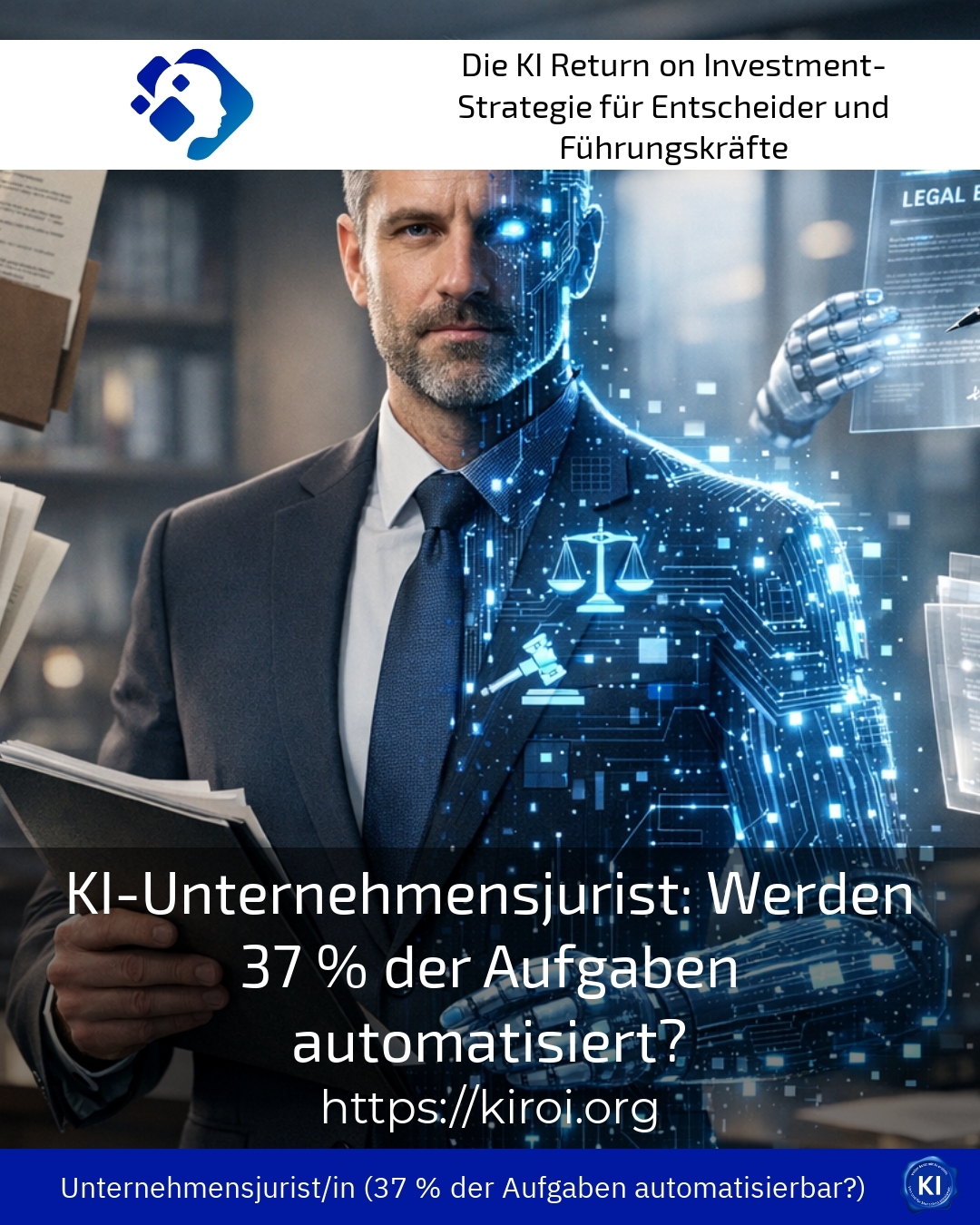
Will classic legal advice in companies soon become obsolete because intelligent systems can take on its core tasks, and what does this mean in concrete terms for the future of this demanding profession? This question currently concerns not only human resources managers in large corporations, but also the professionals themselves who daily review contracts, create compliance guidelines, and assess legal risks. The platform of the Institute for Employment Research provides astonishing data in this regard, because the AI Corporate Lawyer Companies are facing a transformation that could affect around 37 percent of their traditional activities [1]. This number may seem initially frighteningly high, but upon closer inspection, a nuanced picture emerges that presents both opportunities and challenges. transruptions coaching supports companies and professionals precisely during such profound change processes, in order to actively and independently shape the transition into a new working world.
The transformation of legal work in the corporate context
Digitalization has covered almost all professional fields in recent years, but the legal departments of large companies have long been considered particularly resistant to technological changes. This assumption is increasingly proving to be a fallacy. Intelligent systems are already reviewing standardized contract documents today. They analyze thousands of documents in minutes. They automatically identify problematic clauses.
A concrete example from practice vividly illustrates this development. In the insurance industry, legal teams regularly have to verify the compliance of policies. This task traditionally consumes significant amounts of time. Modern analytical tools now perform this work significantly faster. They do so with remarkable accuracy.
Similar patterns are also evident in the banking sector. The review of credit agreements is increasingly being carried out automatically. Compliance checks are running in the background in parallel. Risk analyses are being made more precise through algorithmic support.
The field of intellectual property also benefits greatly from these developments. Patent searches that used to take weeks are now possible in hours. Trademark law conflicts are examined globally and comprehensively. The documentation of intellectual property rights is more systematic than ever before.
The AI corporate lawyer between efficiency and ethical responsibility
The question of which tasks can actually be automated is closely related to the nature of legal work. Routine tasks such as the drafting of standardized confidentiality agreements are ideally suited to technological support, while complex negotiation management and strategic legal advice continue to require human expertise. AI Corporate Lawyer It is therefore not being replaced, but rather experiencing a shift in its scope of tasks towards more value-adding activities.
In the automotive industry, we are observing this development particularly clearly. Product liability issues are being supplemented by data-based risk models. Supplier contracts undergo automated verification processes. The international harmonization of contractual terms is being carried out systematically.
Pharmaceutical companies face similar challenges in clinical trials. Regulatory requirements change frequently and quickly. Intelligent systems help monitor these changes. They significantly support the adaptation of internal processes.
The energy sector is also undergoing significant change. Approval processes are being accompanied by digital assistants. Environmental compliance requirements can be better monitored. Contract management for renewable energy is being made more efficient.
Best practice with a AIROI customer A medium-sized technology company based in southern Germany faced the challenge of making its legal department future-proof without compromising long-standing employees or losing their valuable expertise. In the context of a transruptive coaching session, we analyzed all existing processes together with the leadership team and identified those areas that were particularly suitable for technological support. Contract recording and categorization proved to be an ideal starting point because it was time-intensive on the one hand and yet provided clear structures on the other. We supported the team in selecting suitable tools and trained the employees in using the new systems. Particularly important was open communication about fears and concerns that many team members initially harbored. After six months, the participants reported a significant relief in routine tasks. They were able to focus more on demanding advisory tasks. Employee satisfaction increased measurably. The company benefited from shorter processing times while maintaining consistent quality.
Concrete effects on typical fields of activity
The 37 percent determined by Job-Futuremate is by no means evenly distributed across all areas of responsibility; rather, it focuses on specific activity clusters that are characterized by repeatability and clear regulatory structures. Contract creation for standard cases, conducting due diligence checks, and searching legal databases are among those areas that are particularly affected by automation. At the same time, competencies such as strategic consulting and negotiation skills are gaining importance.
In the telecommunications industry, this is evident in licensing negotiations. Legal frameworks are automatically formulated. The actual negotiation strategy remains a human domain. Managing relationships with regulatory authorities continues to require personal expertise.
Business enterprises experience similar shifts in contract law. Supplier contracts are standardized by templates. Risk clauses can be identified automatically. However, the final contract design requires individual adjustments.
In the real estate sector, legal departments benefit from digital land registry searches. Purchase contract templates are prepared by intelligent systems. The coordination with notaries remains a personal process.
How the AI corporate lawyer can redefine his role
The realignment of legal activities in the corporate context requires a rethinking on several levels, which includes both individual further training and organizational adjustments. Professionals who familiarize themselves early with technological developments while simultaneously cultivating their genuine human strengths will be particularly in demand in the new working world. AI Corporate Lawyer The future sees itself as a orchestrator of various resources.
The media industry illustrates this development vividly. Copyright issues become more complex due to global streaming services. At the same time, digital tools help with rights management. Strategic licensing negotiations remain a creative endeavor.
Logistics companies need legal expertise for international transport contracts. Customs regulations are monitored by systems. The design of innovative business models requires human creativity.
In healthcare, data protection requirements are increasing steadily. Automated systems support documentation. Ethical evaluation of medical issues remains a human task.
Best practice with a AIROI customer An international trading company with complex supply chains approached us because its legal department was almost collapsing under the burden of regulatory requirements from different countries, and employees were increasingly frustrated with repetitive compliance tasks that required little of their professional expertise. Together with the team, we developed a step-by-step plan that initially included an inventory of all processes and then defined priorities for technological support. Particularly impressive was the introduction of a system for automatically monitoring sanctions lists, which previously employed several full-time employees. The freed up capacity could be used to develop a new compliance strategy that made the company significantly more competitive. Team members often reported a new sense of appreciation because they were now able to take on more demanding tasks. Management recognized the strategic value of the legal department more than before. Collaboration with other departments improved noticeably. Overall, efficiency increased by an estimated thirty percent.
The human dimension remains indispensable
Despite all technological developments, we must not forget that legal work in companies encompasses far more than mere legal application; it also involves interpersonal communication, ethical considerations, and an understanding of complex business contexts. transruptions coaching begins precisely here and provides the impetus for professionals to strengthen their unique human abilities. The support provided during change projects helps overcome uncertainties.
In the luxury goods industry, trademark rights play a central role. The emotional component of trademark disputes requires a delicate touch. Cultural sensitivity in international negotiations remains indispensable. Creative solutions emerge through human dialogue.
Start-ups in the technology sector need flexible legal support. Investor negotiations require convincing arguments and empathy. The design of innovative contractual models requires creative thinking. Founder advice relies on personal trust.
Family businesses face special challenges when it comes to succession. Corporate legal issues are intertwined with emotional aspects. Managing the transition between generations requires diplomatic skill. Long-term relationships fundamentally shape collaboration.
My AIROI Analysis
The analysis of the available data and practical experience paints a nuanced picture that does not call for panic or carelessness, but rather for a conscious engagement with the upcoming changes. The figure of 37 percent of tasks that can be automated, as identified by the Job Future Observatory of the Institute for Employment Research, describes a potential rather than a necessary development. Companies and professionals have considerable leeway to shape the future.
Successful navigation through this transformation requires several elements simultaneously. First, we need a realistic assessment of technological possibilities. Second, we need openness to new working methods. Third, we need to specifically strengthen core human competencies.
The AI Corporate Lawyer It won’t disappear, but will continue to evolve. Its role is shifting towards strategic consulting. Technological expertise becomes a basic prerequisite. At the same time, soft skills are gaining in importance.
transruptions-Coaching actively and practically accompanies organizations and individuals in this transformation. We provide inspiration for new perspectives. We support the development of future-proof competence profiles. We help overcome resistance. The future belongs to those who see change as an opportunity and actively prepare themselves to take part in it, rather than passively waiting to see what happens.
Further links from the text above:
[1] Job-Futuromat of the Institute for Employment Research
For more information and if you have any questions, please contact Contact us or read more blog posts on the topic Artificial intelligence here.








 Deutsch
 English (UK)