
Have you ever wondered why your company feels stuck despite the latest technology?
This question currently concerns numerous executives in production companies, logistics companies, and manufacturing halls that have invested significant sums in automated systems and yet have to conclude, frustrated, that their processes have become no faster at all, but paradoxically even slower. The phenomenon we are observing here can be explained by the concept of AIROI strategy explain and resolve problems, because often the problem lies not in the technology itself, but in the lack of clarity about what that technology is actually meant to achieve. Companies race ahead while not noticing that they are merely multiplying existing uncertainties at an astonishing pace.
The paradox of accelerated slowdown in modern businesses
In numerous production facilities, we observe a fascinating phenomenon. The more automation is introduced, the more often machines are left idle. For example, a medium-sized automotive supplier invested in a state-of-the-art warehouse management system. The system worked lightning fast. But the employees did not fully understand the new processes. The result was more questions, longer decision-making processes, and paradoxically, slower deliveries.
A mechanical engineering company implemented automated quality controls. The software analyzed components in seconds. However, there were no clear criteria for boundary cases. Employees spent more time interpreting results than previously with manual inspections. A food manufacturer implemented intelligent ordering systems. These generated order suggestions within milliseconds. However, because no one had defined the underlying parameters, absurd overorders occurred, while at the same time there were shortages of critical ingredients.
These examples clearly show that speed without clarity leads to chaotic results. The technology merely reinforces what is already present. When there is uncertainty, this uncertainty spreads more quickly. When processes are not well thought out, flawed processes are more efficiently replicated.
The conventional approach: The faster the technology, the more productive the company
Average companies follow an alluringly simple logic. They assume that faster systems automatically lead to higher productivity. This assumption seems plausible at first glance. If a computer performs calculations in microseconds, it must be better than human work, which takes minutes or hours.
A textile manufacturer purchased an intelligent cutting machine with impressive computing power. The machine optimized cutting patterns in real time. The management immediately expected increased productivity. Instead, material losses initially increased. The software optimized according to criteria that no one had questioned. It minimized computation time, not fabric consumption. A chemical company relied on automated recipe calculation. The algorithms delivered lightning-fast results. But they did not take supply chain fluctuations into account. The theoretically optimal recipes were often practically not implementable.
A packaging company implemented a self-learning planning system. It generated production plans within seconds. However, the plans ignored informal arrangements between departments. Conflicts and rework increased. The supposed time savings evaporated into endless rounds of coordination.
Why this approach is structurally doomed to failure
The fundamental problem with this model lies in a fundamental misunderstanding. Speed is not an end in itself. It is a tool. A tool can only be as good as the hand that wields it and the mind that guides it. If a company does not know where it wants to go, speed only brings it faster to nowhere.
One electronics manufacturer experienced exactly this dynamic. The company had unclear quality standards. Different departments interpreted specifications differently. The introduction of automated testing systems dramatically worsened the situation. The systems made quick decisions based on conflicting requirements. The result was more complaints, not fewer.
Best practice with a AIROI customer
A medium-sized precision parts manufacturer approached us with a seemingly technical problem that turned out to be a fundamental organizational problem upon closer examination, as the company had invested in a state-of-the-art production control system that automatically prioritized orders and optimized machine utilization, while the throughput times paradoxically increased by twenty percent instead of decreasing. During the joint analysis as part of the transruptive coaching, it emerged that no one in the company had ever defined what priority actually meant, as for the sales department priority meant the importance of the customer, for production the technical feasibility, and for controlling the margin. The intelligent software had recorded these contradictory signals and optimized them according to an algorithm that tried to somehow take all three criteria into account, which led to absurd results. Only after we had developed a clear priority matrix with all the stakeholders could the system unleash its potential, and the throughput times eventually dropped by an impressive thirty-five percent below the original level.
The AIROI strategy: Clarity before speed as a fundamental principle
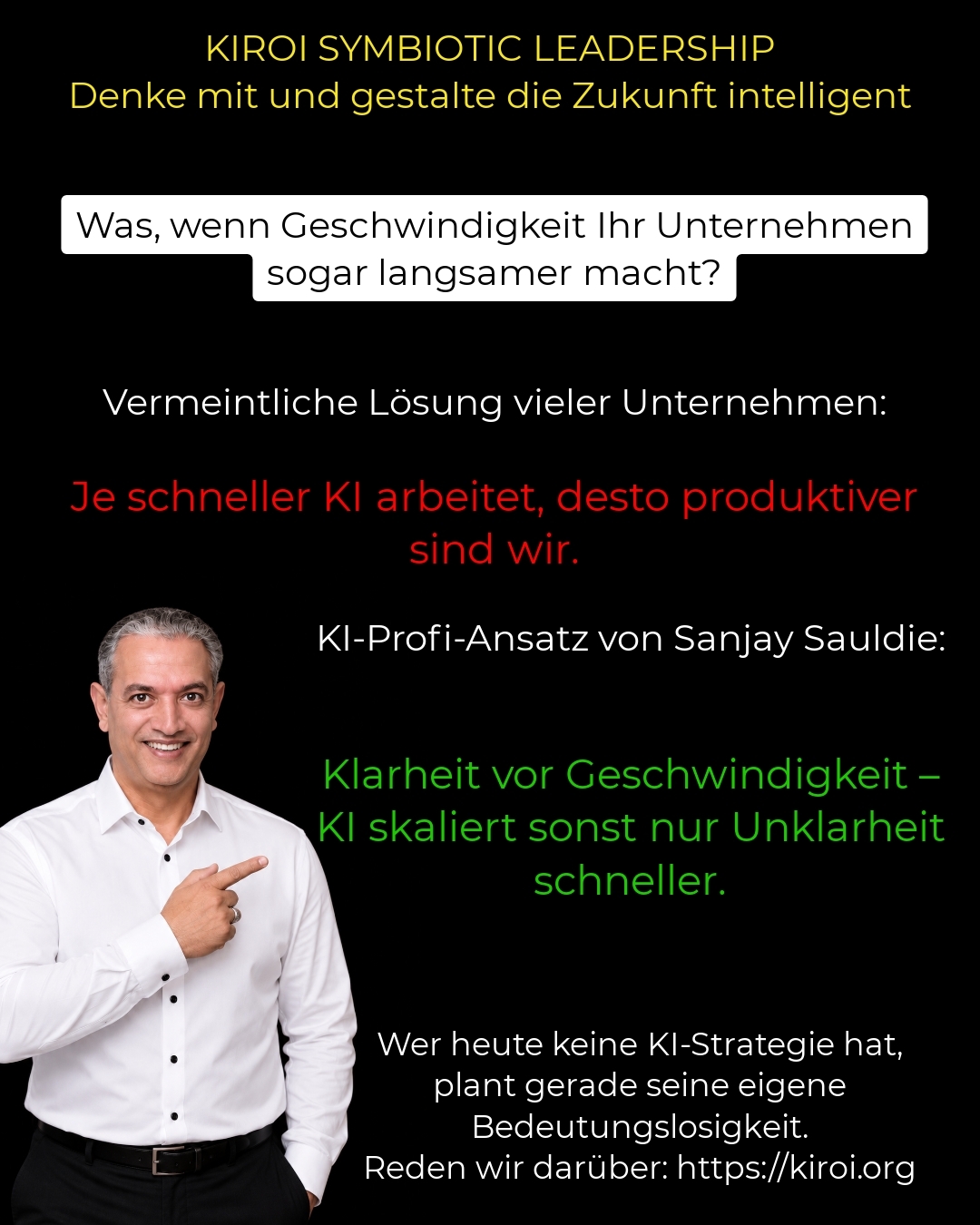
The AIROI strategy It is based on a simple but far-reaching insight. Technology always scales up what is already available. When clarity prevails, that clarity is amplified. When chaos reigns, that chaos is exponentially multiplied. Therefore, every technological initiative must begin with a phase of clarification.
A metal processing company implemented this approach with remarkable results. Before introducing a new planning system, the company invested three months in process clarification. Every step of the process was documented and questioned. Implicit knowledge was explicitly made explicit. Only then did the technology come into use. The implementation proceeded almost flawlessly.
A plastics manufacturer took a similar approach. Before automated quality controls were introduced, all relevant stakeholders jointly defined the quality criteria. Boundary cases were discussed and decided upon. Tolerances were defined and justified. When the system finally went into operation, it worked immediately effectively. A machine tool manufacturer used the clarification phase for an unexpected side effect. During the process analysis, the team discovered several redundant work steps. These were eliminated before the new technology arrived. The actual automation then brought additional efficiency gains.
How AIROI the strategy works in practice
The first step always involves an honest inventory of the situation. Where do unspoken assumptions exist? Which processes are based on habit rather than conscious decision-making? Where do different departments interpret the same terms differently? These questions may seem trivial. However, answering them requires courage and perseverance.
During this exercise, an equipment manufacturer noticed that the term “delivery date” was understood completely differently in different departments. For sales, it was the date of the customer agreement. For production, it was the earliest possible date of completion. For logistics, it was the shipping date. This discrepancy had been causing conflicts for years. No automated system could have solved this problem.
A pharmaceutical company discovered similar inconsistencies in batch nomenclature. Different teams used the same terms for different situations. Automated reporting systems therefore regularly produced contradictory information. Only the conceptual clarification enabled meaningful automation. A construction material supplier recognized that its calculation bases were based on outdated assumptions. Faster calculation software would have only more efficiently propagated these erroneous assumptions. The correction of the underlying principles brought more than any technical acceleration.
Best practice with a AIROI customer
A long-established family business in the surface finishing sector approached us with an interesting request, as the management had invested significant funds in an intelligent production planning system that was systematically circumvented by the employees because they simply did not trust the system and preferred to rely on their proven Excel spreadsheets. In the context of our transruptive coaching, we facilitated an extensive dialogue between the technology and the workshop, which revealed that the system used planning assumptions that applied under laboratory conditions but ignored the realities of daily production. For example, the experienced employees knew that certain materials react differently in high humidity, which the system did not take into account, and they also knew which customer requests had informal priority. Together, we integrated this knowledge into the system logic, and today, man and machine work in harmony, with the system taking on the computational work and the people performing the fine-tuning, which resulted in a productivity increase of twenty-five percent.
The deeper truth behind the speed paradox
In our support of companies, we repeatedly observe that the real challenge is rarely of a technical nature. Most difficulties stem from human and organizational factors. Communication gaps, unclear responsibilities, and conflicting goals cannot be solved by faster processing systems.
One steel manufacturer vividly experienced this realization. The company had invested in automated bidding [1]. The software produced bids in minutes instead of days. However, the order rate declined. Analysis showed that the automated bids appeared technically correct but emotionally cold. Customers did not feel understood. A medical technology manufacturer had similar experiences with automated customer communication. The systems responded lightning-fast to inquiries. However, the answers often did not address the core of the question. Customers were made more efficient but dissatisfied.
The AIROI strategy It addresses exactly this dimension. It recognizes that human factors cannot be automated away. They must be understood, respected, and integrated into technological planning. Only then will solutions emerge that truly work.
AIROI-Strategy as the foundation for sustainable transformation
Sustainable change requires more than quick implementations. It requires deep understanding, patient development, and continuous adaptation. A packaging machinery manufacturer has been successfully practicing this approach for years. Every technological innovation undergoes a structured clarification process. All affected employees are included. Potential conflicts are anticipated and addressed [2].
A laboratory equipment manufacturer follows a similar path. Before every major system introduction, workshops are held. These not only clarify technical issues. They also address fears, hopes, and expectations. These subjective factors often determine success or failure. A automotive supplier integrates clarification loops firmly into its development process. Regular reflection rounds ensure that technological developments and organizational realities remain in sync.
My AIROI Analysis
The experiences from numerous accompaniment projects clearly show that speed alone is not a success criterion and that companies that follow this delusion often fall into a downward spiral from which they find it difficult to recover. AIROI strategy offers a proven solution to this dilemma by establishing clarity as a prerequisite for meaningful acceleration, thereby establishing a sequence that appears counterintuitive at first glance but proves to be extraordinarily effective in practice.
Clients often report feeling under enormous pressure to act quickly and implement the latest technologies before the competition catches up, and that precisely this pressure leads them to skip important clarification steps, which backfires later on. We accompany these companies in taking a step back, asking the right questions and only acting when the fundamentals are in place. This approach requires courage, because it sometimes means saying no to tempting offers and seemingly urgent calls to action [3].
The AIROI strategy It is not a brake on innovation. It is, rather, the turbocharger for sustainable transformation. Because those who clearly know where the journey is going can use speed wisely. Those who wander aimlessly will only end up colliding with walls faster with acceleration. This insight may be uncomfortable, but in the long run it saves enormous resources and frustrations.
Further links from the text above:
[1] McKinsey – The Future of Manufacturing
[2] BCG – Managing AI Responsibly
[3] Harvard Business Review – AI Will Not Replace Humans
Are you a leader and would you like to learn how you can genuinely introduce AI into your company in a valuable and sustainable way, away from the hype? Take part Contact us or read more blog posts on the topic Artificial intelligence here.











 Deutsch
  English (UK)