
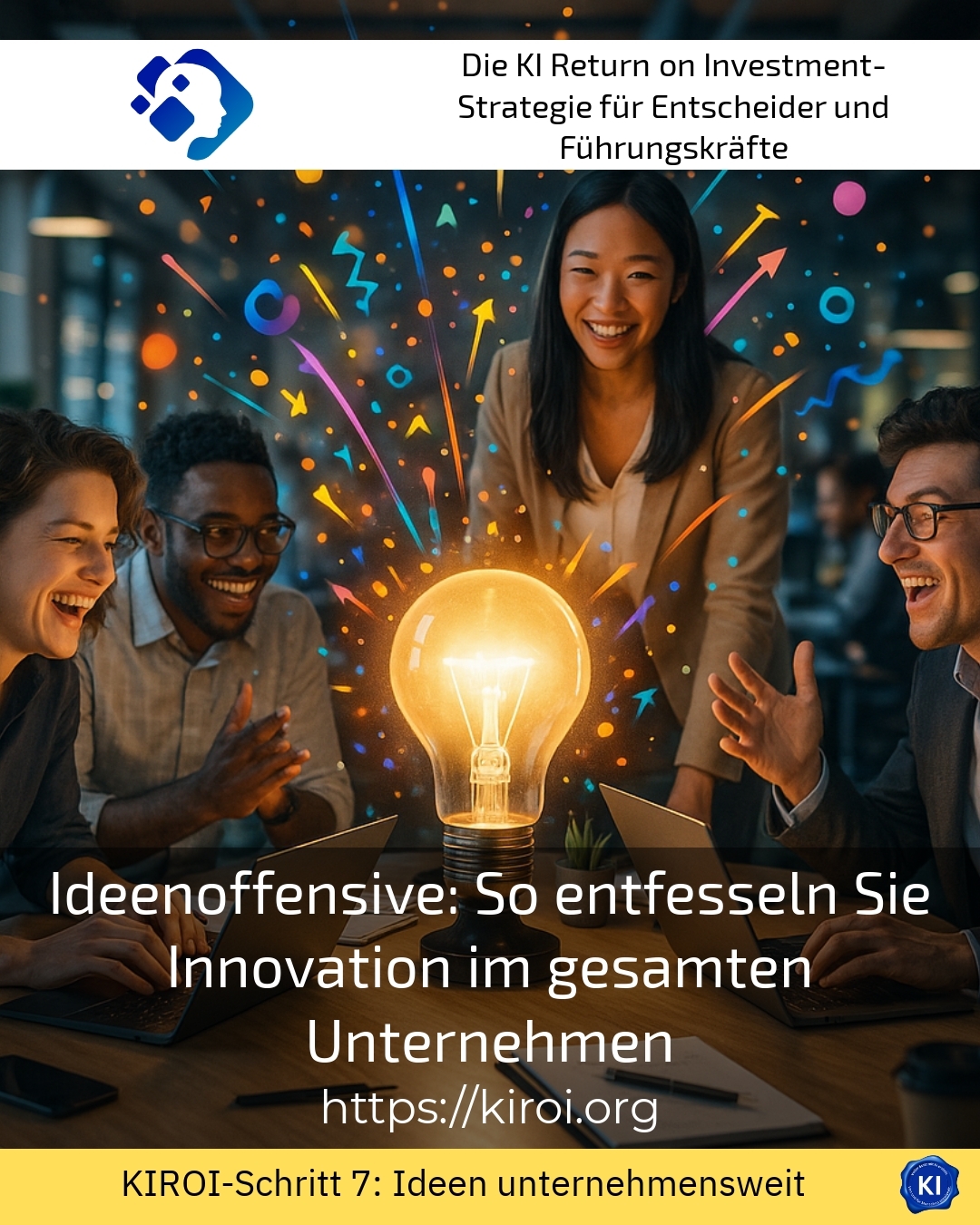
Imagine that the next groundbreaking business idea is already dormant in your company. It is just waiting to be discovered. Many organizations underestimate the creative potential of their own employees. A well-thought-out Ideas offensive: How to unleash innovation throughout the company This can make the crucial difference here. After all, real innovation rarely arises in isolated research departments. It often develops where people from different fields come together and share their perspectives. This article shows you how to systematically unlock this hidden potential.
Recognize and harness the power of collective creativity
Companies that want to be sustainably successful must wisely utilize their internal resources. This is especially true for the intellectual capital of their workforce. Often, executives report that they have received surprising solutions from unexpected sources. The accounting clerk sometimes brings the spark idea. The customer service colleague recognizes market trends earlier than the strategy department. These observations show that creativity is not a matter of hierarchy. A medium-sized family-owned machine manufacturing company conducted regular cross-departmental workshops. Within six months, thirteen implementable product improvements were created. A logistics service provider motivated its drivers to submit optimization suggestions for routes. The result was an eight percent fuel savings. A software house set up a digital idea channel. Within a quarter of a year, over two hundred proposals for improving internal processes were submitted.
Structures create the foundation for a sustainable idea offensive
Spontaneous inspiration alone is not enough. It needs channels through which it can flow. Organizations should therefore consciously establish structures that promote creative thinking. This is not about bureaucratic hurdles, but about inviting spaces. One pharmaceutical company established so-called innovation labs where employees were allowed to experiment. These open spaces led to several patent applications. A trading company established monthly pitch sessions where teams could present their ideas. The best proposals received budgets for implementation. An energy provider introduced a digital reward system for submitted improvement proposals. Participation subsequently quadrupled. These examples illustrate that systematic approaches can yield measurable results.
Best practice with a AIROI customer
A medium-sized industrial company with about four hundred employees turned to transruptions coaching because the company’s innovation power had stagnated for years. The management felt that valuable ideas were stagnating within the organization. As part of the coaching, a comprehensive analysis of the existing communication channels was initially conducted. It turned out that suggestions often remained stuck at the middle management levels. The employees also felt that their contributions were not appreciated. Together, we developed a multi-stage strategy to establish a vibrant culture of ideas. First, a digital platform was set up where all employees could submit suggestions anonymously or on a first name basis. In parallel, we trained management in appreciative communication and active listening. Monthly innovation rounds with mixed teams from different departments complemented the concept. After six months, the company experienced a significant increase in actionable ideas. Particularly noteworthy was that many of the suggestions came from areas that were previously considered less creative. The production department developed a process optimization that enabled annual savings in the six-digit range. The transruptions coaching accompanied the entire transformation process and provided continuous impetus.
Cultural change as the foundation of the ideas offensive: This is how you unleash innovation throughout the entire company
Structures alone do not create an innovation culture. The internal attitude of the organization must also change. Many companies unconsciously inhibit the creativity of their employees through fear of mistakes. The best ideas often emerge through experimentation and failure. A technology company established the principle of psychological safety in all teams. Employees were allowed to openly discuss mistakes without fearing negative consequences. This openness led to a noticeable improvement in the innovation rate. A financial services provider introduced so-called error celebrations, where failed projects were analyzed. The insights were incorporated into future initiatives. A media company created the role of an innovation coach who guided teams in idea development. These measures show that cultural changes take time but can have a lasting effect.
Leaders as Facilitators of Creative Processes
The role of leaders transforms fundamentally in innovative organizations. They become the facilitator rather than the decision-maker. Instead of evaluating ideas, they create spaces for their creation. An insurance company trained its leadership in design thinking methods. These were then able to support their teams in creative processes. A construction company established the principle of service leadership at all levels. Leaders actively sought suggestions for improvement and implemented them promptly. A telecommunications provider introduced reverse mentoring, in which younger employees mentored their supervisors. These approaches illustrate that leadership behavior directly affects innovation capability.
Digital tools to support creative processes
Modern technologies can significantly support creative processes. They do not replace human creativity, but enhance it. Collaboration platforms enable the exchange across locations and time zones. A global automotive supplier used virtual whiteboards for international brainstorming sessions. Teams from different countries developed new product concepts together. A consumer goods manufacturer used artificial intelligence to evaluate submitted ideas for feasibility. This significantly accelerated the selection process. A consulting firm established gamified idea competitions on a digital platform. The playful elements significantly increased participation. These technological solutions can Ideas offensive: How to unleash innovation throughout the company effectively complement.
Best practice with a AIROI customer
A long-established retail company with several hundred stores sought ways to better utilize the knowledge of its employees. The store managers had valuable insights into customer behavior that had not previously been systematically recorded. As part of the transruptive coaching, we developed a digital solution together to collect and evaluate ideas. The platform enabled all employees to submit observations and suggestions. An algorithm supported the thematic grouping of similar ideas. Monthly evaluations identified trends and patterns in the submissions. The ability to build on ideas from others and develop them further was particularly valuable. This resulted in a vibrant idea marketplace that grew continuously. Within a year, over sixty proposals were put into action. The topics ranged from assortment optimizations to new service concepts. The transruptions coaching accompanied both the technical implementation and the necessary cultural change. Regular feedback rounds with the users enabled continuous improvements to the platform. The management received training on how to respond appreciatively to submitted ideas.
Diversity as a driver of innovative solutions
Homogeneous teams tend to develop similar solutions. Diversity in terms of backgrounds, experiences, and ways of thinking significantly enriches creative processes. A chemical company deliberately put together teams from people with different professional backgrounds. The interdisciplinary collaboration led to surprising product innovations. An educational institution actively involved learners in developing new offerings. The perspective of the target group noticeably improved the quality of the programs. A healthcare provider established patient councils that contributed to the development of new services. This external perspective uncovered blind spots in the organization. The inclusion of diverse perspectives strengthens innovation capacity sustainably.
From idea to implementation: building bridges
The best idea is of little use if it is not implemented. Many organizations fail to translate concepts into practice. Therefore, clear processes are needed for the development of promising approaches. A food producer established a stage-gate process for new product ideas. Each stage included clear criteria for further development or termination. An IT service provider established an internal incubator program for promising innovation projects. Selected teams received time and resources to develop their ideas. A mobility provider collaborated with external startups to bring internal ideas to market more quickly. These approaches illustrate that implementation must be systematically supported.
Measurability and continuous improvement of the idea offensive
What is not measured cannot be improved. Key performance indicators help assess the success of innovation initiatives. An electronics manufacturer recorded the number of ideas submitted and implemented per quarter. The development of these indicators served as an indicator of the innovation culture. A tourism group regularly surveyed its employees on the perceived innovation friendliness of the workplace. The results were incorporated into targeted improvement measures. A logistics company linked innovation metrics with the objectives set by management. This significantly increased attention to the topic at all levels. The Ideas offensive: How to unleash innovation throughout the company benefited from regular performance measurement and adjustment.
My AIROI Analysis
After extensive examination of numerous organizations and their innovation efforts, a clear pattern emerges. Companies that actively involve their employees develop more sustainable and practical solutions. The challenge lies not in a lack of ideas, but in their systematic identification and implementation. Many leaders underestimate the cultural change that is necessary for a vibrant innovation culture. They focus too much on structures and processes, but neglect the emotional dimension. Employees need to feel secure to be creative. They need the confidence that their contributions are valued. Mentoring by experienced coaches can significantly support this transformation process. It is not about ready-made recipes, but about individual impulses for each organization [1]. Technological possibilities have expanded significantly in recent years. Digital platforms can support and accelerate creative processes. Nevertheless, the human factor remains crucial. Artificial intelligence can recognize patterns and sort suggestions, but the spark for an idea comes from the human mind [2]. Organizations should therefore take both dimensions equally into account. Investing in a vibrant innovation culture pays off in the long term. It not only strengthens competitiveness but also employee engagement and satisfaction [3]. Those who get things right today will be able to benefit from the fruits of collective creativity tomorrow.
Further links from the text above:
[1] AIROI-Methodology for innovation processes
[2] Harvard Business Review – Innovation Topics
[3] McKinsey – The Eight Essentials of Innovation
For more information and if you have any questions, please contact Contact us or read more blog posts on the topic Artificial intelligence here.











 Deutsch
  English (UK)