
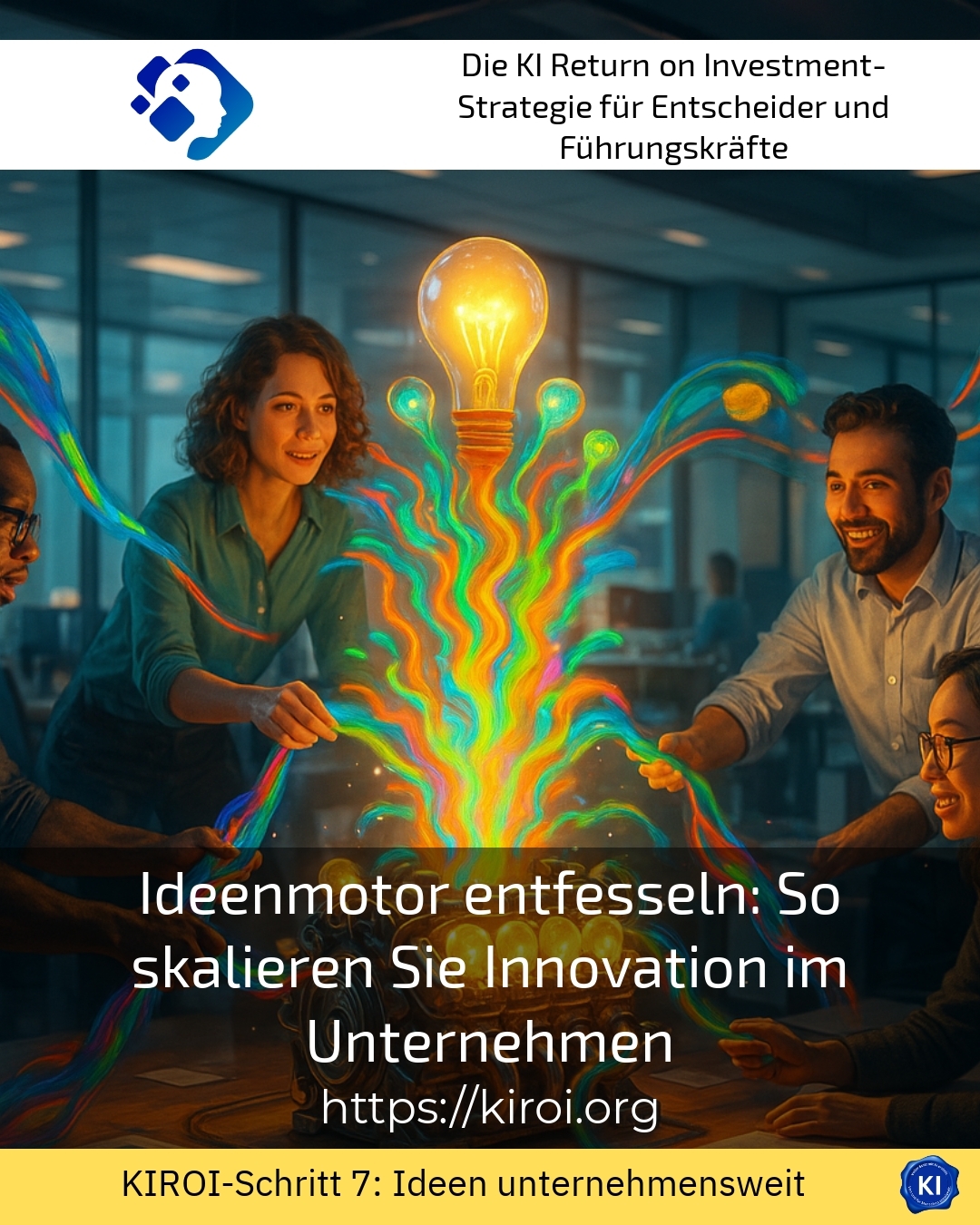
Imagine your company has an unlimited source of creative energy. This energy is just waiting for you to unleash the ideas engine and thereby trigger transformative change. In a business world that is changing rapidly, the ability to achieve continuous renewal determines success and failure. Many executives face the challenge of systematically establishing creative processes. This is not just about individual flashes of genius, but about sustainable structures. These structures make it possible to implement innovations on a large scale. This is precisely where a well-thought-out strategy comes in, going far beyond traditional approaches.
Unleashing the idea engine: fundamentals for creative excellence
Before organisations can fully tap into their creative potential, they must first establish the right framework. An open corporate culture forms the indispensable foundation for any sustainable change. Employees at all hierarchical levels must feel safe when contributing unconventional proposals. This psychological safety has been proven to foster the willingness to take risks and explore new paths [1]. At the same time, teams require clear structures that provide them with orientation while still leaving sufficient leeway for experimental work.
For example, a medium-sized mechanical engineering company established weekly creative sessions in which engineers together with sales staff analysed customer feedback. Within a few months, these cross-functional encounters led to several product improvements that directly addressed real market needs. A chemical corporation, in turn, set up so-called innovation laboratories where small teams could work on future topics completely detached from day-to-day business. Furthermore, an automotive supplier has launched an internal start-up programme in which employees can pitch their own business ideas and be equipped with resources.
Cultural transformation as the key to success
Changing a corporate culture does not happen overnight, but requires continuous attention and deliberate shaping. Leaders play a crucial role as role models here, because through their behaviour they shape the implicit rules of the game within the organisation. When superiors act experimentally themselves and openly discuss their own mistakes, this encourages others to act similarly. The willingness to learn from setbacks is what distinguishes successful companies from those that remain stuck in stagnation.
For example, a pharmaceutical company introduced so-called failure festivals, where teams presented their failed projects and analysed them together. These events transformed supposed defeats into valuable learning moments for the entire organisation. A telecommunications provider, on the other hand, established a mentoring programme that brought experienced managers together with young talent to promote cross-generational knowledge exchange. In addition, an energy supplier has offered creativity workshops in which employees could learn design thinking methods.
Best practice with a AIROI customer
A long-established industrial company with several thousand employees was faced with the challenge of fundamentally modernising its product development processes. The existing structures had worked well for decades, but were increasingly proving too cumbersome for heightened market demands. As part of a transruption coaching process, we accompanied the management team in developing a completely new approach. First, we jointly analysed existing decision-making paths and identified numerous bottlenecks. We then designed a multi-stage pilot programme that could be tested in selected departments. Employees were given expanded decision-making powers and were able to drive smaller projects forward autonomously. Particularly noteworthy was the reaction of middle management, who were initially sceptical. However, through regular reflection sessions and transparent communication, it was possible to involve this important group as well. After about six months, project teams reported significantly shorter development cycles and higher motivation. The company has since transferred these insights to other business areas.
Systematic approaches to scaling creative processes
While individual creative breakthroughs often occur by chance, their systematic repetition requires well-thought-out methods and tools. Companies that want to unleash the engine of innovation need clear processes for idea generation, evaluation and implementation. A structured idea management system can help to identify and further develop promising approaches [2]. At the same time, bureaucracy must not get out of hand, because too many control mechanisms can stifle creativity.
A logistics company implemented a digital platform where all employees could submit suggestions for improvement. These suggestions were evaluated by an interdisciplinary panel and the best ideas received resources for implementation. A financial services provider, in turn, organised regular hackathons where mixed teams developed prototypes for new services within 48 hours. In addition, a retail company introduced a points system where employees received rewards for implemented ideas.
Technological levers for accelerated growth
Modern technologies open up completely new possibilities to support and accelerate creative processes. Artificial intelligence can, for example, help to search large amounts of data for patterns and uncover surprising connections. Collaboration platforms enable distributed teams to work closely together despite geographical distance and to share knowledge in real time. These digital tools do not replace human creativity, but rather enhance it in a variety of ways.
For example, an insurance company uses machine learning to automatically deduce potential product improvements from customer conversations. A construction group has used virtual reality to make it easier for architects and engineers to jointly develop complex projects. In addition, a media company is experimenting with generative technologies to validate and further develop content ideas more quickly.
The role of leadership in unleashing the idea engine
Without committed leaders, even the best structures remain ineffective, because people ultimately make the difference. Modern leadership means creating spaces in which others can grow and develop their potential. This requires a fundamental rethink for many managers, who traditionally relied more on control than on empowerment [3]. The transition from the traditional boss to coach and enabler represents one of the most demanding transformation tasks.
A technology company trained its entire leadership team in agile methods, fundamentally changing the way they collaborated. A consumer goods manufacturer introduced 360-degree feedback systems, which regularly provided leaders with feedback on their behaviour. Furthermore, a service company time-limited leadership positions to promote continuous renewal at all levels.
Best practice with a AIROI customer
A female managing director from the professional services sector came to us because she felt that her organisation was losing its creative drive despite its economic success. The employees carried out their tasks reliably, but hardly contributed any ideas of their own any more. As part of the transruptions coaching support, we first analysed the existing communication structures and decision-making processes. It turned out that unconscious signals from the management level systematically discouraged innovative proposals. Employees had learned that deviations from the tried and tested were viewed as a risk and could have corresponding negative consequences. Together, we developed a strategy to change these implicit messages and establish a genuine culture of error. The managing director began to explicitly ask for unconventional ideas in team meetings and to receive even unpolished proposals with appreciation. Within a few months, the atmosphere changed noticeably and employees reported a new energy in the company. Clients frequently report similar breakthroughs when leadership consciously creates spaces for experimentation.
Measurability and continuous improvement
To unleash the idea engine, companies also need appropriate key performance indicators that make progress visible. Traditional success metrics such as revenue and profit only inadequately reflect creative performance. Therefore, many organisations are experimenting with complementary indicators such as the number of improvement suggestions submitted or the time to market for new products. However, these metrics should never become an end in themselves, but must always serve the overarching goal.
For example, an electronics manufacturer measures the proportion of revenue generated by products that are less than three years old. A software company, in turn, tracks how many employees are actively involved in innovation projects. In addition, a consultancy has introduced qualitative surveys to regularly assess the perceived culture of innovation.
Leverage external impulses and ecosystems
The most creative ideas frequently arise at the intersections between different disciplines and organisations. Companies that isolate themselves forego valuable external input and risk missing important developments. Collaborations with universities, start-ups or partners from other industries can help to broaden one's own horizons [4]. At the same time, open collaboration requires clear agreements to protect intellectual property.
For example, a mobility provider has founded an accelerator that supports promising start-ups while simultaneously providing access to new technologies. A food manufacturer cooperates with universities to translate basic research into applicable product innovations. In addition, a textile company has established partnerships with design colleges to bring fresh perspectives into product development.
My AIROI Analysis
The systematic promotion of creative processes represents one of the central challenges for organisations in an accelerating economic world. It repeatedly becomes apparent that technical solutions alone are not enough to bring about sustainable change. The cultural dimension plays a role just as important as the right structures and processes. Leaders must be prepared to reflect on their own behaviour and, if necessary, fundamentally change it. Only when psychological safety is present do employees dare to contribute unconventional proposals. Examples from various industries make it clear that there is no universal blueprint that works in every context. Instead, approaches must be carefully tailored to the specific situation and culture of an organisation. Transruptions coaching support can provide valuable impetus in this regard and assist the process of self-reflection. Clients frequently report surprising insights that only became possible through an outside perspective. The integration of digital technologies opens up additional possibilities, but human creativity remains the decisive factor. Organisations that want to be successful in the long term invest continuously in their capacity for renewal. The development of genuine innovation competence requires patience and persistence over a period of several years.
Further links from the text above:
[1] Harvard Business Review: Innovation Management
[2] McKinsey: The Eight Essentials of Innovation
[3] MIT Sloan Management Review: Leading Change
[4] Forbes: Innovation Insights
For more information and if you have any questions, please contact Contact us or read more blog posts on the topic Artificial intelligence here.







 Deutsch
 English (UK)