
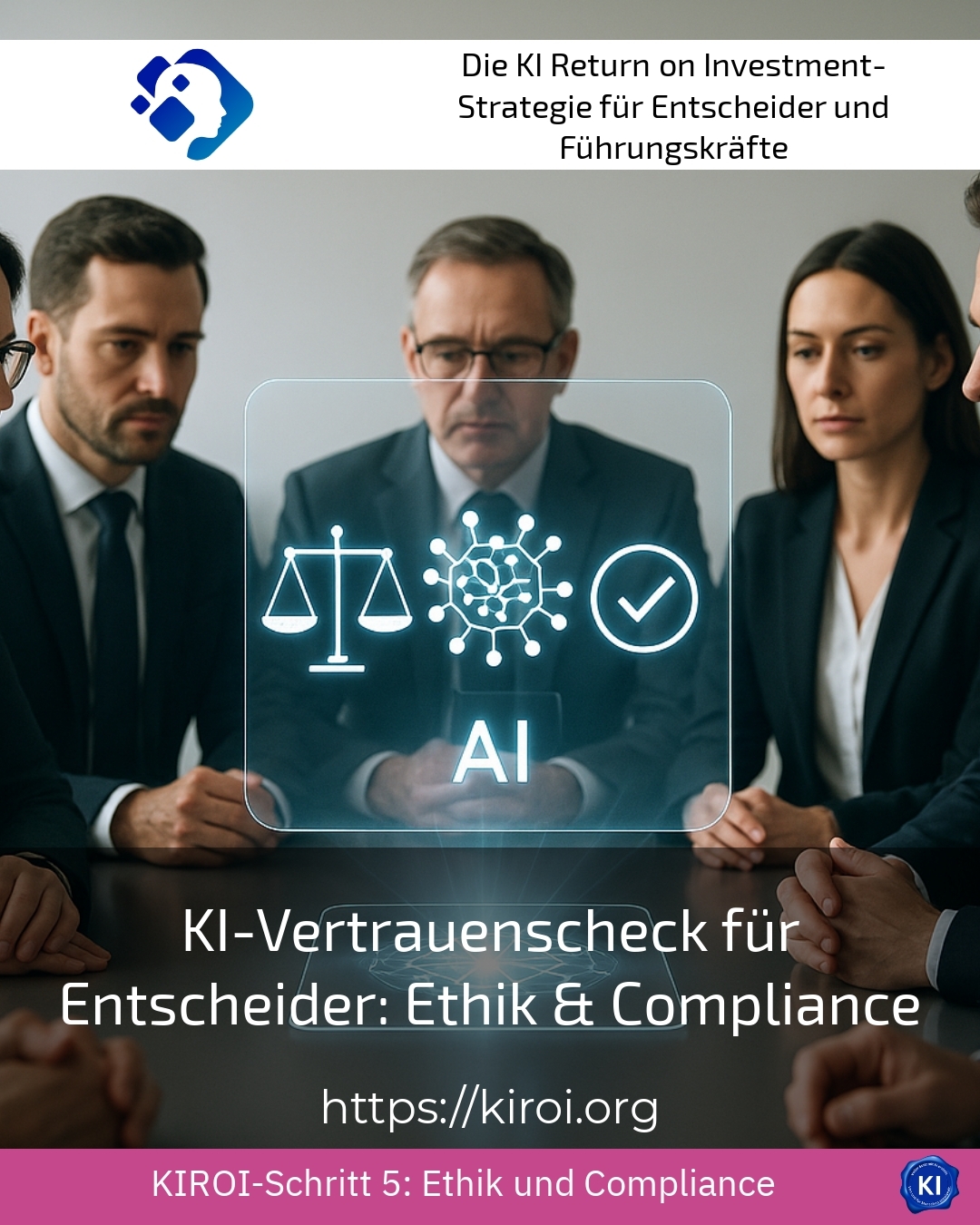
Imagine a single flawed algorithmic decision costing your company not just millions, but also the trust of your customers and partners – a scenario that is far from fictional. The AI Trust Check for Decision-Makers: Ethics & Compliance serves as the indispensable foundation for sustainable business success. Because while intelligent systems are rapidly finding their way into business processes, many organisations are dangerously lagging behind in their ethical and legal frameworks. In a world where algorithms influence credit decisions, personnel choices, and customer relationships, leaders today must understand their responsibilities more than ever.
The new dimension of responsibility in automated decision-making processes
The integration of machine learning methods into business processes fundamentally changes how organisations operate and make decisions. This gives rise to entirely new challenges that go far beyond technical implementation issues. Leaders are faced with the task not only of understanding complex algorithmic systems but also of evaluating and managing their societal impact. For example, a financial service provider that uses automated credit checks must ensure that these systems do not adopt discriminatory patterns from historical data. Likewise, insurance companies that automate the assessment of claims must be able to transparently explain the criteria by which decisions are made. And retail companies that use personalised pricing tread a fine line between optimisation and ethically questionable price discrimination.
Regulatory requirements are continuously tightening, with the European AI Act [1] representing a milestone. This obliges companies to conduct comprehensive risk assessments and comply with transparency obligations. At the same time, customer, employee, and public expectations regarding the responsible use of data-driven technologies are growing. Those who do not act proactively in this area risk not only hefty penalties but also significant reputational damage. The AI Trust Check for Decision-Makers: Ethics & Compliance provides a structured framework for systematically addressing these complex requirements.
Concrete areas of action for responsible automation
In the banking sector, automated credit decision systems have already led to critical situations. Algorithms trained on historical data systematically reproduced disadvantages for certain population groups. A leading credit institution had to revise its entire scoring system after investigations uncovered discriminatory patterns. In human resources, many companies are now relying on automated pre-selection of applications, with systems often reinforcing unconscious biases. A technology company found that its recruitment algorithm systematically favoured male candidates. And in healthcare, automated diagnostic systems have already resulted in misdiagnoses because the underlying training data was not representative of all patient groups.
Best practice with a AIROI customer
A medium-sized insurance company approached us with a complex challenge. They had already made significant investments in automated claims processing but were facing increasing customer complaints about feeling unfairly treated. Our initial analysis as part of our transruption coaching revealed fundamental issues within the system architecture, particularly a lack of decision traceability. Together, we developed a comprehensive ethics framework that clearly defined guidelines for the development and deployment of automated decision-making systems. The transruption coaching project team for several months, with a particular emphasis on employee training and the establishment of control mechanisms. The implementation of a transparent explanation system subsequently enabled customers to be clearly informed about how decisions were reached. The volume of complaints decreased by over forty percent within six months, and customer satisfaction demonstrably improved. This project serves as an exemplary case of how systematic support for projects involving algorithmic systems can bring about sustainable improvements.
AI Trust Check for Decision-makers: Ethics & Compliance as a Strategic Competitive Advantage
Companies that integrate ethical aspects into their digitalisation strategy early on are increasingly positioning themselves as preferred partners and employers. The German Ethics Council's study [2] underlines that trust in automated systems is significantly dependent on their transparency and traceability. For example, a telecommunications provider was able to significantly increase customer loyalty by consistently implementing ethical guidelines for its customer service automation system. A logistics company, in turn, differentiates itself from the competition through particularly fair and transparent algorithms for its drivers' route planning. And an online retailer attracts conscious consumers by disclosing the principles behind its recommendation system.
The economic benefits of a proactive approach are considerable. Companies avoid costly rectifications and legal disputes. They build sustainable customer relationships based on trust. And they position themselves as attractive employers for talented professionals, who increasingly value responsible technology development. AI Trust Check for Decision-Makers: Ethics & Compliance allows for a systematic evaluation and continuous improvement of these aspects.
Establish governance structures for sustainable success
Establishing effective oversight and control mechanisms requires a shift in thinking within many organisations. Traditional governance structures are often not designed for the dynamics and complexity of algorithmic systems. Consequently, a pharmaceutical company has established an interdisciplinary ethics committee to review every new automation initiative before its implementation. An energy provider, in turn, has appointed a Chief AI Ethics Officer who reports directly to the board. And an automotive manufacturer has introduced a three-stage approval process for all systems that automate safety-critical functions.
The Bitkom recommendations [3] offer a practical guide for developing such structures. It shows that successful governance does not only consist of regulations and processes, but is above all a question of corporate culture. Leaders must embody ethical reflection and encourage employees to ask critical questions. Only then can organisations emerge that truly handle automated decision-making systems responsibly.
Best practice with a AIROI customer
An internationally active trading company sought support in developing a group-wide governance structure for automated pricing and customer interaction. The "transruptions-Coaching" initially facilitated a comprehensive inventory of all relevant systems, revealing surprising insights into existing algorithmic decisions, of which even management had no full knowledge. Together, we developed a multi-stage approach that encompassed both technical and organisational measures. The establishment of an internal audit team, which regularly reviews all automated systems for ethical compliance, proved to be particularly valuable. Furthermore, "transruptions-Coaching" supported the development of training programmes for managers and employees, enabling them to independently identify and address ethical risks in the future. The implementation of a whistleblower system for algorithmic errors complemented the governance structure and created additional security. Upon completion of the project, those responsible reported a significantly increased awareness of ethical issues throughout the company, and several potential risk situations were identified and avoided at an early stage.
transparency as the foundation of AI Trust Check for Decision-Makers: Ethics & Compliance
The demand for explainable systems is continually gaining importance, from both a regulatory and business perspective. Customers increasingly expect information on why certain decisions were made. A mobile network operator has therefore implemented a system that explains to customers in understandable language how their individual tariff recommendations were generated. A bank has developed an interactive visualisation that makes it transparent to loan applicants which factors influenced their assessment. And a recruitment agency provides applicants with insight into the criteria used for automated pre-selection.
The technical capabilities for explainable systems have advanced considerably, as demonstrated by research findings from the Fraunhofer Society [4]. Methods such as SHAP values or LIME make even complex models understandable. However, the implementation of such explanation systems requires careful planning and continuous adaptation. Explanations must be tailored for different target audiences, as what is comprehensible to subject matter experts will be of little help to the average customer. This is where the added value of systematic support in projects concerning transparency and understandability becomes apparent.
Practical implementation steps for leaders
The path to responsible automation begins with an honest assessment of the current situation within one's own company. Many organisations underestimate how many algorithmic decision-making systems are already in use and their ethical implications. One retail company found in such an analysis that over thirty different systems were independently making decisions affecting customers and employees. A hospital realised that automated appointment scheduling systematically disadvantaged certain patient groups. And a media company discovered that its recommendation algorithm was preferentially promoting problematic content.
Following the inventory, the identified risks and areas for action are prioritised. Not all systems require equally intensive attention. Classification according to risk classes, as provided for by the European AI Act, offers a helpful framework for this. Systems with high risk potential require comprehensive documentation, regular audits, and human oversight. For systems with lower risk, simplified procedures may suffice. The specific design depends on the individual circumstances of the respective company.
My AIROI Analysis
The systematic examination of ethical and regulatory requirements for automated decision systems is no longer an optional extra task, but a central leadership responsibility. The analysis of numerous companies clearly shows that those organisations are most successful which understand ethics and compliance not as an obstacle, but as an opportunity for differentiation and sustainable value creation. The examples presented here from a wide range of industries illustrate how diverse the challenges are and how individual the approaches to solutions must be. Standardised procedures can provide a framework but do not replace a thorough examination of the specific circumstances of one's own company.
Particularly noteworthy is that many managers initially underestimate the complexity of the task. Ethical issues in the context of automated decisions touch upon technical, legal, organisational, and philosophical dimensions equally. An interdisciplinary approach is therefore indispensable. Experience from numerous accompanied projects shows that external impulses and systematic reflection on one's own approach offer considerable added value. Companies that embark on this journey early and continuously work on their ethical competence will enjoy significant competitive advantages in the coming years, while others will struggle with expensive remedial measures and loss of trust.
Further links from the text above:
[1] European AI Act – Full Documentation
[2] German Ethics Council – Technology and Digitalisation
[3] Bitkom – Guidelines for Artificial Intelligence
[4] Fraunhofer Society – Research into Artificial Intelligence
For more information and if you have any questions, please contact Contact us or read more blog posts on the topic Artificial intelligence here.










 Deutsch
  English (UK)