
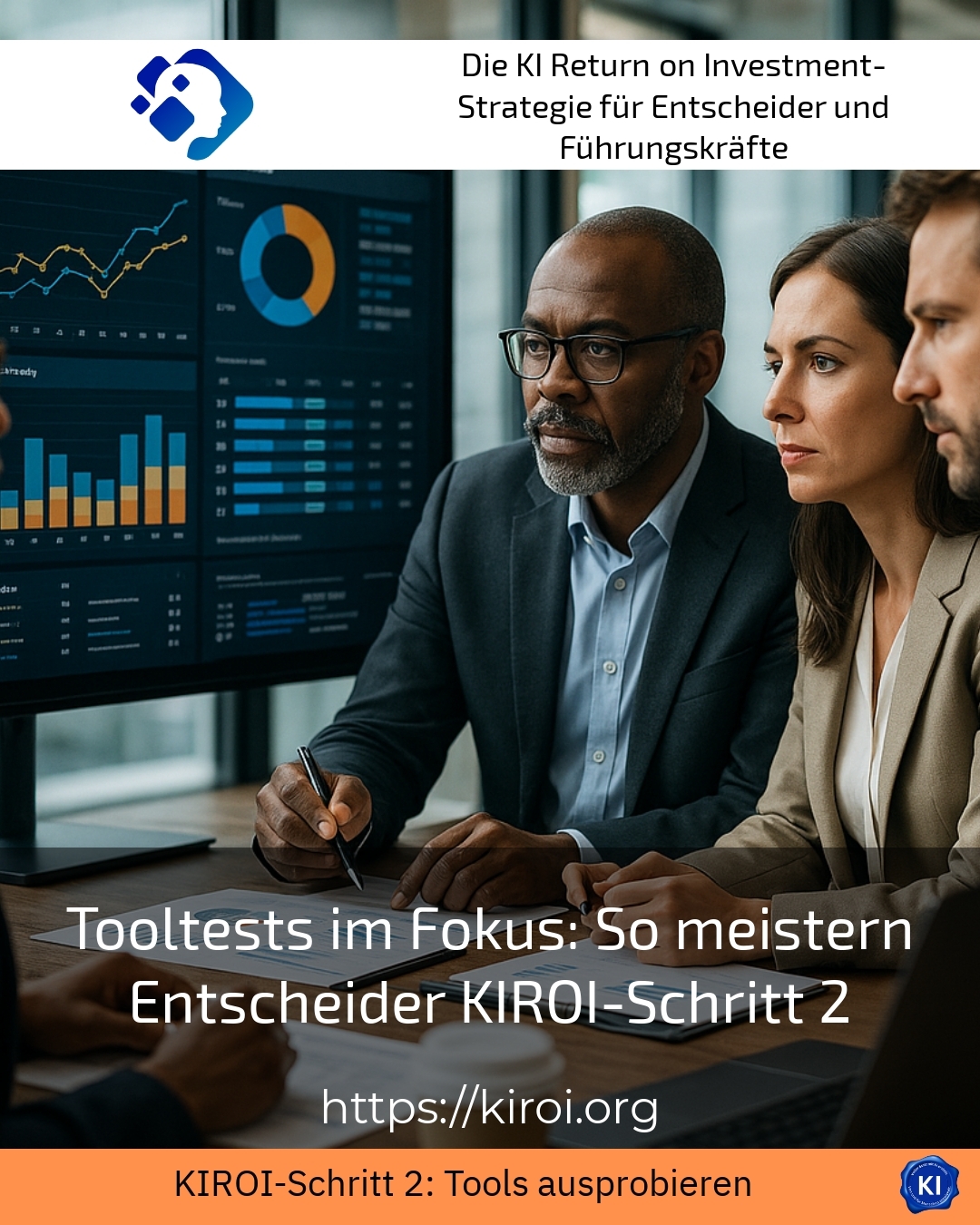
Tooltests in Focus: How Decision-Makers Master AIROI Step 2
Selecting suitable digital solutions presents many companies with challenges. Tool tests are becoming increasingly important as they offer decision-makers a structured way to evaluate software tools. Tool tests are particularly supportive in step 2 of our AIROI methodology (AI ROI), assisting with a targeted assessment of functionalities and benefits. This ensures selection is accurate – and with measurable success.
Efficiency increase through systematic tool testing
Decision-makers often report that the multitude of providers and features can make the software selection process considerably more difficult. This is where tool tests come into play, which not only make comparing tools clear but also provide practical insights into their performance. Consequently, companies in sectors such as financial services, e-commerce, and manufacturing are increasingly relying on transparent tool testing methods.
An example from the financial sector illustrates how tool tests help when integrating accounting software. Interfaces, user experience, and automation potential are thus thoroughly examined. In e-commerce, a tool test provides important indicators for CRM solutions to optimally manage customer relationships. Manufacturing companies, in particular, benefit from tool tests by testing production planning tools for their everyday efficiency.
BEST PRACTICE with one customer (name hidden due to NDA contract)
In the industrial sector, transruption coaching supported a company in selecting a project management tool. We analysed several candidates based on defined criteria such as user-friendliness and adaptability. The result led to a significant increase in employee acceptance and improved processes in project coordination.
AIROI Step 2: Support and insights for successful tool testing
AIROI Step 2 challenges decision-makers to go beyond a superficial assessment of a product's benefits and to examine its precise fit for individual project requirements. Transruption coaching offers a structured support process that assists clients with tool testing and provides valuable insights for selection. Practical guidance reduces uncertainty and leads to more informed decisions.
In the healthcare sector, for example, tool tests facilitate the selection of electronic health records by testing user-friendliness alongside data protection. In the education sector, tool tests help in selecting learning platforms that support different didactic approaches. In the services sector, well-founded tool tests ensure better coordination of CRM and automation tools.
BEST PRACTICE with one customer (name hidden due to NDA contract)
A medium-sized consulting firm used transruption coaching to conduct a tool test for new customer management software. The structured process enabled a detailed evaluation of various tools and an assessment of their adaptability to specific requirements. This helped to avoid later implementation problems and significantly increase staff acceptance.
Practical tips for successful tool testing
To effectively implement tool tests, several points should be considered. Firstly, clear criteria should be defined that are aligned with one's own needs and objectives. Secondly, it is important to simulate practical scenarios to experience the tools in everyday use. Thirdly, an interdisciplinary team that brings different perspectives and knowledge is recommended.
Companies in the logistics sector report that they have significantly optimised their software usage through this approach. Creative agencies, in turn, use mock-ups and prototypes to make tool tests vivid and clear. Service providers focus on integration capability to keep existing systems compatible.
BEST PRACTICE with one customer (name hidden due to NDA contract)
A major retailer used tool tests to select a new merchandise management system. This involved simulating key process steps in daily operations and running through several scenarios. This helped to precisely identify the strengths and limitations of the candidates and to focus the choice on a particularly flexible system.
My analysis
Tool tests have become indispensable in the context of digital transformation. They help decision-makers evaluate software solutions not only from a technical perspective but also in a practical way. Structured tool tests, especially in AIROI Step 2, provide a reliable basis for well-founded decisions. Guidance from experienced coaches can further stabilise the process and provide valuable impetus. Those who systematically use tool tests increase their chances of selecting perfectly fitting and sustainable digital tools for their company.
Further links from the text above:
[1] Tool Tests for Decision-Makers: AIROI Step 2 - SAULDIE
For more information and if you have any questions, please contact Contact us or read more blog posts on the topic Artificial intelligence here.











 Deutsch
  English (UK)