
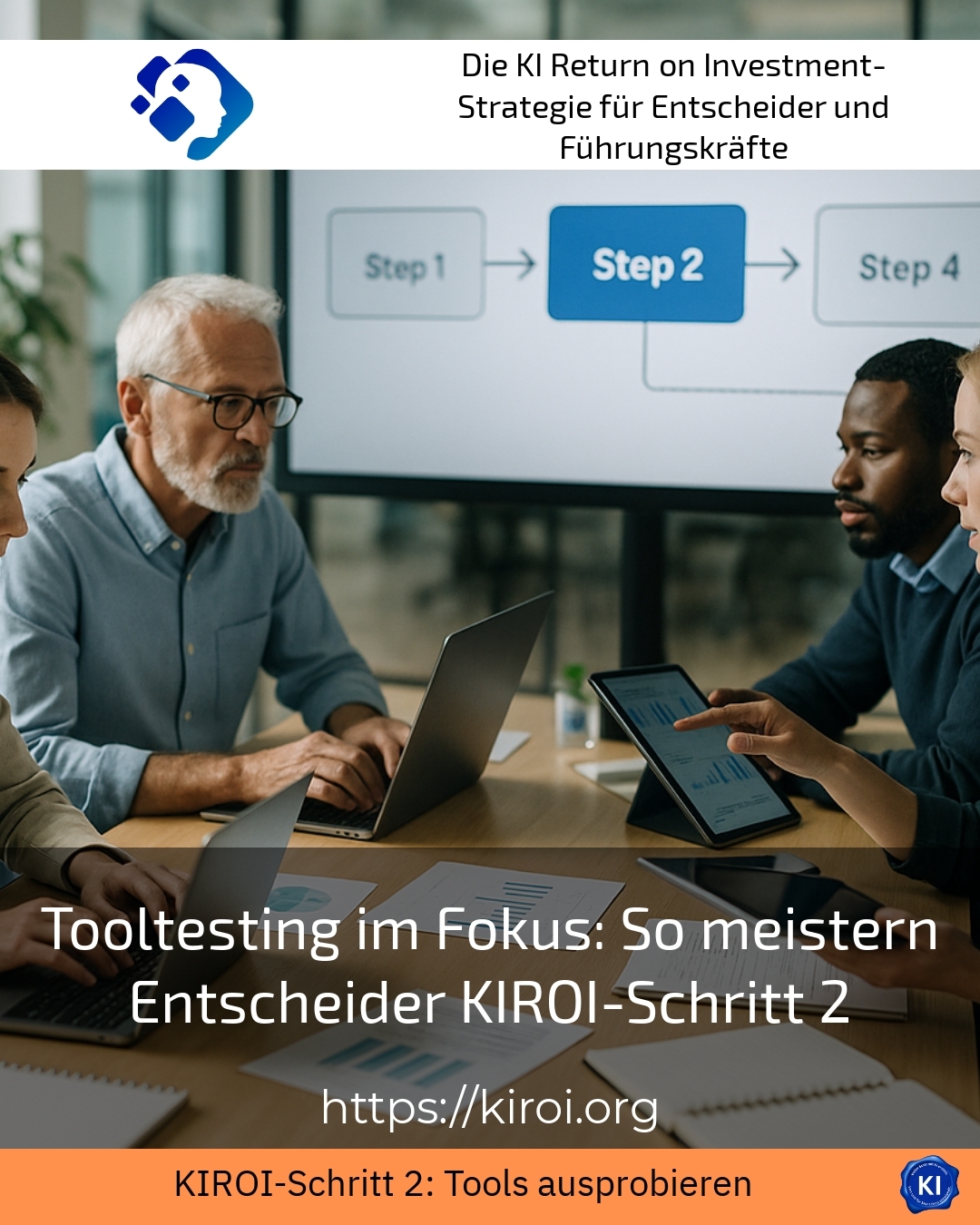
The term tool testing is gaining increasing importance for decision-makers who want to make informed choices in the context of complex digitisation projects. Tool testing is centrally anchored in the second step of the proven AIROI framework. It supports managers in selecting, from a multitude of digital tools, those that best meet the individual requirements of their company.
Tool Testing – the cornerstone of AIROI Step 2
In the second step of the AIROI process, the focus is on trying out and evaluating various software solutions. This highlights how crucial a structured approach to tool testing is for reducing uncertainty and selecting optimal tools. Numerous companies report that a systematic testing phase uncovers weaknesses early on that could otherwise cause significant expense later.
For example, a medium-sized logistics provider is analysing how AI-based planning tools perform in terms of data connectivity and flexibility. The insights gained help to communicate the introduction more effectively and to motivate the team to use it actively. In parallel, a sales department is experiencing how a tool improves cross-departmental communication, which significantly promotes collaboration.
Another practical example comes from the production environment: sensor data was analysed there with intelligent analysis tools. The solution was particularly convincing because, in addition to pure data analysis, it also provided concrete recommendations for action for the shop floor. This shows how versatile tool testing is used to identify tailor-made systems that are convincing both technically and organisationally.
Key criteria for successful tool testing
Decision-makers should view tool testing as a dynamic learning process that encompasses far more than simple functionality checks. Key aspects include:
- Usability testing to ensure high adoption
- Assessment of compatibility with existing IT structures
- Flexibility and adaptability to changing requirements
- Integration into existing workflows and processes
- Cost transparency and scalability of solutions
Companies from marketing were able to improve their campaign management and uncover gaps in their strategy through targeted tool testing. Likewise, a technical service provider supported its digital alignment by testing and successfully integrating a competitor analysis software.
Methodological support as the key to success
Experience shows that tool testing should not be considered in isolation. Transruption coaching is a valuable addition here because it provides impulses for decision-makers and supports them in making the process transparent and open. This way, they avoid bad decisions and can better prepare the team for new digital tools.
In an example from the analytics industry, various AI tools were tested, with user feedback systematically gathered. The team collected insights on time savings and intuitive usability. The structured documentation enabled a comprehensible recommendation to management – a key success factor in tool testing projects.
Customer communication also showed: The choice of the right tool depends not only on automated functions but also on the ability to deliver personalised and timely responses. The testing phase can evaluate and optimise these aspects in a practical way.
Holistic decision-making process for tool testing
Tool testing supports decision-makers in considering not only technical but also cultural and organisational factors. The involvement of all stakeholders – IT, business departments, users, and management – is essential for acceptance and sustainable success. A transparent process and comprehensive documentation create a reliable basis for investment decisions.
The principle here is that tool testing is not a finished project, but a continuous optimisation process. Companies often report that the effectiveness of deployed tools increases with regular use and adjustments. In this way, digital transformation is experienced as a valuable companion rather than an obstacle.
Practical tips for getting started with tool testing
- Define clear objectives and specific use cases before beginning testing
- Involve all relevant departments early on to determine realistic requirements
- Allow sufficient time for pilot phases and feedback rounds
- Use external support to test impartially and professionalise the process
- Document each step carefully to make informed decisions.
This approach is valued by companies across a wide range of sectors – whether in logistics, customer service, or production. The diversity of application areas proves how important it is to take tool testing seriously and to tackle it in a structured way.
My analysis
Tool testing in the AIROI Step 2 is a key success factor for selecting suitable digital tools. It brings clarity to the market of diverse solutions and supports decision-makers in making targeted and low-risk investments. Practical examples show that systematic testing can unlock not only technical but also organisational potential. The addition of transruption coaching provides additional security and supports the change process at all levels. This enables the effective integration and sustainable use of digital tools.
Further links from the text above:
Tool test: How decision-makers master AI tools in AIROI Step 2
AIROI Step 2: How to succeed with the decision-maker tool test
How to KI-Test for Dummies
Tool test for decision-makers: successfully mastering AIROI step 2
AIROI Step 2: Unleash AI Potential with the Tool Test
For more information and if you have any questions, please contact Contact us or read more blog posts on the topic Artificial intelligence here.









 Deutsch
  English (UK)