
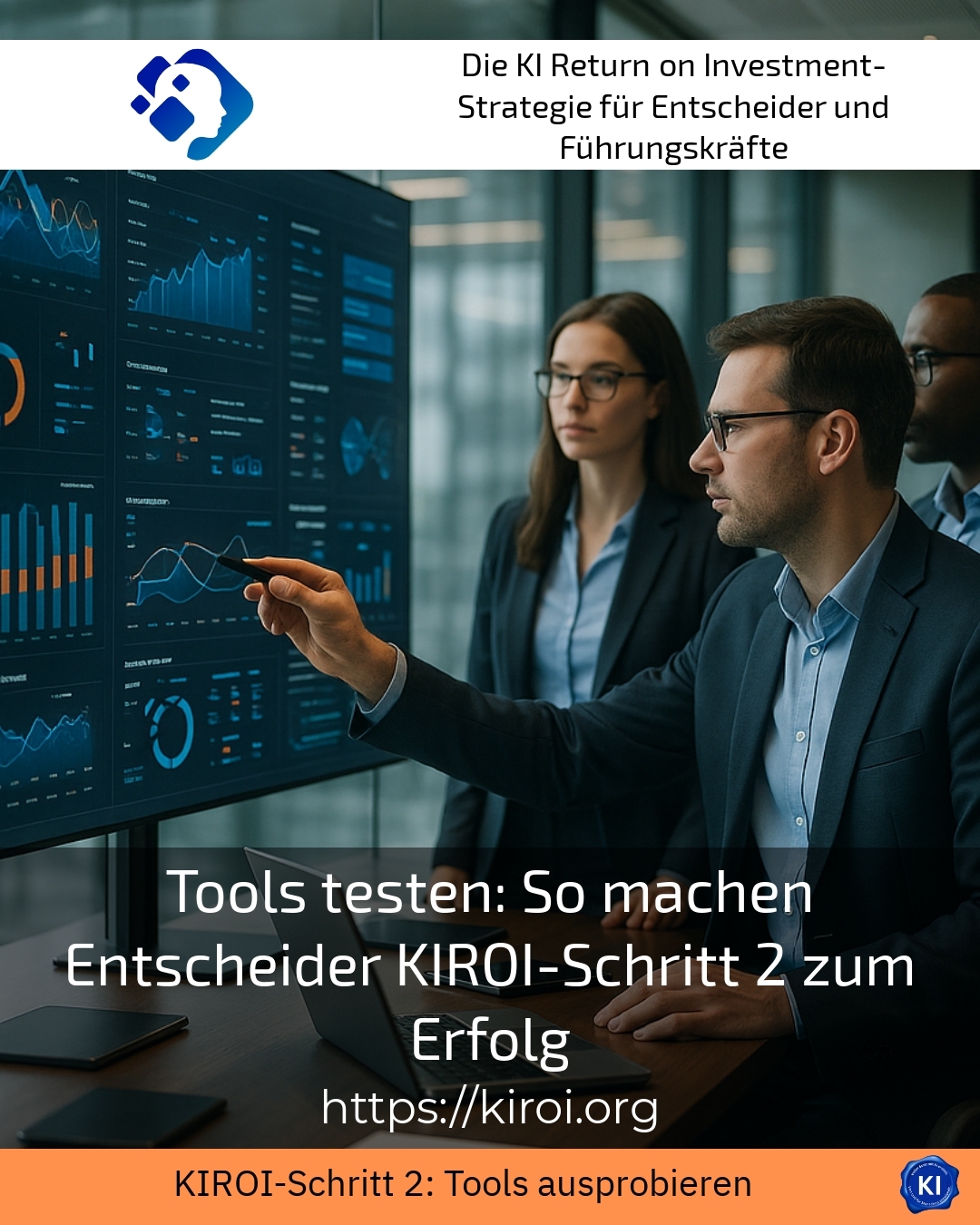
The process of testing tools is a central challenge for many decision-makers when it comes to identifying the right AI tools and using them profitably within step 2 of the AIROI process. Only by systematically testing tools can their added value within the company be realistically assessed and successfully implemented. In this article, you will learn how decision-makers can effectively test tools to gain a real advantage during the project.
Testing tools – the core of successful decisions
Many managers face the task of choosing from a variety of digital solutions those that are best suited to the specific problem. There is a wide range of AI applications in particular – from chatbots and automated data analysis to intelligent assistance systems. To make an informed decision here, careful tool testing is essential.
Clients often report that they initially have difficulty efficiently evaluating the functionalities that are relevant to them. In practice, it is advisable to compare tools not only in terms of features, but also to use them in realistic scenarios. Only in this way can it be determined how they perform in everyday use and what adjustments are necessary.
An example from the customer service sector shows that proven AI chatbots often respond to standard queries more quickly and consistently than conventional solutions. Decision-makers can use these findings to specifically support and control the implementation, thereby minimising operational friction.
How decision-makers test tools in the AIROI Step 2
The second step of the AIROI framework is dedicated precisely to this phase: trying out different AI solutions in order to make a well-informed decision afterwards. Decision-makers particularly benefit from a systematic approach that is methodically guided and practical.
For example, some companies use structured test phases where the following aspects are checked:
- How intuitive is the tool to use?
- What efficiency improvements are noticeable in the processes?
- How flexibly does the system react to changing requirements?
Another important criterion is the integration of the tool into existing IT infrastructures. Here, clients repeatedly experienced that supposedly powerful tools could hardly be used due to a lack of compatibility.
Insights from the sales industry also show that tools, which enable seamless communication between different departments, generally find greater acceptance within the team. Decision-makers can thus better support and promote key processes.
BEST PRACTICE with one customer (name hidden due to NDA contract) In a medium-sized company in the logistics sector, an AI-based planning tool was tested, which calculated multiple scenarios for route optimisation. The iterative testing process helped to identify and resolve weaknesses in the data connection. The support provided by transruptions coaching gave the team impulses on how to better communicate the introduction internally to increase acceptance and usage.
Practical tips for successful tool testing
To make the testing process efficient, the following measures are recommended:
- Define specific use cases the tool is intended to fulfil. For example: Automated document creation in legal advice or analysis of customer data in marketing.
- Use pilot projects with clear success criteria. Set realistic timeframes for the test so that results become visible quickly and decisions are not unnecessarily delayed.
- Integrate interdisciplinary teams to include diverse perspectives. This will improve the quality of the assessment and foster buy-in from the outset.
For example, in advising a manufacturer of industrial equipment, the use of AI-powered fault diagnosis in the service process measurably reduced processing time. Decision-makers tested various solutions in parallel before selecting the tool that also performed stably under real-world loads.
Retailers also benefit from intelligent inventory analysis tools, which are continuously adapted based on user feedback. Testing on a relatively small scale allows for rapid responses to challenges and gradual product improvement.
Tool testing as an integral part of the AIROI strategy
In the AIROI process, tool testing is not an isolated step but an integral part of a phased, structured approach. It links needs analysis with practical testing, thus forming the basis for sustainable implementation of AI technologies.
Being accompanied by experienced coaches helps to avoid pitfalls and keep the focus squarely on entrepreneurial goals. Many clients report that this support was crucial for their later success, particularly in the second AIROI step.
This is how testing tools can become a driver for innovation processes within a company – whether in marketing automation, customer service, or operational optimisation.
BEST PRACTICE with one customer (name hidden due to NDA contract) A service company, in collaboration with AIROI Coaches, conducted a structured tool test for AI-powered text creation. The iterative testing phase quickly revealed which solutions were well-aligned with specific requirements. This enabled gradual integration without disrupting ongoing operations and noticeably increased team acceptance.
My analysis
Careful testing of tools is an essential part for decision-makers to derive maximum benefit from AI applications in AIROI Step 2. Through practice-oriented tests, teams learn not only about the technical possibilities but also about the operational requirements. The entire process thus becomes more transparent and focused. The combination of clearly defined use cases, an iterative approach, and professional support offers a stable basis for successfully integrating new technologies into the company. This allows decision-makers to systematically reduce uncertainty and harness the full potential of the tools.
Further links from the text above:
Tooltest: How decision-makers master AI tools in AIROI Step 2 [2]
Tool Testing in AIROI Step 2: How to Successfully Implement AI [11]
AI as an opportunity in times of skills shortage [4]
Introduction to Artificial Intelligence according to the requirements of the EU AI Act [6]
For more information and if you have any questions, please contact Contact us or read more blog posts on the topic Artificial intelligence here.










 Deutsch
  English (UK)