
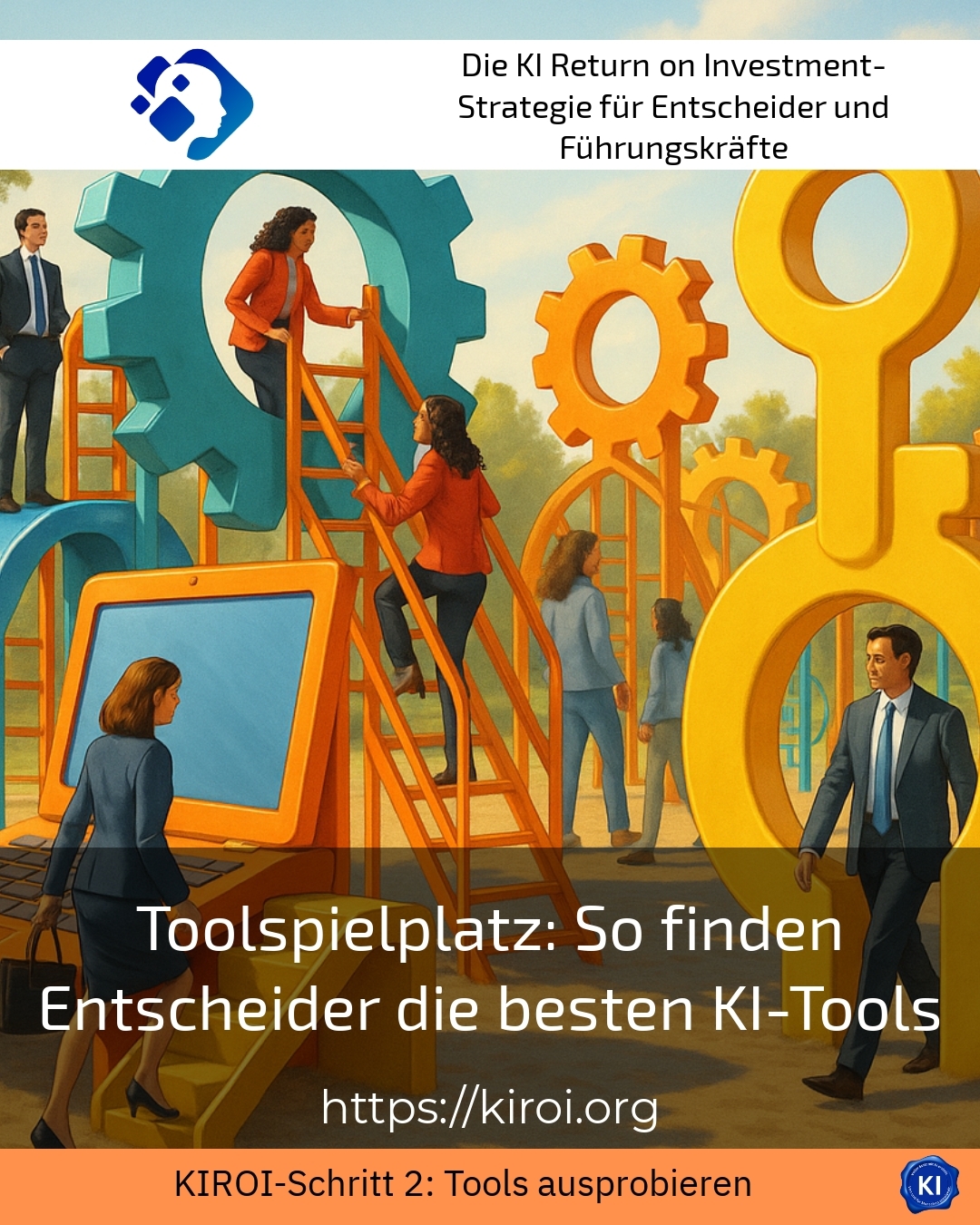
Imagine you're standing in front of a vast playground filled with gleaming equipment, yet only a few pieces truly suit your needs. That's how many leaders feel today, faced with an overwhelming array of intelligent software solutions. The Tool playground The use of digital tools is growing daily. New applications promise increased efficiency, cost reductions, and revolutionary ways of working. But which of these promises stand up to critical scrutiny? And how do smart decision-makers navigate this jungle of possibilities? These questions are of intense interest to boards of directors, managing directors, and IT managers alike. The answers often determine the long-term success of a company.
The Sandbox of Tools as Strategic Terrain for Modern Leaders
Digital transformation has brought forth a plethora of tools. Decision-makers often report feeling overwhelmed by the selection process. They come to consultations with specific challenges. Some are looking for automation solutions for recurring processes. Others require support in analysing large volumes of text data. Yet others aim to optimise and personalise customer interactions. The breadth of requests reflects the diversity of the market.
For example, a medium-sized manufacturing company was looking for quality control tools. The previous manual inspection methods were time-consuming and prone to errors. A logistics service provider, on the other hand, needed solutions for route optimisation. Its drivers were spending too much time in traffic jams. A financial services provider, in turn, wanted to improve fraud detection. The existing systems detected suspicious patterns too late. These three examples clearly show the different starting points. They also illustrate why a blanket recommendation is impossible.
The Transruptions Coaching It comprehensively supports companies in such projects. It provides impetus for strategic direction. It supports the evaluation of various options. It accompanies implementation and subsequent optimisation. The individual company situation is always at the centre.
Best practice with a KIROI customer
A globally operating trading company faced a complex challenge, as the purchasing department was already using seven different digital tools concurrently, leading to significant inefficiencies and data silos. Management recognised the need for consolidation but didn't know how to proceed systematically. As part of the KIROI support process, we first analysed all existing applications based on defined criteria such as ease of use, integration capability, and actual added value for business processes. It emerged that three of the seven tools offered redundant functions and two others were hardly used actively anymore. Employees reported frustration and wasted time due to constantly switching between interfaces. Together, we developed a consolidation strategy that was implemented step by step, always taking staff acceptance into account. After six months, the department was working with only three carefully selected solutions, which noticeably increased productivity and significantly improved team satisfaction.
Systematic Evaluation on the Tool Playground of Possibilities
A structured approach differentiates successful from failed implementations. Decision-makers should first define their specific requirements. Which processes are to be supported? Which outcomes are being sought? What resources are available? These questions form the foundation of any evaluation.
An insurance company defined its main objective as accelerating claims processing. Case workers spent a lot of time analysing documents. A suitable application was intended to automatically extract relevant information. Time savings were estimated at thirty percent. A pharmaceutical company, on the other hand, sought support with literature research. Scientists had to review and evaluate hundreds of studies. Here, a solution was meant to take over the preliminary selection of relevant publications. A media company, in turn, needed help with content creation. Editors were to be relieved, not replaced.
The Tool playground offers multiple options for each of these requirements [1]. The art lies in making the right choice. This doesn't just involve functional aspects. Factors such as data protection, integration capability, and cost must also be taken into account. Transruptions coaching supports this multi-faceted evaluation. It accompanies the entire selection process with a methodologically sound approach.
Criteria for successful navigation on the tool playground
The evaluation should consider multiple dimensions simultaneously. Technical aspects form only part of the overall picture. Organisational and cultural factors are equally important. A tool can be technically brilliant. If employees do not adopt it, the benefit will not materialise.
A management consultancy evaluated various analysis platforms for internal purposes. The technical performance was comparable across all candidates. The decisive factor was ultimately the intuitive user interface of one solution [2]. A mechanical engineering company tested predictive maintenance tools. Here, seamless integration into existing systems was convincing. A retailer examined chatbot solutions for customer service. The ability to process German dialects became the crucial criterion.
These examples show that individual factors often outweigh others. Standardised assessments are rarely sufficient. Decision-makers should therefore conduct their own pilot projects. They should seek feedback from future users. They should test realistic scenarios. Only then can a complete picture be formed.
Best practice with a KIROI customer
A medium-sized automotive supplier wanted to speed up their offer creation process, as complex customer inquiries often required several days of processing time, leading to missed business opportunities. Management requested support in identifying suitable solutions, whereby in the KIROI process, we first analysed the existing workflow in detail and identified bottlenecks. It became apparent that not the actual calculation, but the collection of information from various sources, accounted for the majority of the time. We therefore recommended not an all-encompassing system, but a specialised solution for automatic document analysis and information extraction, which could be seamlessly integrated into the existing calculation software. The selection process included structured test runs with real past inquiries, whereby three employees of different experience levels evaluated the candidate solutions in parallel. The chosen application reduced the preparation time by more than half, which significantly improved the reaction speed to customer inquiries and ultimately led to a measurable increase in the order rate, without the quality of the offers suffering.
Implementation and sustainable integration of digital tools
The selection is just the first step. The real challenge lies in successful implementation. Many promising projects fail at this stage. Technical problems are rarely the main cause. Clients more often report human and organisational resistance.
A telecommunications company introduced an automated customer communication solution. The technical installation went smoothly and quickly. However, the call centre staff felt threatened. They subtly but effectively boycotted the system. A utility company implemented a power consumption forecasting tool. The prediction quality far exceeded all expectations. However, the responsible planners ignored the recommendations. They trusted their own estimates more. A construction company opted for digital project assistance. The younger employees enthusiastically embraced the system. However, the experienced site managers consistently refused to use it.
These scenarios highlight the importance of change management. Technology alone does not create transformation. People must be brought along and convinced. Transruption coaching therefore places great importance on this aspect. It doesn't just support the technical side; it also provides impetus for cultural transformation.
Success factors for the permanent embedding of new applications
Sustainable integration requires continuous attention and resources. The introduction phase is often characterised by high energy. After that, everyday life threatens to displace the new practices. Decision-makers should therefore establish long-term support structures.
An auditing firm appointed dedicated points of contact per department. These so-called champions actively and continuously promoted usage [3]. A food manufacturer integrated regular exchange formats into the work rhythm. Employees shared best practices and solved problems together. A technology group linked usage goals with the bonus system. This created financial incentives for consistent application.
The Tool playground is also constantly evolving. New versions are regularly released in quick succession. Functionalities are expanded or fundamentally changed. Decision-makers must therefore continuously stay on the ball. They should budget for training and allow for learning time.
Best practice with a KIROI customer
A family-run company in mechanical and plant engineering, with around five hundred employees, sought support in systematically developing new digital opportunities, with management emphasising that previous digitalisation initiatives had often failed to come to fruition. Within the KIROI support process, we identified the main cause to be a lack of clear responsibility structures, as projects were started but not consistently seen through to completion. We recommended setting up a small but effective innovation unit with direct access to management, which was to act as an internal centre of expertise and coordinate all digital initiatives. This unit was given a defined budget and clear decision-making authority, which significantly increased its capacity to act. Within one year, three successfully implemented applications were put into production, each addressing specific problems in manufacturing, sales, and human resources. The success was largely due to the systematic approach, which took equal account of both technical aspects and human factors, and incorporated regular reflection cycles in order to learn from experience and continuously improve processes.
My KIROI Analysis
The experiences from numerous accompanying projects clearly highlight recurring patterns. Successful decision-makers are characterised by a combination of openness and critical distance, which enables them to recognise new opportunities without blindly following every trend. They invest sufficient time in the definition phase and resist the pressure to start implementing immediately before the requirements are truly clear.
The Tool playground The use of digital tools will continue to grow. The speed of development is increasing rather than decreasing. Decision-makers must therefore build systematic evaluation skills. They should create internal structures that enable and promote continuous learning. They should selectively involve external expertise where internal know-how is lacking or insufficient.
The KIROI methodology offers a tried-and-tested framework for this. It combines a strategic perspective with operational implementation focus. It takes into account both technical and human factors equally. It relies on sustainable integration rather than short-term effects. Companies that follow this approach often report better results. They avoid costly bad decisions. They build valuable long-term competencies. They position themselves well for future developments.
The most important takeaway, therefore, is that it's not about owning the latest or most powerful tool, but rather about finding the right solutions for your specific challenges and successfully implementing them. This perfect fit can only be achieved through careful analysis, structured evaluation, and professional guidance during the implementation process. Transruption-coaching supports companies on this journey with experience, methodology, and collaborative partnership.
Further links from the text above:
[1] Gartner – IT Research and Insight
[2] McKinsey Digital – Insights into Digital Transformation
[3] Harvard Business Review – Change Management Strategies
For more information and if you have any questions, please contact Contact us or read more blog posts on the topic Artificial intelligence here.











 Deutsch
  English (UK)