
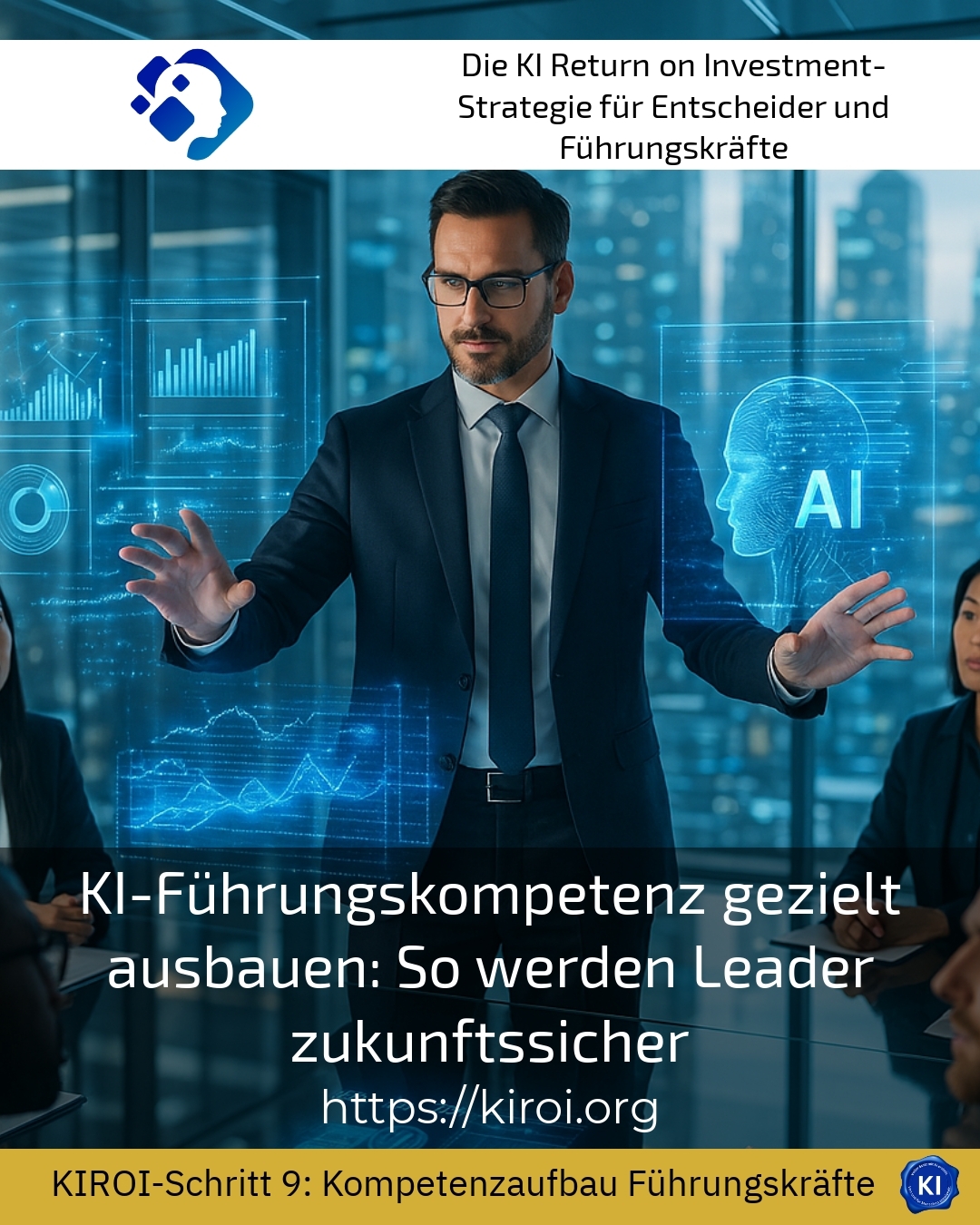
In a world changing at breathtaking speed, leaders stand at a crucial crossroads that will shape their entire professional futures. The ability to understand and strategically deploy intelligent systems is rapidly becoming the most important differentiator between successful and stagnating companies. Developing AI leadership skills in a targeted way fundamentally means much more than learning technical basics – it is about a fundamental transformation of one's own understanding of leadership, which requires courage, openness, and continuous learning. Managers often report feeling uncertain and like they are falling behind. This is precisely where professional support comes in, providing impetus and enabling sustainable development.
Why traditional leadership models are reaching their limits
The classic management approaches, which were considered the gold standard for decades, are increasingly reaching their natural limits in a digitised global economy. Executives who rely exclusively on tried-and-tested methods find themselves more and more often in situations where their accumulated experience no longer yields the desired results. A medium-sized mechanical engineering entrepreneur recently reported his realisation that his years of successful intuition had suddenly failed because market dynamics had fundamentally changed.
The automotive industry provides a particularly striking example of this, as it is in the midst of a profound transformation process. Traditional suppliers must rethink their entire value chain and build new competencies [1]. For example, a supplier of combustion engine components faces the challenge of qualifying its workforce for entirely new production processes. Management must not only make technological decisions but also overcome emotional resistance within the team.
These tensions are also clearly evident in the healthcare sector, and with increasing intensity. Hospital managements face the task of introducing diagnostic support systems, while at the same time they must take the concerns of their medical staff seriously. The nursing management of a large hospital described their experience that the introduction of documentation aids initially met with considerable resistance. It was only through a participatory leadership approach that they managed to gradually increase acceptance and make the benefits visible.
The retail sector is also undergoing a fundamental transformation that requires new leadership skills. Branch managers today need to understand how recommendation systems work and why personalised customer approaches are becoming the standard. A textile retailer reported that their managers initially struggled to accept data-driven decisions. Years of sales experience suddenly seemed to be worth less than algorithmic predictions.
Developing AI leadership competency in a targeted way through structured development programmes
Developing future-proof leadership skills requires a systematic approach that goes far beyond sporadic training. Successful companies invest in long-term development programmes that combine theoretical knowledge with practical application. Experienced coaches play a central role in this, as they support the transfer process into everyday work.
Transruption coaching has established itself as valuable support for leadership development projects. It helps decision-makers find their own position within technological change. The methodology relies on individual development paths that consider both cognitive and emotional aspects. Clients often report that it was only through this intensive engagement that they became aware of their own blockages.
Best practice with a AIROI customer
A medium-sized logistics company with around three hundred employees faced the challenge of preparing its leadership team for digital transformation. The management had recognised that intelligent route optimisation and automated warehouse management could only be successfully implemented if the leaders understood and actively drove these systems. As part of a six-month development programme, department heads worked on their individual competency gaps and jointly developed a vision for the company's future. The combination of group sessions and individual coaching proved particularly valuable, as it fostered both peer exchange and personal reflection. The leaders not only learned how the new systems worked but also how to guide their teams through change processes. Upon completion of the programme, the participants reported significantly increased confidence in dealing with technological decisions. Management turnover noticeably decreased, and employee satisfaction in the affected departments measurably increased. The company was able to implement its transformation projects significantly faster than originally planned.
Similar patterns are emerging in the financial sector, requiring structured competence development [2]. Banks and insurance companies are increasingly implementing automated analysis tools for risk assessments and customer advice. Managers need to understand how these systems generate decision proposals and where their limitations lie. A department head in credit business reported that it was only through intensive further training that she was able to understand the logic behind the scoring models.
The energy sector is also undergoing profound change, requiring new leadership skills. Grid operators are increasingly focusing on predictive maintenance systems and intelligent load management. Managers in these companies must combine technical understanding with strategic thinking. A divisional manager from a municipal utility described his initial scepticism towards automated decision-making systems and how this was resolved through practical experience.
The Role of Emotional Intelligence in Competence Building
Technical understanding alone is not enough to lead successfully in digital transformation. Emotional intelligence is becoming the decisive success factor because leaders must guide their teams through uncertainties. The ability to take fears seriously while providing direction distinguishes outstanding leaders from average managers.
In the pharmaceutical industry, this dimension becomes particularly apparent [3]. Lab directors face the challenge of recruiting highly qualified scientists for the use of assistance systems. Researchers often fear that their expertise will be devalued or that their jobs will be jeopardised. Successful leaders in this environment are distinguished by their ability not to dismiss these concerns, but to actively address them.
Emotional competencies also play a central role in transformation within the media industry. Editorial leadership must explain to their teams why automated text generation can be a relief rather than a threat. One editor-in-chief reported from her experience that open communication and employee involvement made the difference. Acceptance of new tools increased significantly when the editors were involved in shaping them themselves.
Practical Steps for Targeted Development of AI Leadership Competence
The path to a future-proof leader begins with an honest self-assessment of one's strengths and areas for development. Many managers overestimate their technological understanding or underestimate the speed of change. A structured assessment of one's current position is therefore the starting point for any successful development process.
In the construction industry, concrete application areas are emerging that have immediate relevance for action. Site management can significantly increase its efficiency through digital planning tools and automated progress monitoring. A construction manager in building construction reported that he initially had reservations about BIM-supported systems. Through targeted further training and practical trials, his scepticism turned into enthusiasm.
The food industry offers further clear examples of practical competence development. Production managers are increasingly relying on intelligent quality control and predictive maintenance. A dairy plant manager described how he gradually introduced his managers to the new systems. The combination of training and learning by doing proved particularly effective.
Best practice with a AIROI customer
A major hotel chain with an international presence decided on a comprehensive leadership development programme, specifically tailored to the challenges of the hospitality industry. The directors of individual hotels were to learn how guest preference systems, automated pricing, and intelligent resource planning work, and how they can strategically utilise these tools. The programme spanned nine months, combining online modules with in-person workshops at various hotels within the group. The exchange between leaders from different locations was particularly valuable, as they could learn from each other and share best practices. The hotel managers developed a deep understanding of how data-driven decisions can improve guest satisfaction without neglecting personal service. A key element of the programme was the development of individual action plans, which accompanied each participant in their implementation at their own hotel. The results spoke for themselves, as participating hotels saw a significant improvement in their ratings on relevant platforms. At the same time, staff retention increased because the teams felt better led and supported.
Embedding continuous learning as a leadership principle
A one-off qualification is no longer sufficient in a constantly changing technological landscape. Leaders must embrace and exemplify continuous learning as an integral part of their role. This attitude permeates the entire organisation, creating a culture of permanent development.
This necessity is particularly evident and urgent in the telecommunications industry. Technology cycles are becoming ever shorter, and new applications are emerging at a rapid pace. The managing director of a medium-sized IT service provider reported that he blocks out time weekly for personal development. This investment in his own development enables him to make well-informed strategic decisions.
This approach is also gaining importance in the public sector and is changing traditional administrative structures. Heads of departments face the task of modernising their organisations and making them more citizen-friendly [4]. A departmental head from a large municipality described his experience with the introduction of chatbots for citizen enquiries. The initial scepticism of his employees gave way to a positive attitude as the relief in their daily work became noticeable.
The importance of networks and peer exchange
No one needs to embark on the path of digital transformation alone, as exchanging ideas with like-minded individuals significantly accelerates the learning process. Leaders benefit from networking with peers from other companies and industries. Different perspectives enrich one's own thinking and open up new avenues for solutions.
Cross-industry learning communities and experience circles are increasingly emerging in the manufacturing sector. Managing directors of medium-sized companies regularly meet to share their experiences with digitalisation projects. The owner of a metalworking company reported that he gained valuable impulses for his own company through these contacts. An openness to external ideas proved to be key to success.
The tourism industry is showing similar developments that underscore the value of networks. Tour operators and hoteliers exchange experiences with booking systems and guest management. The owner of a boutique hotel reported on her participation in an industry network. The insights gained there helped her make informed investment decisions.
My AIROI Analysis
Developing leadership skills for the digital age presents one of the most significant challenges for organisations of all sectors and sizes. My observations from working with numerous companies clearly show that technical knowledge alone is not enough to successfully shape change. The combination of technical expertise with emotional intelligence, communication skills and strategic thinking makes the crucial difference.
Particularly noteworthy is the fact that many leaders initially underestimate or suppress their own development needs. Confronting one's own knowledge gaps requires both courage and humility. Successful leaders distinguish themselves by understanding this self-awareness not as a weakness, but as a starting point for growth.
The importance of structured development programmes cannot be overstated. Sporadic training sessions or simply reading articles are insufficient to bring about sustainable changes in leadership behaviour. Guidance from experienced coaches and exchange with peers create the necessary framework for genuine transformation. Developing AI leadership skills in a targeted way requires time, resources, and above all, the genuine commitment of those involved. Organisations that shy away from this investment risk their competitiveness in an increasingly digitalised economy.
Further links from the text above:
[1] Association of the Automotive Industry – Innovation and Technology
[2] BaFin – Financial Supervision and Digitisation
[3] Association of Research-Based Pharmaceutical Companies – Digitalisation
[4] Federal Ministry of the Interior – Modern Administration
For more information and if you have any questions, please contact Contact us or read more blog posts on the topic Artificial intelligence here.







 Deutsch
  English (UK)