
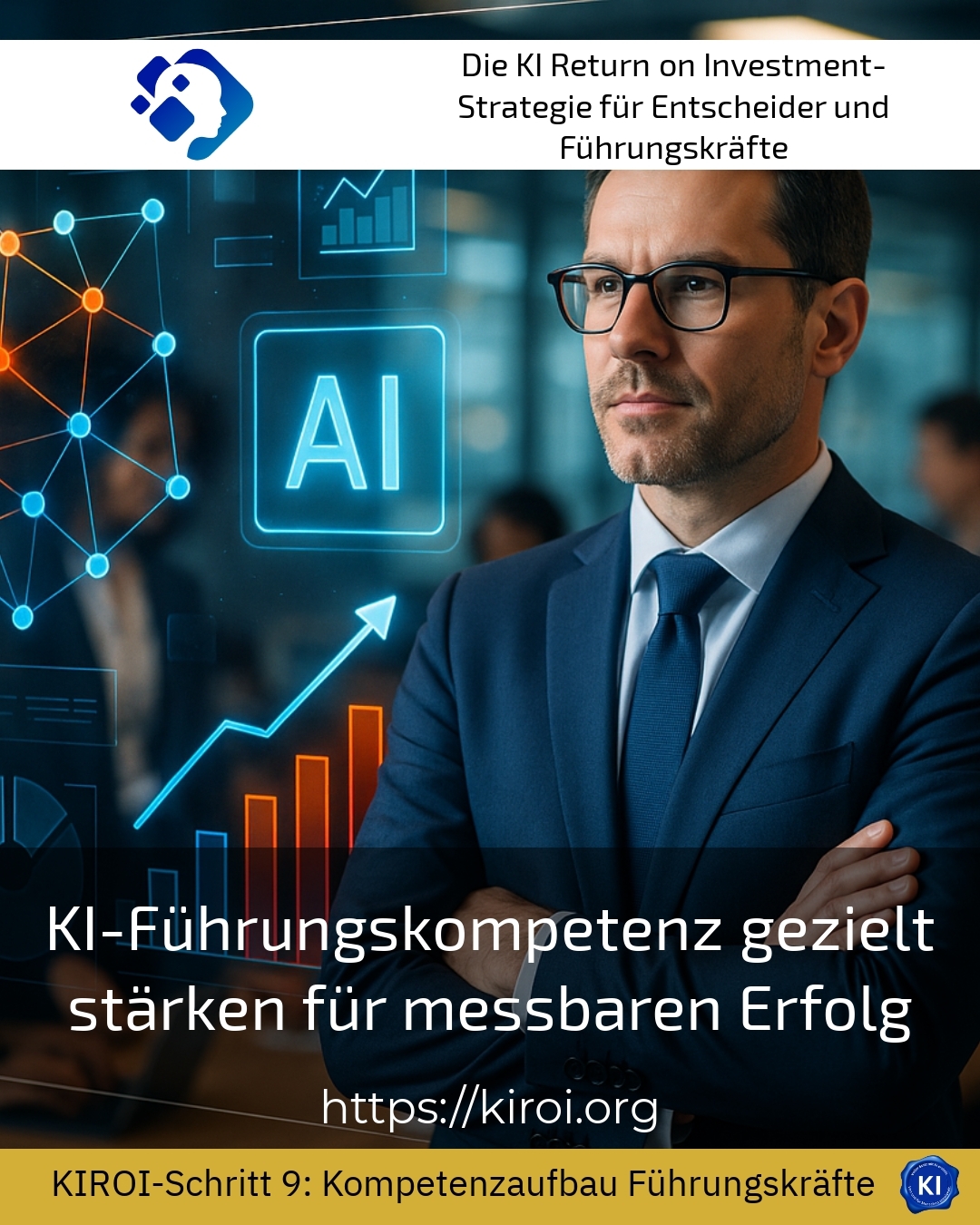
Digital transformation is fundamentally changing organisations, demanding entirely new competencies in corporate leadership. Leaders face the challenge of not only understanding intelligent systems but also deploying them strategically. Those who today Strengthening AI leadership skills deliberately wants to, must be prepared to shed old ways of thinking and embark on a continuous learning journey. This is no longer just about technical understanding, but about the ability to bring together humans and machines in a productive way. This development affects almost every industry and every hierarchical level, which is why a strategic approach seems essential.
The necessity of new leadership approaches in the digital era
Traditional leadership models are increasingly reaching their limits. The speed of technological change often overwhelms classic decision-making structures. Leaders report growing uncertainty in dealing with data-driven systems. At the same time, employees' expectations of modern work environments are continuously rising.
For example, in the financial sector, institutions use algorithmic trading systems that make decisions in milliseconds. Here, managers must understand when human intervention is sensible and when they can trust the system. In the healthcare sector, intelligent diagnostic systems support doctors in their findings. However, responsibility remains with humans, raising new ethical questions. In the logistics sector, self-learning algorithms optimise supply chains in real-time. Managers need to learn to critically question these recommendations while simultaneously harnessing their potential.
Transruption coaching accompanies leaders through precisely these complex challenges. It offers a structured framework for redefining one's own role in an increasingly automated world of work. The focus is on individual development, not just the transfer of knowledge.
Targeted strengthening of AI leadership skills through systematic development
Sustainable skills development requires a holistic approach. Technical understanding forms only the basis. Crucial is the ability to recognise strategic implications and derive courses of action from them. Furthermore, leaders need strong communication skills to guide their teams through change processes.
In retail, companies are experimenting with personalised shopping experiences based on customer data. Leaders must weigh up personalisation and data protection. In the automotive industry, vehicles are evolving into driving computers with complex software systems. This requires leaders to rethink product development and quality management. In the media sector, intelligent systems are already automatically generating simple news articles or sports reports. Editorial management faces the question of how to ensure journalistic quality in this environment.
Best practice with a AIROI customer
A medium-sized mechanical engineering company faced the challenge of preparing its management level for the integration of intelligent production systems. The management recognised early on that pure training would not be sufficient to manage the necessary transformation. Together with the transruptions coaching team, the company developed a personalised support programme for senior management. Over a period of six months, the managers worked on their personal digital maturity. They learned to make data-based decisions while simultaneously utilising their intuition as a valuable resource. The programme included regular reflection sessions in which the managers exchanged their experiences. The support provided for specific process automation projects proved to be particularly valuable. The managers reported significantly increased confidence in dealing with intelligent systems. After the completion of the programme, the company was able to successfully implement the planned automation initiative because the management level supported the changes and actively drove them forward.
Core competencies for leadership in the digital age
The development of AI leadership competence encompasses several dimensions. Firstly, a fundamental understanding of algorithmic decision-making is required. Leaders need to comprehend how systems arrive at recommendations. They should be able to identify where biases may occur in data or algorithms.
In the insurance industry, companies use intelligent systems for risk assessment and claims processing. Managers must ensure these systems are not discriminatory. In human resources, algorithms assist in the initial screening of applicants [1]. Here, the responsibility lies with managers to ensure fairness and diversity. In customer service, chatbots are increasingly replacing human interactions for standard enquiries. Managers decide at which points personal contact remains essential.
Measurable success through structured support
The effectiveness of leadership development can certainly be measured. The key is to use the right metrics and a long-term perspective. Clients often report noticeable improvements in their decision-making quality. Teams become more open to change when their leaders act as role models themselves.
In the banking sector, success can be measured by the speed at which new digital products are introduced. In the pharmaceutical industry, progress is demonstrated by the integration of data-driven research approaches [2]. In the energy sector, the successful implementation of intelligent grid controls serves as a benchmark for leadership competence.
Transruption coaching places particular emphasis on defining individual success criteria. Measurable goals are formulated together with the clients. Progress is regularly reflected upon and documented. This structured approach supports sustainable development.
Best practice with a AIROI customer
A senior executive from the telecommunications sector approached us with the aim of better preparing her department for data-driven ways of working. She herself felt uncertain about dealing with new technologies and feared being overtaken by younger colleagues. In the coaching process, her own attitude towards technological changes was first reflected upon. It became clear that deep-seated beliefs about her own learning ability were blocking development. Through targeted suggestions and practical exercises, the executive gained new self-confidence. She began to actively engage with the systems used in her department. After a few months, she herself took on the role of an internal ambassador for digital transformation. Her employees reported a significantly improved communication regarding technological topics. The department achieved its digitisation goals earlier than planned. The executive attributes this success to the continuous support and the opportunity for honest reflection.
Targeted strengthening of AI leadership skills in practice
Practical implementation requires courage and perseverance. Leaders should consciously take time for their own development. Exchanging ideas with others in similar situations can be very valuable. At the same time, protected spaces are needed for honest self-reflection.
In the education sector, higher education institutions are experimenting with adaptive learning systems that adjust to individual learning paces [3]. Leaders in this field must find a balance between technological innovation and fundamental pedagogical principles. In agriculture, intelligent systems enable more precise land management. Agricultural businesses require leaders who can combine traditional knowledge with data-driven approaches. In the tourism sector, algorithms personalise travel recommendations based on extensive user profiles. Leaders face the challenge of reconciling customer desires with data protection.
The role of corporate culture in skills development
Individual development alone is not enough. The company culture must enable experimentation and learning from mistakes. Leaders significantly shape this culture through their own behaviour. An open approach to their own uncertainty can serve as a role model.
In the chemical industry, companies are relying on intelligent systems to optimise production processes. The leadership culture must create room for critical questioning of automated recommendations. In the media industry, algorithmic content curation requires new editorial guidelines. Leaders must set clear ethical frameworks. In transport, autonomous systems are developing rapidly. Leaders need expertise in dealing with gradual automation.
Disruption coaching can also provide valuable impetus at an organisational level. Supporting leadership teams fosters a common language and shared visions. This creates cultures that value innovation and human values equally.
My AIROI Analysis
Engaging with intelligent systems is becoming an unavoidable task for executives. Those who ignore this development risk being left behind. At the same time, actively shaping this transformation offers enormous opportunities for personal growth and organisational success. My experience in supporting executives shows that the key lies in a combination of technical understanding and personal maturity. Executives who are willing to question their own assumptions often develop the fastest. They become catalysts for change within their organisations. The AIROI framework offers a structured approach to specifically strengthen AI leadership competence and achieve measurable results. It combines strategic analysis with practical implementation support. The combination of individual reflection and an organisational perspective proves to be particularly effective. Executives not only develop new skills, but also a changed self-understanding. They increasingly see themselves as learners in a changing world. This attitude is transferred to their teams and shapes the company culture sustainably. The path requires patience and perseverance, but the results speak for themselves. Organisations with competent executives navigate the digital transformation more successfully and humanely.
Further links from the text above:
[1] McKinsey – AI in Hiring: Trends, Insights and Predictions
[2] PwC – Artificial Intelligence in the Pharmaceutical Industry
[3] UNESCO – Artificial Intelligence in Education
For more information and if you have any questions, please contact Contact us or read more blog posts on the topic Artificial intelligence here.








 Deutsch
  English (UK)