
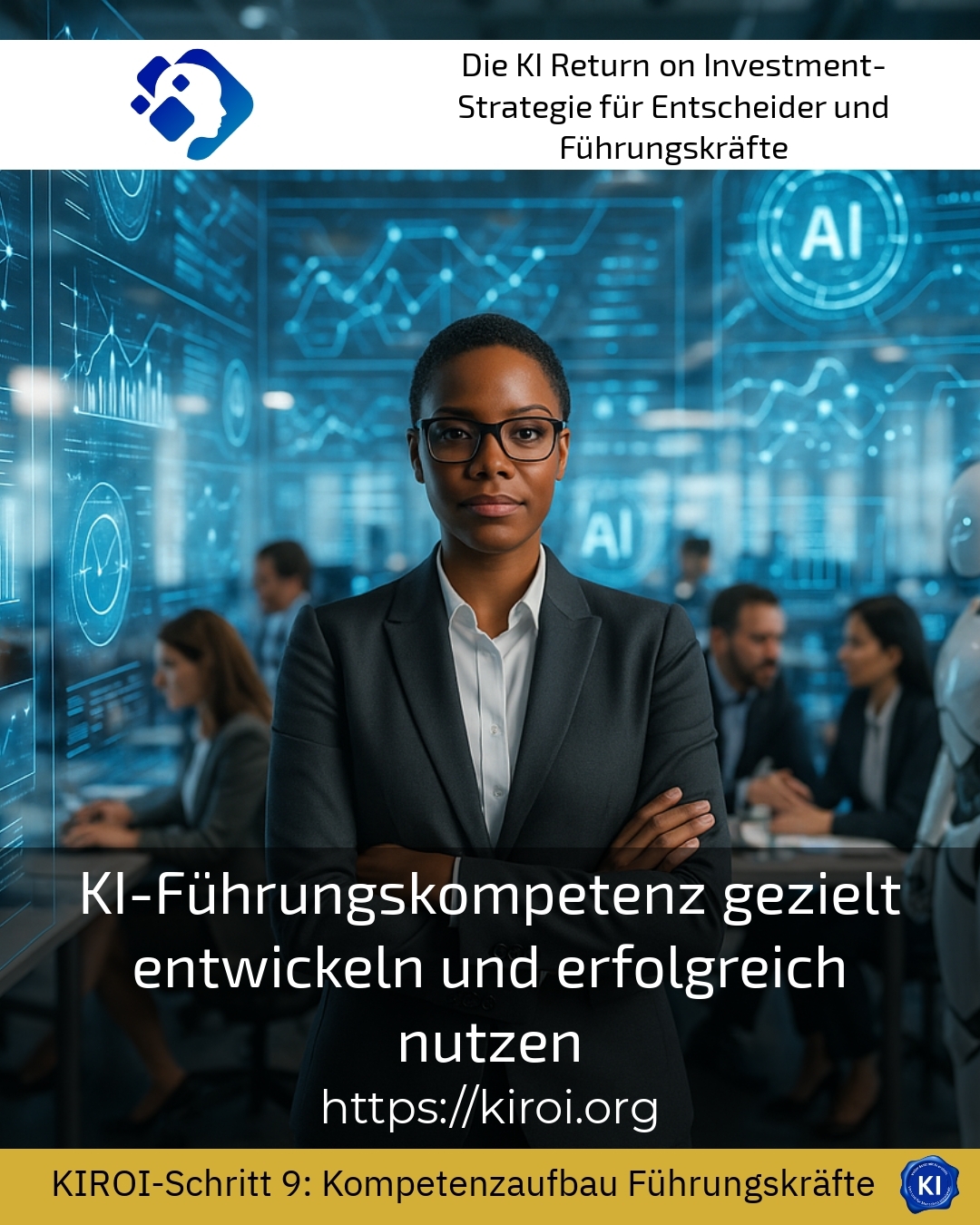
In a time when algorithmic systems are increasingly influencing strategic decisions, leaders face a completely new challenge. The ability to, Developing AI leadership competence with a targeted approach To be able to, today decides the long-term success of companies. This is no longer just about technical understanding. Rather, this competence requires a fundamental reorientation of one's own understanding of leadership. Those who miss this transformation risk falling behind the competition. At the same time, enormous opportunities open up for far-sighted leaders.
The fundamentals of modern leadership competence in the digital age
Manufacturing industry leaders are currently experiencing a fundamental shift in their roles. While technical expertise and process optimisation were previously paramount, strategic skills are now gaining importance. For example, an automotive supplier's production manager needs to understand how predictive maintenance systems work. However, they also need to empower their team to collaborate effectively with these systems. This dual role demands a completely new skill profile. This development is particularly evident in the semiconductor industry. Here, quality managers are already working closely with intelligent testing systems. They interpret the results and make far-reaching decisions based on this information.
The mechanical engineering sector faces similar challenges. Plant managers today must understand how networked production facilities generate and utilise data. They also need to be able to translate these insights into concrete courses of action. A medium-sized manufacturer of precision parts recently trained its entire management team. The focus was not on programming but on strategic thinking in a digital context. This investment quickly paid off. The managers were subsequently able to make decisions about technology investments in a much more informed way.
How to specifically develop AI leadership skills
The development of these new capabilities will happen in stages and requires a structured approach. Initially, leaders should develop a fundamental understanding of how modern algorithms work. This doesn't mean they need to code themselves. Rather, it's about being able to realistically assess the possibilities and limitations of these technologies. In the chemical industry, several companies have established internal academies [1]. There, leaders learn how to use data-based decision-making tools in practical workshops. The results have been remarkably positive.
Another important aspect concerns the development of a critical stance towards algorithmic recommendations. Leaders must learn when they can trust the systems. However, they must also recognise when human judgement is required. This balancing act is particularly critical in the pharmaceutical industry, where flawed decisions can have far-reaching consequences. A quality manager recently reported on his experiences. He uses intelligent analysis systems daily but always retains the final decision-making authority.
Best practice with a AIROI customer
A medium-sized industrial robot manufacturer approached us with a specific concern. Management had recognised that existing leadership skills were no longer sufficient. The increasing interconnectedness of production facilities required a fundamentally new understanding of leadership. As part of a transruption coaching programme, we supported the company over a period of six months. We worked closely with twelve managers from various departments. Initially, we jointly analysed the specific challenges in robotics manufacturing. Subsequently, we developed individual learning paths for each participant. Production managers learned to interpret data-based dashboards meaningfully. Quality managers intensively engaged with predictive analysis methods. Sales managers recognised new opportunities for customised service offerings. After completion of the programme, participants reported significantly increased confidence in dealing with new technologies. The company was subsequently able to successfully implement several innovative projects because the leadership level actively supported and drove them forward.
Practical fields of application in the manufacturing industry
The concrete applications for newly developed leadership competencies are diverse and sector-specific. In the metal industry, shift managers are increasingly using intelligent planning systems for resource allocation. They need to understand how these systems work and where their limitations lie. A steelworks in North Rhine-Westphalia has mastered this transformation as an example [2]. The managers there now routinely work with algorithmic recommendations, while simultaneously maintaining an overview of the entire system.
Further exciting fields of application are emerging in the electronics industry. Intelligent systems support the quality control of components there. Managers must interpret the results and integrate them into the production process. A manufacturer of printed circuit boards has mastered this integration particularly well. The production managers understand exactly how the testing systems work. They can therefore make well-founded decisions about rework or scrap. This expertise has significantly reduced the error rate.
The plastics industry offers another vivid example. Here, intelligent systems continuously optimise process parameters in injection moulding. Managers need to understand which controls the system operates. They also need to recognise when manual interventions are sensible. A specialist in technical plastic parts reported on his experiences. Initial scepticism within the management team quickly gave way to constructive collaboration with the new systems.
Developing AI leadership competence with targeted, structured guidance
The development process benefits significantly from professional guidance by experienced experts. Transruption coaching offers a proven framework for sustainable change. The focus here is not on theoretical concepts, but rather on practical application in the concrete daily work environment. Several companies in the textile industry have already successfully embarked on this path. The managers there initially received input on fundamental concepts, and subsequently put what they had learned into practice directly within their areas of responsibility.
The paper industry is showing similar developments. Here, production managers now routinely work with systems for process optimisation. Support from external experts helped them to overcome initial reservations. One manufacturer of packaging paper reported on their positive experiences. After the coaching, the managers felt significantly more confident in handling the new technologies. This confidence also transfers to the employees.
These skills are also playing an increasing role in the food industry. Here, managers have to monitor and control complex production processes. Intelligent systems support them in this, but do not provide ready-made solutions. The interpretation of the data and the derivation of measures remain human tasks. A dairy company has trained its entire management level accordingly [3]. The investment in this skills development has paid off multiple times.
Best practice with a AIROI customer
A company with a rich tradition in the machine tool industry approached us with a specific request. The management felt increasingly overwhelmed by the rapid pace of technological development. While they recognised the need for change, they didn't know where to start. Our transruption coaching began with a detailed assessment of existing competencies. We found that there was significant potential for further development. The managers brought extensive experience in mechanical engineering and possessed a deep understanding of processes. What they lacked was the bridge to new technological possibilities. In several workshops, we worked together to establish this connection and create a shared understanding. The production managers learned how to use data-based insights for their daily decisions. The development managers recognised new opportunities for innovative product features. The sales managers understood how they could offer their customers more comprehensive service packages in the future. Today, the company reports significantly increased innovation capacity and an improved working atmosphere.
Success factors for sustainable skills development
The successful development of new leadership skills depends on several factors. Firstly, an open basic attitude from leaders is required. Those who fundamentally reject change will find it difficult to acquire new skills. Several companies in the glass industry have had this experience. There, the transformation only succeeded where the leaders themselves showed an interest in further development. The willingness to engage in lifelong learning is more important today than ever before.
Another factor for success concerns the support of top management. If the executive board actively promotes skills development, the prospects for success increase considerably. This connection is particularly evident in the construction industry. There, companies with committed management have achieved significantly better results. The managers felt validated and supported in their development process. This positive atmosphere also had an effect on the employees.
The furniture industry offers another instructive example. A medium-sized manufacturer invested specifically in the further training of its executives. In doing so, it placed particular emphasis on practical applications. The production managers learned how to optimally use intelligent manufacturing systems. Those responsible for quality focused on automated testing procedures. This practice-oriented approach led to a rapid implementation of what was learned in everyday work.
My AIROI Analysis
The development of leadership skills for the digital age is no longer an optional extra. It is a fundamental necessity for long-term business success. The manufacturing industry faces particular challenges in this regard. The complexity of production processes requires a deep understanding of both technical and human aspects. Leaders must learn to combine and productively integrate both worlds. Structured support from experienced experts significantly aids the development process.
The examples presented in this post show that the transformation can be successful. However, it requires commitment, openness and a willingness for continuous development. Transruption coaching offers a proven framework for these change processes. It supports leaders on their individual development path and provides important impetus. The positive feedback from various industries confirms the effectiveness of this approach. Companies that invest in the competence development of their leaders today lay the foundation for future success. They position themselves as attractive employers and win in the competition for qualified professionals. The investment in Developing AI leadership competence with a targeted approach therefore pays off several times over.
Further links from the text above:
[1] VDMA Future Business – Digitalisation in Mechanical Engineering
[2] Steel Industry Association – Innovation and Digitalisation
[3] Federation of the German Food Industry – Digitalisation
For more information and if you have any questions, please contact Contact us or read more blog posts on the topic Artificial intelligence here.








 Deutsch
  English (UK)