
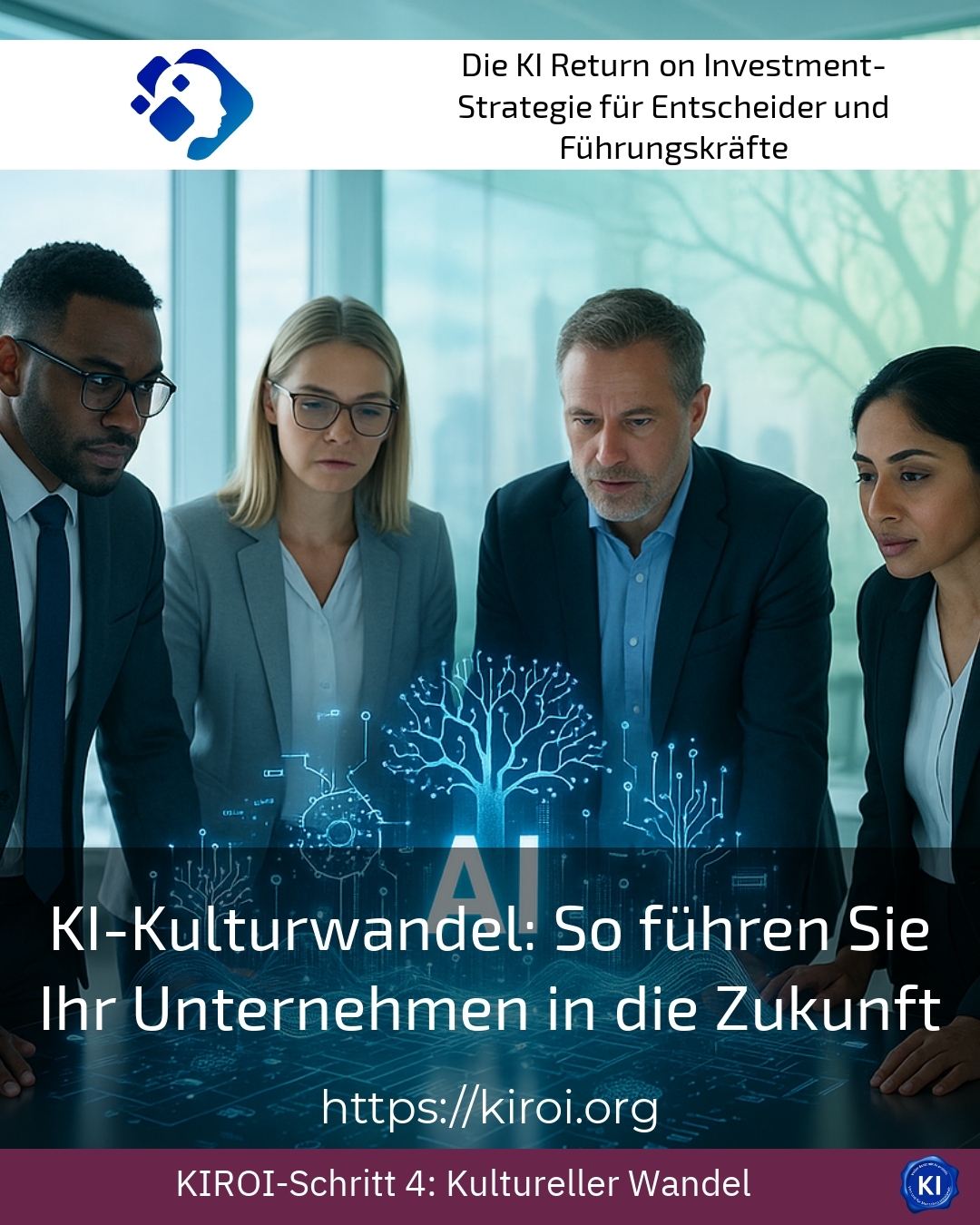
Imagine your company could unlock entirely new value creation potentials within mere months, potentials that previously seemed unimaginable. The AI cultural change is fundamentally changing the rules of the game across all economic sectors. Many leaders are currently wondering how they can successfully manage this profound transformation process. The answer lies not solely in the technology itself, but rather in the way organisations think, act, and collaborate. In this post, you will learn what concrete steps are necessary to future-proof your company.
Why the AI cultural shift is becoming indispensable now
The speed of technological developments has increased dramatically in recent years. Companies that hesitate today may already have lost out tomorrow. This is not just about implementing new tools or systems. Rather, a fundamental reorientation of corporate culture is at the heart of this development. Employees must learn to collaborate with intelligent systems and use their potential effectively. Leaders, in turn, face the challenge of reducing anxieties and fostering enthusiasm for new opportunities.
For instance, a medium-sized manufacturing company realised that its quality control could become significantly more precise through automated image analysis. The technical solution was quickly found, but the real work only began afterwards. This is because the experienced inspectors initially perceived the new technology as a threat to their expertise. It was only through intensive communication and their involvement in shaping the new process that scepticism turned into acceptance. Another example involves a logistics company that wanted to optimise its route planning. The drivers were involved from the outset and were able to contribute their practical experience. This resulted in a hybrid solution that combined technical precision with human knowledge. Similarly, a retail group experienced this when modernising its inventory management system and actively involving the store managers in the development process.
The role of leadership in the AI culture change
Leaders significantly shape whether a transformation process succeeds or fails. Their attitude towards change is immediately transmitted to the entire workforce. Leaders who themselves show apprehension about change can hardly expect employees to move forward courageously. Therefore, every successful cultural change begins with the people at the top of the organisation. They must not only set the strategic direction but also act as role models [1].
The managing director of an engineering firm reported how he was initially sceptical himself. He then deliberately took time to personally explore the new possibilities. This openness inspired his entire leadership team to adopt a similar approach. In a financial services company, the CEO introduced regular learning circles. Here, managers experimented with new applications together and shared their findings. At an energy provider, the technical director initiated a mentoring programme. Younger, technically adept employees guided experienced managers in familiarising themselves with new systems.
Best practice with a AIROI customer
An international trading company faced the challenge of fundamentally transforming its customer service. Management recognised that intelligent assistance systems could automatically answer a significant portion of standard queries. At the same time, long-serving service employees feared that their expertise would no longer be in demand in the future. In collaboration with transruptions-coaching, the company developed a multi-stage support process for this project. Initially, all service employees were invited to categorise their most frequent customer queries and document suggested solutions. This accumulated knowledge directly fed into the development of the automated system and gave the employees the feeling that they were making valuable contributions. In the second phase, selected team members took on the role of internal ambassadors, guiding and supporting their colleagues during the onboarding process. Employees frequently reported that they felt taken seriously through this involvement and that their initial concerns were largely dispelled. The result was impressive, as customer satisfaction measurably increased while at the same time, fluctuation in the service team significantly decreased. This example illustrates how well-thought-out support in transformation projects can make the crucial difference.
Employees as the key to success in AI cultural change
Without the active involvement of the workforce, every transformation project will inevitably encounter limitations. People are not passive recipients of change, but rather its actual shapers. Those who ignore their perspectives squander valuable potential and risk considerable resistance [2]. The most successful companies therefore consistently focus on participation and transparent communication. They create space for dialogue and encourage constructive criticism.
For example, a pharmaceutical company established an internal innovation laboratory. There, employees from all departments can test new applications and submit suggestions for improvement. The best ideas are regularly recognised and put into practice. An insurance group took a similar approach and established cross-departmental project groups. These teams independently analyse optimisation potential and develop solution concepts for specific challenges. At a telecommunications provider, an internal network of technology enthusiasts was created. These informal ambassadors support their colleagues with onboarding and gather valuable practical feedback.
Competence development as a continuous process
The skills that are in demand today may well be obsolete tomorrow. Therefore, it is not enough to offer one-off training sessions and then move on to business as usual. Instead, a culture of lifelong learning is needed, one that rewards curiosity and encourages experimentation. Companies must integrate learning time into the daily working routine and provide the appropriate resources. Only in this way can employees keep pace with the speed of technological development.
An automotive supplier therefore introduced a so-called "learning hour". Every Friday, the teams dedicate themselves to new topics together and share their insights. A media company established a buddy system where experienced and less experienced employees learn from each other. A construction group created so-called "skill tandems" where technical and manual knowledge flows together. These diverse approaches show that there isn't one right way, but many opportunities for skills development exist.
Best practice with a AIROI customer
A medium-sized mechanical engineering company with several hundred employees wanted to modernise and automate its production planning. The challenge was that many experienced employees had been with the company for decades. They possessed enormous implicit knowledge that was not documented anywhere and could only be transferred into formal systems with difficulty. The management decided to bring in external support for this complex project and chose transruption coaching as their partner. In a first step, detailed interviews were conducted with the most experienced planners, and their decision-making patterns were carefully analysed. These findings were then incorporated into the design of the new system, which thus took human expertise into account from the outset. In parallel, workshops were held where employees could articulate their concerns and wishes. Many reported that this process made them feel truly heard for the first time and that their concerns were taken seriously. The new system was ultimately positioned as an assistant that supports and complements human expertise. Acceptance was high from the beginning because employees viewed the system as their own creation and not as an external directive.
Structural prerequisites for sustainable transformation
Cultural change does not happen in a vacuum, but requires supportive structures and processes. Without appropriate organisational frameworks, even the best intentions remain ineffective [3]. Companies must critically examine and, if necessary, adapt their organisational structures and processes. Rigid hierarchies and isolated silos can significantly hinder innovation and must therefore be broken down. Flexible structures and permeable boundaries, on the other hand, facilitate the necessary knowledge exchange between different areas.
A consumer goods manufacturer fundamentally reorganised its development department and formed cross-functional teams. These now work together on a project-by-project basis and disband after completion. A healthcare provider created a new position for a Chief Transformation Officer. This person coordinates all change initiatives and ensures coherence in the overall process. A chemical group established so-called "Agile Cells" which undertake optimisation projects autonomously and report directly to senior management.
Dealing with resistance and fears
Changes initially cause unease or even fear in many people. This reaction is profoundly human and should never be ignored or belittled. Instead, there is a need for spaces where concerns can be openly addressed and taken seriously. Only those who feel heard will be willing to embrace the new in the long term. The issues that employees bring to managers or external consultants are diverse.
Some worry about their job security and wonder if their skills are still needed. Others feel overwhelmed by the pace of change and wish for more time. Still others experience conflicts in their teams, arising from differing attitudes to transformation. Transruption coaching supports companies with precisely these challenges and provides impetus for constructive solutions. Clients often report that simply voicing their concerns brings significant relief.
My AIROI Analysis
The confrontation with the AI cultural change clearly shows that technological and human aspects are inextricably linked. Companies that only focus on the technical side will inevitably fail due to human factors. At the same time, it is not enough to just talk about culture without adapting concrete structures and processes. The most successful transformations occur where both dimensions are equally considered and carefully designed.
The examples presented illustrate that there is no universal recipe for successful change. Each company must find its own path that suits its specific culture and individual circumstances. External support and methodological assistance can provide valuable impetus and accelerate the process. Transruption coaching has established itself as helpful support for such projects and assists companies from a wide range of industries. Experience shows that participatory approaches are particularly promising and enable sustainable change.
For the future, it will be crucial for companies to understand their transformative capability as a core strategic competence and to continuously develop it. The AI cultural change is not a one-off project, but an ongoing process that requires continuous attention. Those who set the right course today will be among the winners of this historic period of upheaval tomorrow and will remain competitive in the long term.
Further links from the text above:
[1] Harvard Business Review – Insights on Leadership and Management
[2] McKinsey – People and Organisational Performance
[3] Gartner – Human Resources Research and Insights
For more information and if you have any questions, please contact Contact us or read more blog posts on the topic Artificial intelligence here.






 Deutsch
  English (UK)