
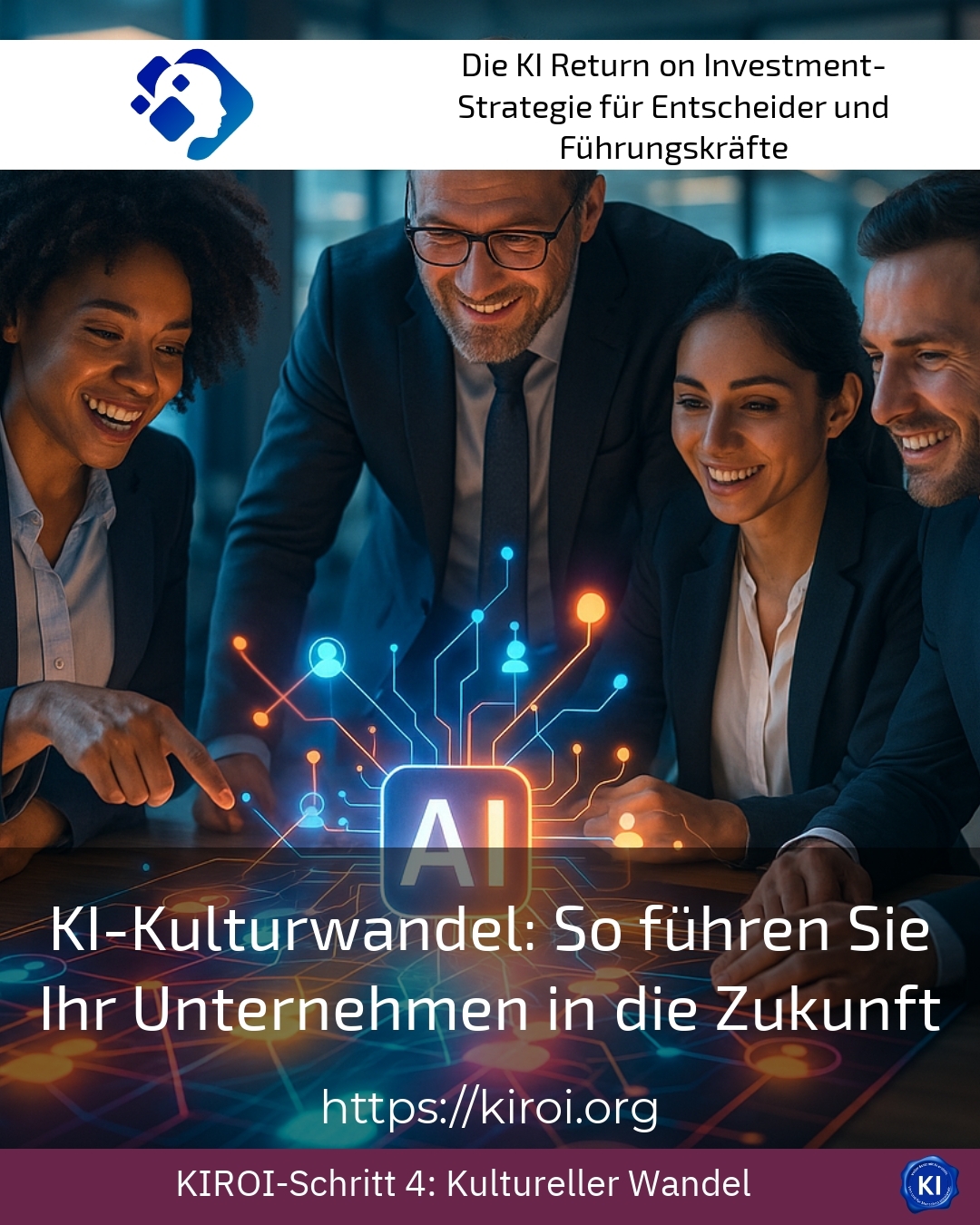
The digital revolution has long since begun. Companies are facing a turning point. Those who don't act now will be left behind. The AI cultural change It encompasses all industries and fundamentally changes how people work, communicate, and make decisions. But what does this transformation specifically mean for your organisation? How can you bring employees along while securing economic success? These questions are on the minds of leaders worldwide. The answers are more complex than one might expect. In this post, you'll learn which levers you can pull and which pitfalls to avoid.
Understanding the initial situation and recognising opportunities
Intelligent systems are now permeating almost every area of business. In retail, algorithms optimise inventory management and predict purchasing behaviour with astonishing accuracy. Insurance companies use automated processes for claims settlement, significantly accelerating their processing times. In healthcare, digital assistants support diagnosis and noticeably relieve the burden on medical professionals. These developments clearly show that technological progress is no longer a thing of the future but is already influencing competitiveness today. Managers often report that their teams initially feel uncertain when new technologies are to be introduced. This reaction is understandable and human. This is precisely where professional support comes in, offering transruption coaching as a partner for transformation projects.
In the financial sector, intelligent systems analyse credit risks faster than human clerks. Logistics companies plan routes more efficiently and sustainably reduce fuel consumption. Manufacturing plants rely on predictive maintenance and avoid costly machine failures. These examples highlight the enormous potential contained in the systematic use of modern technologies [1]. At the same time, new requirements are emerging for skills and working methods. Employees must learn to use digital tools and critically assess their results. This learning process requires time, resources, and intelligent management by company leadership.
Why the AI culture shift requires more than just technology
Many organisations underestimate the human element in transformation projects. They invest large sums in software and hardware, but employees are often left behind. A successful company in the automotive sector recognised early on that technical excellence alone is not enough. It launched a comprehensive training programme for all hierarchical levels. Managers learned how to guide their teams through change processes. The results were impressive and were reflected in increased employee satisfaction and higher productivity. In mechanical engineering, pioneers are focusing on cross-functional teams that combine technical and organisational knowledge. Pharmaceutical companies are investing in ethical guidelines for the use of intelligent systems. These approaches demonstrate that sustainable transformation always puts people at the centre.
Best practice with a AIROI customer
A medium-sized company in the food industry faced significant challenges in introducing intelligent production control. The workforce showed clear reservations about the planned changes, fearing job losses. Management opted for a phased approach with intensive communication across all levels. Initially, so-called change ambassadors were identified from within the company and received targeted training. These multipliers disseminated information to their teams while simultaneously gathering feedback from the workforce. Company leadership established regular dialogue formats to answer open questions. In parallel, pilot projects were launched in selected departments, and their successes were made visible. After about eighteen months, the sentiment within the company had fundamentally changed. Employees independently submitted suggestions for improvement and saw the new technologies as support for their daily work. Productivity increased measurably, and error rates declined significantly. This example impressively demonstrates the importance of cultural support during technological change processes.
Developing leadership skills for the digital era
The AI cultural change requires new skills and a changed self-perception from leaders. Traditional hierarchies are increasingly giving way to agile structures and networked ways of working. In the banking sector, institutions are experimenting with flatter organisational models and decentralised decision-making powers. Telecommunications providers are relying on self-organising teams that can react more quickly to market changes. Energy suppliers are forming interdisciplinary working groups that drive innovation while ensuring operational excellence. These developments require leaders who can let go and trust. They must provide direction without dictating every step. Coaching approaches support finding and authentically living this balance [2].
Clients often report feeling overwhelmed by the speed of technological developments. They feel torn between day-to-day operations and strategic realignment. Some doubt their own competencies or wonder how they can remain relevant. These are the issues that bring people to transruption coaching, which supports them in projects related to digital transformation. In the retail sector, managers struggle to integrate brick-and-mortar stores with online channels. In the construction industry, project leaders face the challenge of combining traditional craftsmanship with digital planning. Media companies must question established business models and tap into new revenue streams. All these situations require individual support and tailor-made solutions.
Practical steps for sustainable change
The successful design of transformation processes follows certain principles that have proven themselves across industries. First of all, it is important to develop a clear vision and to communicate it understandably. In the chemical sector, pioneers formulate concrete visions of the future that inspire and mobilise employees. Retail companies define measurable milestones that make progress visible. Transport companies involve their workforce in planning processes early on and utilise their expertise. This participation creates acceptance and significantly reduces resistance.
In the next step, it is advisable to provide resources for qualification and plan time for learning processes. Insurance companies are setting up digital learning platforms that enable individual learning paces. Manufacturing companies are organising work shadowing in innovative departments or with external partners. Hospitals are creating experiment spaces where new technologies can be tested without performance pressure [3]. This builds competencies and, at the same time, increases confidence in one's own learning ability. Furthermore, it is important to make successes visible and celebrate them. Small progress deserves recognition. It is motivating and shows that the chosen path is the right one.
Best practice with a AIROI customer
An international logistics service provider wanted to fully automate its route planning but faced complex organisational hurdles. The dispatchers, who had previously made decisions independently, felt devalued and disempowered by the planned system implementation. It became clear in discussions that decades of experience and intuition were perceived as being under threat. The project team therefore opted for a participatory approach and invited experienced dispatchers to be involved in the system design. Their knowledge flowed directly into the development of the algorithms and made the system more practical. At the same time, the employees involved recognised that their expertise remained essential and was valued. The new role of the dispatchers shifted towards exception management and strategic planning. They monitored the automated system and intervened to steer operations in unforeseen situations. This hybrid working method optimally combined machine efficiency with human judgement. Following the successful implementation, transport costs decreased and employee satisfaction increased simultaneously. This project impressively demonstrates how technological and cultural transformation can go hand in hand.
Constructively utilise resistance and take concerns seriously
Every profound change elicits resistance. These reactions are normal and even valuable. They show that employees are thinking and feel a sense of responsibility. In the industrial sector, concerns often relate to job security and qualification requirements. In the service sector, people worry about the loss of personal customer relationships. In creative industries, the fear of being replaced by algorithms is dominant. Savvy leaders listen to these concerns and take them seriously. They create spaces for open dialogue and transparent information. They outline development prospects and invest in the future viability of their teams.
The pharmaceutical industry relies on change management experts to professionally support change processes. Financial service providers are establishing feedback systems that continuously capture sentiments and concerns. Craft businesses are utilising informal discussion rounds to stay close to their employees [4]. All these measures contribute to AI cultural change to make it more human. It's not about breaking or ignoring resistance. Rather, it can serve as a valuable impulse for improving change processes. Those who listen and learn create better solutions and gain sustainable support.
Ethical Dimensions and Social Responsibility
The deployment of intelligent systems raises fundamental questions that go beyond business considerations. How transparent must algorithmic decisions be? What responsibility do companies have towards employees whose jobs are automated? How can discrimination through biased datasets be avoided? In human resources, professionals are intensely discussing fair selection procedures and comprehensible evaluation criteria. Insurance companies are grappling with equitable risk assessments that appropriately consider individual circumstances. Medical institutions are developing guidelines for the responsible use of data-driven diagnoses.
These ethical considerations deserve a firm place in corporate culture and should not be treated as a secondary concern. Companies that develop clear standards early on build trust with employees, customers, and the public. Trade benefits from transparent recommendation systems that customers can understand and follow. Energy companies gain credibility by disclosing their grid control algorithms. Banks strengthen their reputation through comprehensible credit decisions [5]. All these aspects demonstrate that ethical reflection is not an obstacle, but can offer a real competitive advantage.
My AIROI Analysis
Following an in-depth consideration of the various aspects, a multi-faceted picture emerges, encompassing both opportunities and challenges. AI cultural change proves to be a fundamental transformation that goes far beyond technological upgrades and affects all dimensions of corporate action. Successful organisations are characterised by consistently putting people at the centre and understanding technological possibilities as tools for human growth. The analysed examples from various industries impressively demonstrate that participatory approaches achieve better results than top-down implementations without genuine employee involvement.
Leaders are well-advised to view change processes as a marathon rather than a sprint that forces quick results. Investment in skills and corporate culture pays off in the medium and long term. It creates resilience and adaptability for future challenges that are not yet foreseeable today. Ethical guidelines prove not to be a brake, but rather a guide and anchor of trust for all involved. Professional support, such as that offered by transruption coaching for digital transformation projects, can be crucial in avoiding pitfalls and making optimal use of existing potential. Ultimately, the quality of implementation, not the technology itself, determines success or failure.
Further links from the text above:
[1] McKinsey – The State of AI
[2] Harvard Business Review – Leadership in the Digital Age
[3] World Economic Forum – Future of Work
[4] Gartner – HR Transformation Insights
[5] Deloitte – Digital Transformation Research
For more information and if you have any questions, please contact Contact us or read more blog posts on the topic Artificial intelligence here.








 Deutsch
  English (UK)