
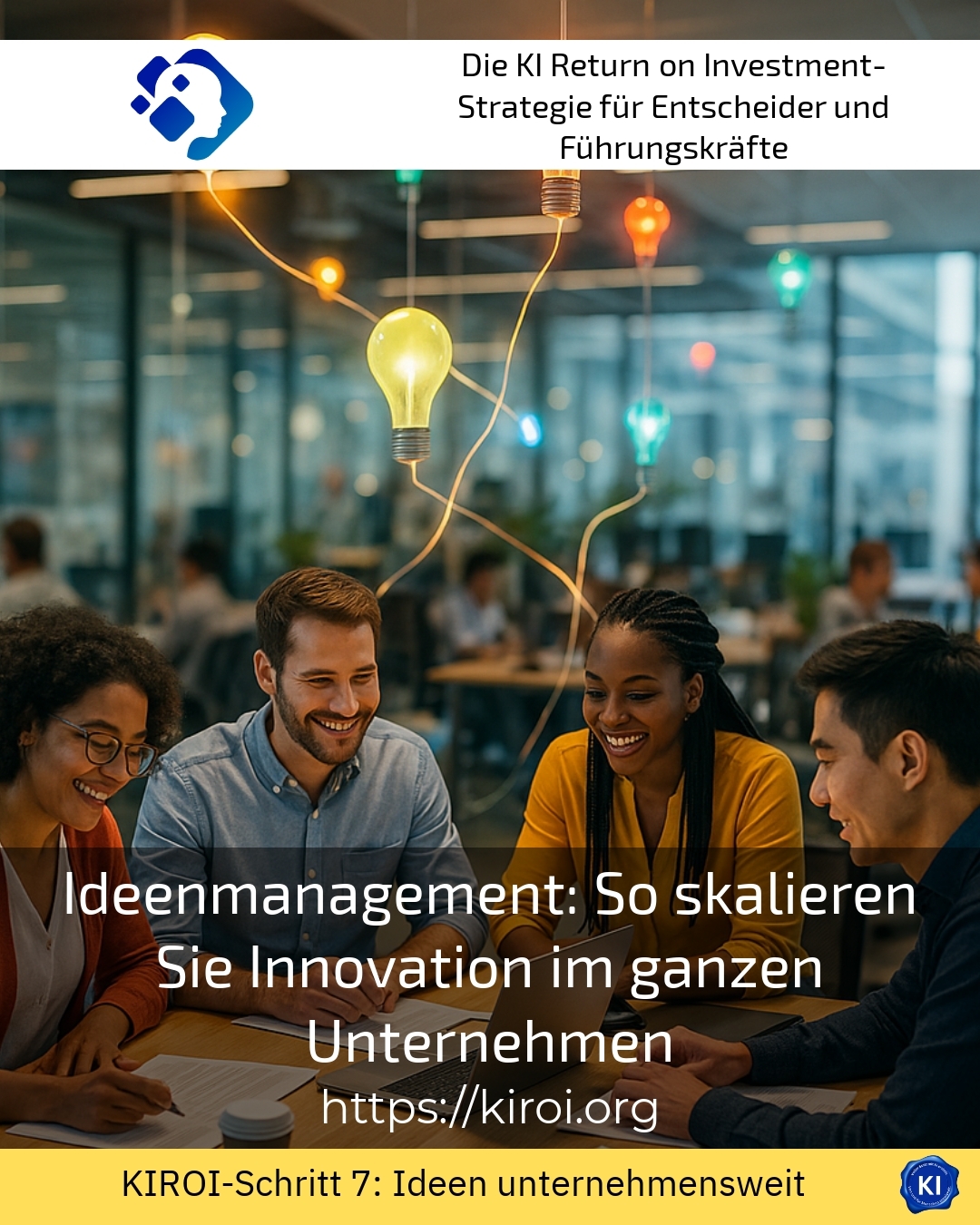
Imagine if every single employee in your company could become an engine for progress. Ideas management enables exactly that. It transforms isolated flashes of inspiration into systematic improvement processes. However, many organisations struggle to carry creative impulses beyond individual departments. The good news is: there are tried-and-tested methods for establishing innovation across the entire company. This article shows you how to activate dormant potential. It delivers practical approaches for sustainable change. Be inspired by strategies that numerous companies have already successfully implemented.
Creating the foundations for company-wide idea management
Before creative thoughts can flow, a solid foundation is needed. This foundation consists of cultural and structural elements. Firstly, leaders must send a clear message. They must show that every idea is welcome. Hierarchical barriers often block the free exchange of ideas between departments. Therefore, it is important to establish open communication channels. For example, a manufacturing company introduced weekly innovation rounds. There, employees from all areas presented their suggestions for improvement. The results positively surprised even management [1].
Transparency plays a crucial role in idea generation. Employees need to understand what happens to their suggestions. A financial services provider implemented a digital dashboard for this purpose. Everyone could track the status of their submitted ideas. This visibility increased the participation rate manifold. At the same time, frustration over seemingly ignored contributions decreased significantly. In retail, a company used gamification elements for motivation. Employees collected points for submitted and implemented ideas. The best idea generators received public recognition and small rewards.
The spatial design influences creative processes more than many might assume. A technology company deliberately set up informal meeting zones. Spontaneous conversations between departments often arose in these areas. Several patented innovations developed from such chance encounters. transruptions-coaching supports companies in designing these creative spaces. The consultancy provides impetus for the optimal environment for idea development.
Best practice with a AIROI customer
A medium-sized mechanical engineering company faced a significant challenge. Innovation was concentrated solely within the development department. Other areas such as production and sales felt excluded from the innovation process. The company implemented a structured Ideas management- System with AIROI support. Initially, innovation ambassadors were appointed in each department. These ambassadors collected suggestions and facilitated local idea workshops. A digital platform connected all locations. Within six months, the number of submitted ideas increased from twelve to over two hundred. The quality of suggestions from production was particularly noteworthy, as these employees best understood the daily challenges. One idea for process optimisation saved six-figure sums annually. Management recognised the value of collective intelligence and continued to invest in the training of the innovation ambassadors.
Scaling through digital tools and platforms
Modern technology enables the networking of ideas across locations. Digital platforms form the backbone of a scalable innovation system. They facilitate the collection, evaluation, and further development of suggestions. A logistics company used such a platform for its worldwide locations. Employees from different countries were able to collaborate on ideas [2]. The platform automatically translated contributions into various languages. This created synergies that were previously unthinkable. An improvement suggestion from Asia inspired an innovation in Europe.
Artificial intelligence is increasingly supporting idea evaluation. Algorithms can recognise and merge similar suggestions. They also identify promising ideas based on specific criteria. A pharmaceutical company successfully deployed such intelligent systems. The software analysed thousands of improvement suggestions from research. It recognised patterns and proposed combinations. Several of these combined ideas led to breakthroughs in development. The healthcare sector particularly benefits from networked knowledge. In this field, small improvements can have a big impact on patient outcomes.
Mobile applications democratise access to Ideas management. Employees without a permanent computer workstation can participate without any problems. A construction company equipped its tradespeople with a simple app. They documented suggestions for improvement directly on the construction site. Photos and short voice notes supplemented the written descriptions. This low-threshold solution activated a previously untapped knowledge source. The number of safety-related improvements increased noticeably.
Integration into existing workflows
Ideas management must not remain an isolated system. It must integrate seamlessly into everyday work. Otherwise, it will be perceived as an additional burden. An insurance company integrated its ideas platform into its project management tool. Every project conclusion automatically included a reflection question about areas for improvement. This routine embedded innovative thinking into day-to-day business. Integration into meeting structures also had positive effects. At the end of every discussion, teams reserved five minutes for idea exchange.
Training and workshops impart the necessary competencies for creative work. An automotive supplier conducted Design Thinking workshops for all managers. These then passed on their knowledge to their teams, spreading innovative methods throughout the company. The energy sector uses similar approaches for transformation, where employees must learn to creatively question traditional processes. Transruptions Coaching supports such transformation projects with tailor-made programmes.
Best practice with a AIROI customer
An internationally active trading company wanted to strengthen its sustainability strategy through employee ideas. Previous attempts had failed due to a lack of participation. The AIROI method helped analyse the root causes. It became clear that employees did not recognise the relevance of their contributions. The company launched a campaign with concrete challenges. Each week, it posed a specific sustainability question. The questions related to the employees' direct work areas. For example, it asked for ways to reduce packaging material. Or for ideas for more energy-efficient cooling processes in the stores. The concreteness significantly motivated participation. Within a quarter, over four hundred feasible suggestions were received. The company thereby saved significant amounts of resources. At the same time, employee commitment to sustainability issues increased measurably.
Understanding idea management as a leadership task
The role of leaders is decisive for the success or failure of innovation initiatives. Managers must act as role models and contribute ideas themselves. However, they must also take their teams' suggestions seriously. A common mistake is rejecting ideas too quickly. Many seemingly unrealistic suggestions contain valuable core concepts. A telecommunications company trained its leaders in appreciative communication. They learned to comment constructively even on rejected ideas [3]. The rejection rate decreased because managers looked more closely.
Providing resources to implement ideas is also part of leadership tasks. Without budget and time, good suggestions remain just paper. A chemical company set up an innovation fund. Each department could apply for funds from it for promising ideas. The process was deliberately designed to be unbureaucratic. Decisions were made within two weeks. This speed signalled the seriousness of the matter to the employees. The innovation culture was thereby sustainably and positively changed.
Fault tolerance is another important aspect of innovation leadership. Not every implemented idea will be successful. Companies must learn to see failures as learning opportunities. A media company conducted regular retrospectives on failed projects. These analyses identified valuable insights for future endeavours. The atmosphere became more open because no one feared blame.
Measurability and continuous improvement of idea management
What is not measured cannot be improved. Key performance indicators help manage innovation processes. This is not just about the number of ideas submitted. Conversion rates and the measurable benefit of implemented suggestions are more important. A consumer goods company developed a comprehensive KPI system. It took into account both quantitative and qualitative factors. Employee satisfaction with the innovation process was regularly recorded. This data was used for continuous optimisation of the system.
Benchmarking with other companies provides valuable insights. Cross-industry exchange opens up new perspectives. An industrial company regularly visited innovation leaders from other sectors. There, it learned new methods that it could adapt. The hospitality industry, for example, uses particularly creative idea evaluation methods. These could be transferred to other contexts. Transruptions coaching conveys such cross-industry best practices.
Best practice with a AIROI customer
A public sector service company wanted to revitalise its stagnant improvement processes. The traditional structures proved too cumbersome. With AIROI's support, an agile Ideas managementA system was developed. Small, cross-functional teams took over the evaluation and implementation of ideas. Lead times from submission to decision were significantly reduced. Monthly Innovation Days provided space for intensive idea generation. Employees from various departments worked together on solutions. The collaboration also fostered mutual understanding between departments. Conflicts at interfaces were noticeably reduced. After one year, the company had tripled its innovation speed. Employee surveys showed a significantly increased job satisfaction. Younger employees in particular valued the new participation opportunities.
My AIROI Analysis
The successful scaling of innovation requires a thoughtful interplay of various factors. Cultural prerequisites form the foundation for every innovation system. Without psychological safety, employees will not share their ideas. Technological tools enable networking across locations and departments. However, they should always be user-friendly and integrated into existing processes. Leaders bear a special responsibility for innovation culture. They must provide resources and exemplify tolerance for mistakes. Regular measurement and optimisation of the system ensures its long-term success.
It seems particularly important to me to specify innovation calls. Abstract requests for ideas often remain ineffective. Specific questions activate the relevant knowledge of employees. Linking them with strategic company goals increases the probability of implementation. Recognition and appreciation motivate further participation. This doesn't primarily involve financial incentives. Public recognition and the experience of self-efficacy often have a stronger effect. Transruptions Coaching supports companies in the holistic development of their innovation capacities. The AIROI method considers all relevant dimensions from mindset to measurement. This leads to sustainable changes that go beyond short-term programmes.
Further links from the text above:
[1] Harvard Business Review – Insights on Innovation Management
[2] McKinsey – The Eight Essentials of Innovation
[3] Gartner – Research in Innovation Leadership
For more information and if you have any questions, please contact Contact us or read more blog posts on the topic Artificial intelligence here.










 Deutsch
  English (UK)