
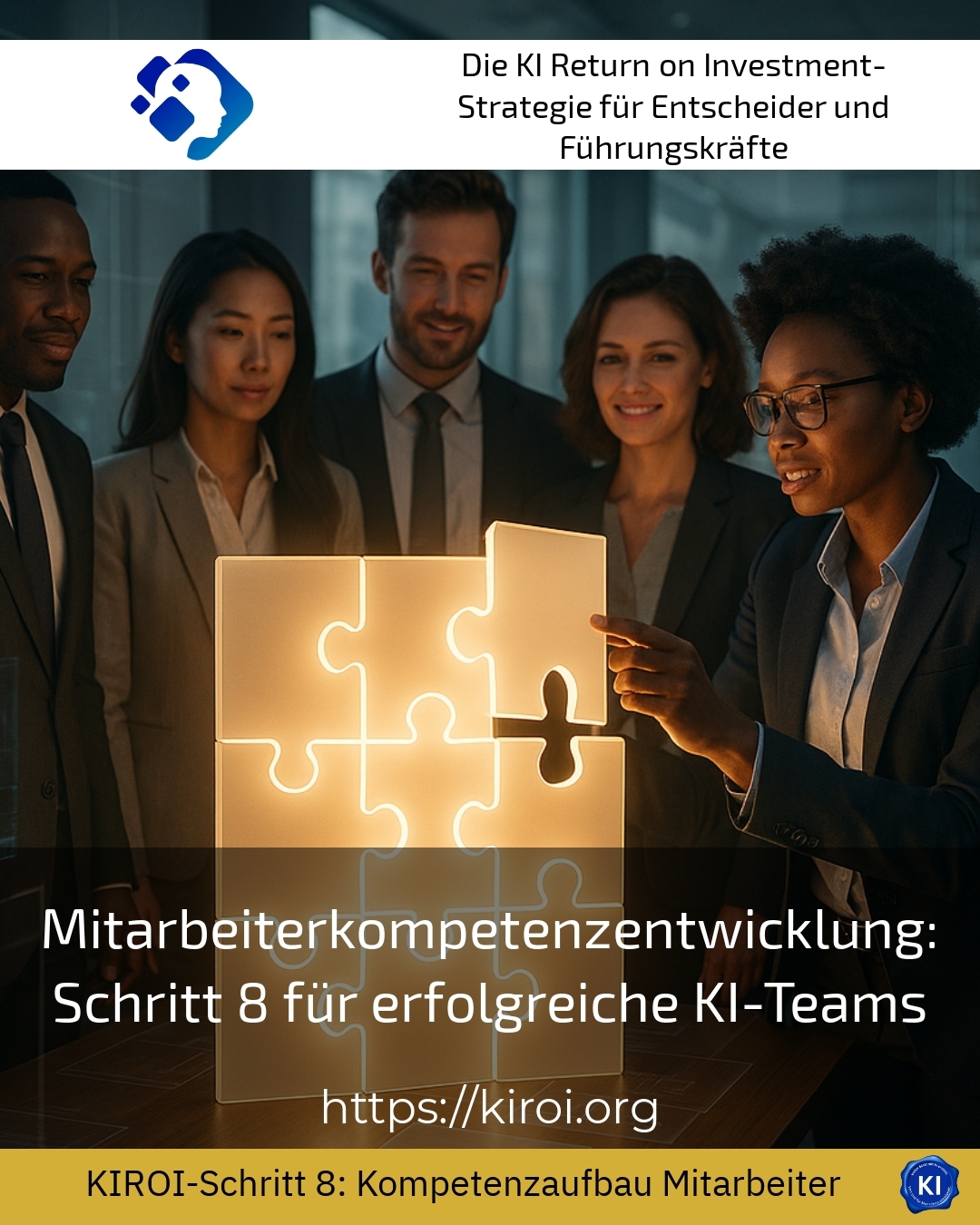
The targeted Employee skills development is a central building block for the long-term success of teams working with complex technologies. Particularly in environments that require the use of advanced digital solutions, the structured development of employee skills opens up paths to greater efficiency and innovation. Step 8, the individual promotion and integration of the developed competencies, plays a key role here.
Employee Competence Development as a Driver for Sustainable Success
Systematic employee skills development supports organisations in expanding and developing existing capabilities. The eighth step in this process specifically focuses on anchoring and adapting previously built-up competencies in practice. Within the scope of transformation projects in the field of innovative technologies, companies regularly experience that the transfer of content and practical application make the difference.
For example, companies in mechanical engineering specifically use feedback loops to support employees in real-time with the implementation of digital control technology after training. This facilitates the direct transfer and reinforcement of newly acquired knowledge.
Another example comes from the automotive industry, where new software platforms for manufacturing processes are being introduced. Coaches accompany the teams in their practical application to ensure success and gradually adapt the workflow. Likewise, IT start-ups have realised that regular peer review sessions help to quickly bring technical competencies up to a high level and to secure them sustainably.
Targeted integration as the core of the eighth step in employee competency development
In the eighth step, the bridge is built from theory to practice. Employees should be encouraged to apply new skills in their daily work. This is achieved through continuous support and concrete impulses that are introduced in ongoing projects. The challenge lies in creating suitable frameworks so that learning and application merge seamlessly.
Typical measures include:
- Individual coaching for reflecting on what has been learned and developing personal action strategies
- Collaborative workshops where employees share their own practical experiences and learn from each other.
- Experience-based tasks that allow for increasing responsibility and independent work in stages
In the logistics sector, positive effects are often seen through targeted project rotations. Employees temporarily take on different roles, thereby deepening their understanding of the overall processes. This not only expands but also connects their competencies.
In a consulting environment, teams benefit from experts of different disciplines working closely together and integrating their know-how in joint customer projects. This creates a learning environment that actively supports competence development.
Within the healthcare sector too, clinics are reporting that employees are able to more effectively apply and further develop their skills in using new information systems through practical workshops and supervision.
BEST PRACTICE with a customer (name hidden due to NDA contract): In an international manufacturing company, continuous support after training on digital tools was implemented as part of employee competency development. This involved providing employees with individual coaching tailored to their specific tasks. This enabled the company to increase the acceptance of new technologies and improve productivity.
Key success factors for sustainable employee competence development
To make the eighth step effective, companies should pay attention to the following aspects:
- Clear objective The improved competency must be directly linked to the project and company objectives.
- Integration into daily work Learning should not be an additional burden, but must be integrated into the normal workflow.
- Personalised support Employees have different learning styles and requirements, so tailored support is helpful.
- Establish a feedback culture Regular constructive feedback strengthens awareness of personal development steps.
- Long-term support Skills development is an ongoing process that goes beyond one-off measures.
In the energy sector, for example, programmes with accompanying coaching show significantly higher adherence to and sustainability of implementation after new norms and standards have been introduced. In the financial sector too, executives reported that methodological follow-up support during the project significantly boosted team performance.
Practical tips for implementation
The following tips can optimise employee competency development:
- Opt for a combination of in-person and digital formats to make learning flexible.
- Encourage teams to regularly reflect on learning experiences during retrospectives.
- Utilise digital tools for documenting and tracking skills development.
- Foster a culture of open exchange and mutual support.
In the manufacturing industry, digital learning platforms combined with real practical phases are proving effective in equipping employees with the skills for new systems. Startup environments also benefit from short feedback cycles, which enable rapid learning processes.
My analysis
The Employee skills development is far more than a formal process step. Step 8 focuses on the practical implementation and integration of the acquired skills and is therefore crucial for the sustainable success of teams. By enabling individual support, continuous feedback, and practical learning experiences, companies create stable foundations for innovation and performance. This is of particular importance in the context of challenging technical projects.
Further links from the text above:
Competence Development: Definition + Successful Examples
Successful Competence Development: 9 Tips and 3 Methods
Skills development: importance and methods
Successful Competence Development in 5 Steps
Popular methods for developing the skills of company employees
For more information and if you have any questions, please contact Contact us or read more blog posts on the topic Artificial intelligence return on investment here.








 Deutsch
  English (UK)