
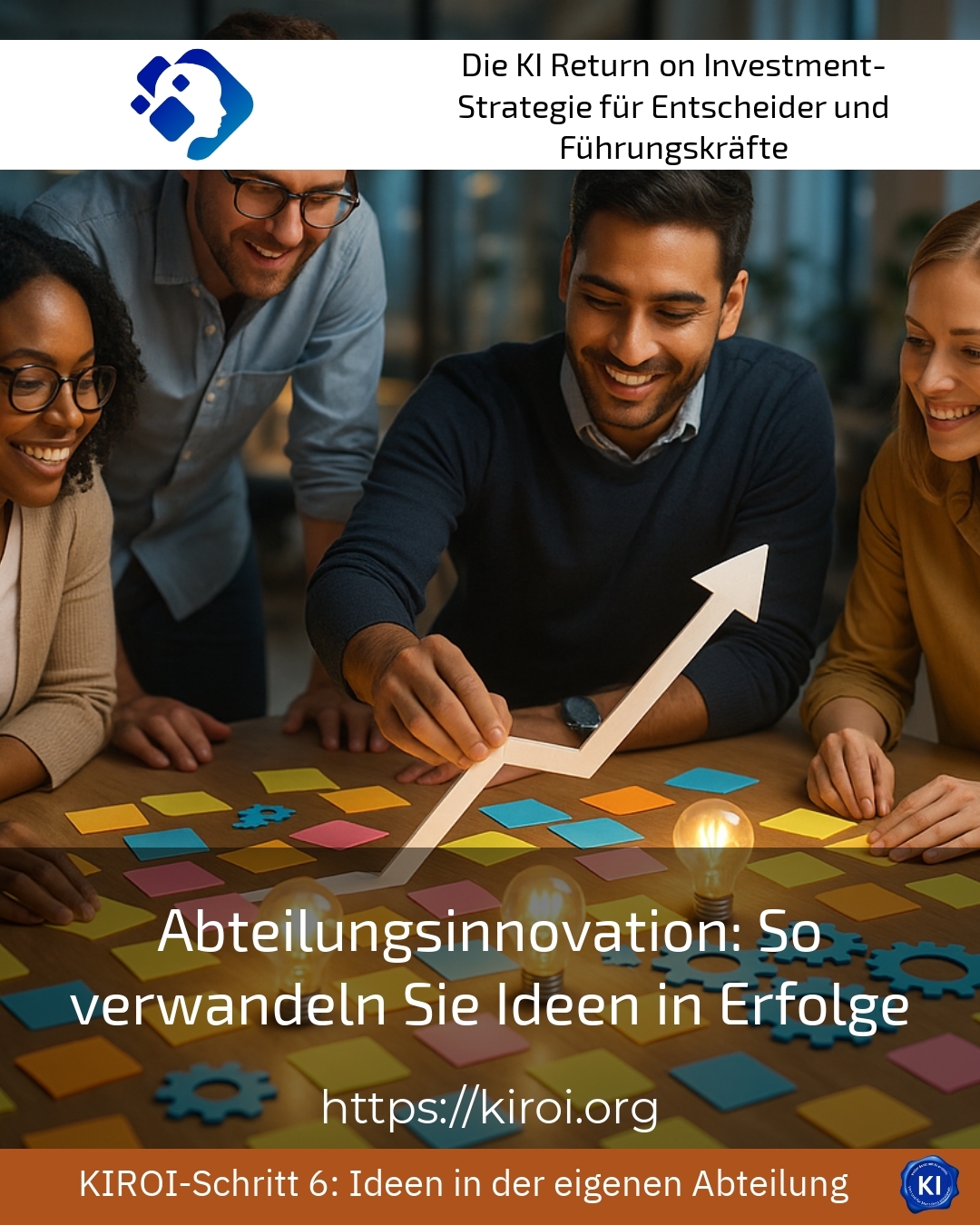
Imagine your employees are bursting with creative ideas, and yet most suggestions peter out in endless approval loops or gather dust unread in digital folders. Many managers know this scenario all too well, because the challenge does not lie in a lack of ideas, but in successfully implementing them. Departmental Innovation: How to Turn Ideas into Successes describes precisely this transformation process that leads companies from stagnation to dynamic further development. In the following sections, you will discover which strategies have proven successful and how transruptions coaching can support you in establishing sustainable changes in your area.
Understanding the Fundamentals of Successful Departmental Innovation
Before organisations can break new ground, they must first understand why traditional approaches frequently fail. Many companies invest significant resources in idea management systems, which however rarely deliver the desired results. The reason often lies in the missing link between creative impulses and operational implementation. Employees submit suggestions, but there is a lack of clear processes for evaluation and implementation. This creates frustration at all levels of the organisation.
For example, a manufacturing company in mechanical engineering introduced a digital suggestion scheme. Within a few months, the platform gathered over 500 submissions. However, management only implemented three ideas. As a result, the workforce lost faith in the system. A similar pattern was seen at a logistics service provider that introduced monthly innovation meetings. The meetings quickly turned into mere status reports without any real creative exchange. A medium-sized automotive supplier also struggled with this issue. Although promising concepts were regularly developed there, implementation failed due to a lack of resources.
Successful Departmental Innovation: How to Turn Ideas into Successes therefore requires a holistic approach. This takes into account both the cultural and structural aspects of the organisation. Transruption coaching helps teams to recognise these connections and address them in a targeted manner. Clients frequently report that sustainable changes only become possible through this guidance.
Creating and using creative spaces
The physical and psychological environment significantly influences the ability of teams to innovate. This is not just about modern office concepts with colourful beanbags and table football. Rather, employees need spaces where they can experiment without fear of criticism. This psychological safety forms the foundation for true creative development.
A renewable energy technology company set up so-called innovation labs, where developers were allowed to spend 20 per cent of their working time experimenting freely. The results positively surprised even the management. An insurance group took a different approach and established cross-functional project teams. These teams worked in spaces separate from day-to-day business on future topics. A pharmaceutical manufacturer also relied on creative freedom, enabling researchers to take regular sabbaticals for their own projects.
However, the creation of such spaces requires more than architectural changes. Leaders must actively model and foster a culture of openness. Transruption coaching provides impetus on how this transformation can succeed. Experienced coaches support departments in developing individual concepts.
Best practice with a AIROI customer
A medium-sized enterprise from the electronics sector approached our coaching team with a complex challenge. The development department regularly produced innovative product ideas, but the implementation rate was below five percent. As part of our collaboration, we initially analysed the existing processes and identified several bottlenecks. The biggest obstacle was the strict separation between the creative phase and the implementation phase. Together, we developed a new model that interlinked both phases. Specifically, we introduced so-called rapid prototyping sprints, in which developers and production experts worked together right from the start. In addition, we established a transparent evaluation system for submitted proposals. Every employee was able to understand why certain ideas were pursued further and others were not. This transparency significantly increased trust in the process. After six months, the implementation rate had quintupled to over 25 percent. According to an internal survey, employee satisfaction regarding innovation management rose by 40 percentage points. The company successfully launched several new product lines on the market that emerged from this process.
Establish structured methods for sustainable departmental innovation
Creativity alone is not enough to bring about lasting change. Rather, organisations require structured methods that clearly define the path from idea to implementation. However, these structures must not be so rigid that they stifle innovative impulses. The art lies in the balance between freedom and system.
A chemical group implemented the stage-gate model for its innovation management [1]. Each idea passed through defined phases with clear decision points. This significantly increased the efficiency of resource allocation. A telecommunications provider, on the other hand, relied on agile methods such as design thinking. Teams developed prototypes in short cycles and gathered early customer feedback. A medical technology company also found its own path. It combined traditional project management with creative ideation workshops.
Choosing the right method depends on various factors. Industry, corporate culture and available resources play central roles in this. Transruption coaching helps with the selection and adaptation of suitable frameworks. Clients frequently report that this individual support was crucial to their success.
Developing leaders as drivers of innovation
The role of leaders in promoting new approaches is often underestimated. Through their behaviour, they significantly shape the innovation culture of their departments. If superiors punish mistakes, employees will not take risks. If, on the other hand, they encourage experiments, a fertile breeding ground for new ideas is created.
A retail company specifically trained its management level in innovation-promoting behaviour. The participants learned how to deal constructively with failed projects. A construction group established mentoring programmes for young innovators. Experienced managers accompanied promising talents in the implementation of their ideas. A financial services provider also invested in the development of its executives. The company conducted regular innovation retreats where managers worked creatively themselves.
Departmental Innovation: How to Turn Ideas into Successes therefore always starts with the leaders. They must understand that their role is not control, but enablement. This transformation often requires a rethink on several levels. Coaching programmes can provide valuable impetus in this regard.
Overcoming resistance constructively
Changes in organisations regularly meet with resistance, and that is completely normal. Employees fear the loss of familiar routines or doubt the point of new approaches. Successful innovation projects take these dynamics into account from the very beginning. They involve potential critics early on and take their concerns seriously.
A food manufacturer experienced massive resistance when introducing new production methods. Management decided to involve sceptics in the pilot group. This strategy proved to be successful. A textile company proceeded similarly and had long-standing employees help shape new processes. Acceptance increased significantly as a result. A steel producer also overcame resistance through transparent communication. The company openly explained why certain changes were necessary.
Constructive handling of resistance requires empathy and communication skills. Transruption coaching guides teams through these challenging phases. The coaches help to use conflicts as an opportunity for improvements.
Best practice with a AIROI customer
A long-standing family business in the precision manufacturing sector was facing a unique challenge. The second generation had numerous modernisation ideas, but the long-standing workforce was sceptical. Management contacted us because initial attempts at change had led to considerable tension. We began with one-to-one discussions at all levels of hierarchy in order to understand the different perspectives. This revealed that the older employees were by all means open to new things. However, they felt bypassed and unvalued. Together, we developed an intergenerational innovation programme. Experienced specialists contributed their process knowledge, while younger colleagues brought technological expertise. We moderated several workshops in which both groups worked out solutions together. The result far exceeded all expectations. Within a year, three patentable process improvements emerged from this collaboration. The generational conflicts largely dissolved, and the company gained in innovative strength. Particularly remarkable was the statement of a long-standing master craftsman at the end of the project. He said that for the first time in years, he had felt like an important part of the development again.
Ensuring measurability and continuous improvement
What is not measured cannot be improved, and this old management wisdom also applies to innovation processes. Organisations need meaningful metrics to evaluate the success of their efforts. However, these metrics should go beyond mere output numbers. Qualitative aspects such as employee engagement and learning progress also deserve attention.
A software company introduced a comprehensive innovation dashboard [2]. This showed not only realised projects, but also the development of the idea pipeline. A consumer goods manufacturer focused on time-to-market as a key performance indicator. Shortening this period became the central criterion for success. An energy supplier also established a differentiated measurement system. It distinguished between incremental improvements and disruptive new developments.
Regular review of these metrics enables continuous adjustments. Teams learn equally from successes and failures. Transruption coaching assists with the definition of suitable metrics and their interpretation.
Using technology as an enabler for department innovation
Modern technologies open up completely new possibilities for the development and implementation of creative ideas. Artificial intelligence, for example, can recognise patterns in large amounts of data that would remain hidden from humans. Collaboration platforms enable teamwork across locations and time zones. Simulation tools allow the risk-free testing of new concepts.
An aerospace company uses digital twins for product development, which shortens development cycles by up to 40 per cent. A retail group uses AI-supported trend analysis to identify market opportunities at an early stage, enabling the company to react more quickly to changes. A plant manufacturer also benefits from new technologies, with virtual reality applications enabling virtual tours of planned production facilities.
However, the introduction of new technologies requires careful planning and support. Not every tool suits every organisation. Transruption coaching helps with the selection and integration of suitable solutions.
My AIROI Analysis
Transforming ideas into measurable successes presents many organisations with significant challenges. However, my many years of experience in supporting such projects shows that these hurdles can be overcome. The decisive factor here is a holistic approach that equally considers technical, organisational and human factors. Companies that focus on only individual aspects rarely achieve sustainable results.
The role of managers in this process seems particularly important to me. They not only have to create structures, but also act as role models. This often requires a fundamental rethink and the willingness to question familiar behaviours. Coaching can offer valuable support here, as it creates a safe space for reflection.
Technological capabilities are evolving rapidly and constantly opening up new opportunities. At the same time, this also increases the complexity that organisations have to manage. Artificial intelligence is increasingly becoming a differentiating factor in this regard. Companies that use these tools wisely gain significant competitive advantages.
My analysis shows that successful innovation programmes share several common features. They combine creative freedom with clear processes. They foster psychological safety and use resistance constructively. They measure progress and learn continuously. And they understand technology as a tool, not an end in itself. Organisations that embrace these principles have a strong prospect of sustainable innovation success.
Further links from the text above:
[1] Stage-Gate International – Official website for the Stage-Gate model
[2] Harvard Business Review – Innovation Management Insights
For more information and if you have any questions, please contact Contact us or read more blog posts on the topic Artificial intelligence here.







 Deutsch
  English (UK)