
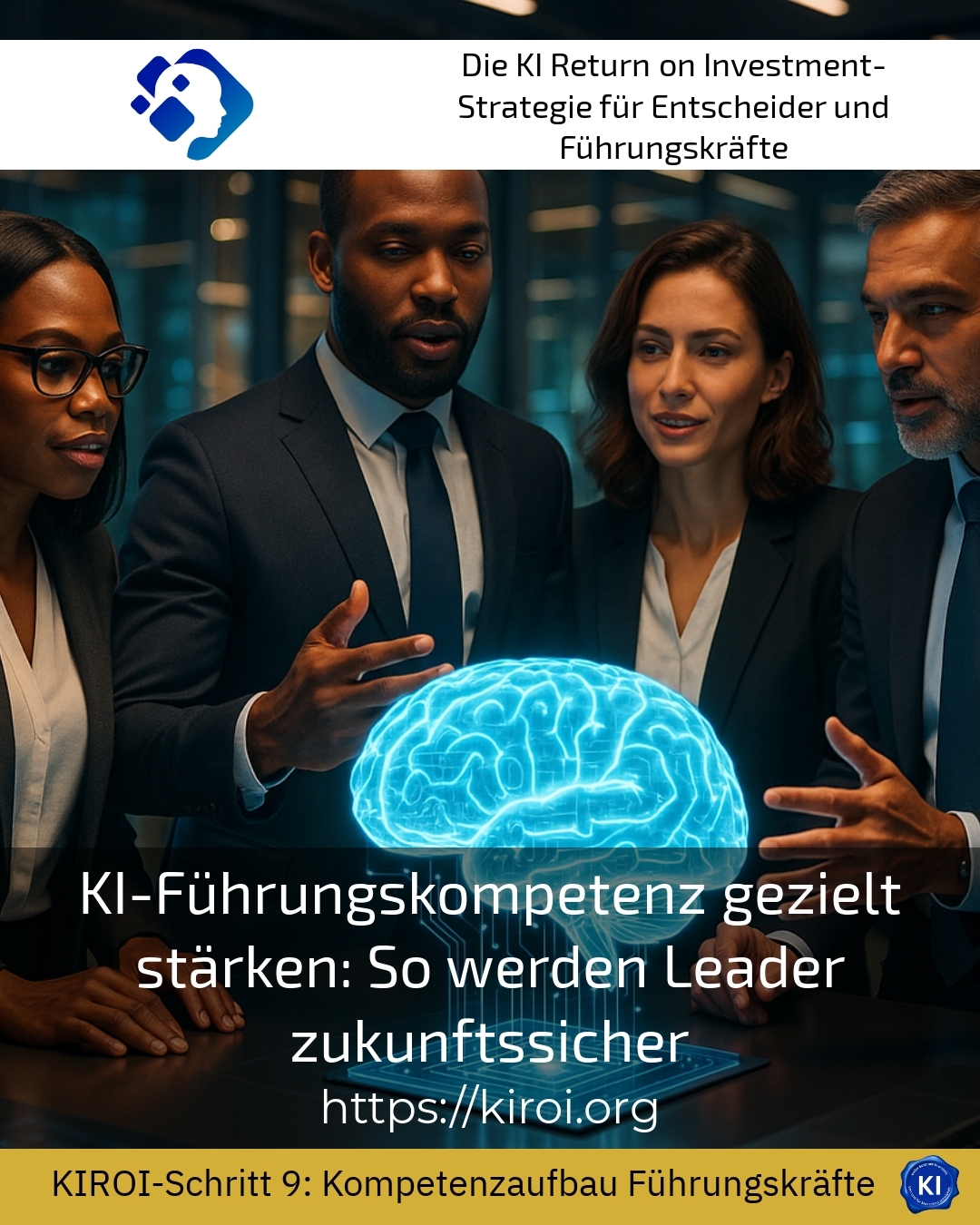
The digital transformation is fundamentally changing companies and presents leaders with entirely new challenges. Those who are not actively engaged today in their Strengthening AI leadership skills deliberately works, risks falling behind a rapidly developing business world. Many decision-makers feel this uncertainty and are looking for guidance. They wonder how to lead their teams through technological upheavals. At the same time, pressure is growing from all sides. Stakeholders expect innovation and efficiency gains, while employees wish for clear visions and authentic support. This article outlines practical ways in which modern leaders can expand their competencies, focusing not on short-term trends but on sustainable development.
Why traditional leadership models are reaching their limits today
Classical management approaches were developed for a different era. They were based on stability, predictability, and hierarchical structures. Today, however, we are experiencing a working world characterised by volatility and complexity. Leaders often report feeling overwhelmed by the speed of technological change. They must make decisions with incomplete information and unclear consequences [1]. The managing director of a medium-sized mechanical engineering company recently described his situation as constantly navigating in fog. His production managers faced the challenge of evaluating new automation solutions without being able to assess their long-term impact. Another example comes from the financial sector, where a divisional head at a regional bank found that his tried-and-tested analytical methods were no longer sufficient. The algorithm-based systems of his competitors were simply faster and more accurate. This dynamic is also clearly evident in the healthcare sector when clinic management has to decide which diagnostic technologies to implement. The investments are substantial, and the consequences of a wrong decision can be far-reaching.
Targeted strengthening of AI leadership competence through structured support
The development of modern leadership skills doesn't happen through one-off seminars or theoretical concepts alone. It requires a continuous process of reflection and practical learning. This is precisely where transruptive coaching comes in as supportive guidance for transformation projects. Support from experienced experts provides impetus and opens up new perspectives. Leaders experience a protected space where they can openly discuss uncertainties. They receive tools to analyse complex situations and make informed decisions. A sales manager from the automotive supply industry used this support to transition their department to data-driven sales processes. They subsequently reported significantly increased confidence in dealing with technological issues. A Chief Human Resources Officer from the retail sector, in turn, focused on developing a communication strategy for their workforce. They wanted to constructively address fears of job losses while simultaneously sparking enthusiasm for new opportunities. In the logistics sector, an operations manager worked on integrating intelligent dispatch systems and required support in motivating their team.
Best practice with a AIROI customer
An internationally active pharmaceutical company faced the challenge of realigning its research and development department. The management recognised that data-driven analysis methods would revolutionise drug development. At the same time, clear strategies for implementation were lacking. Within the framework of a multi-month support programme, the management team developed a profound understanding of the technological possibilities. The participants learned to formulate questions to their technical teams more precisely and gained confidence in investment decisions in the millions. The development of a communication strategy for the supervisory board was particularly valuable. The managers were now able to convincingly explain why certain technology investments were necessary. Collaboration between the scientific departments and the IT departments also improved noticeably. The team reported a new culture of joint experimentation and learning. Project cycles shortened, and employee satisfaction measurably increased.
The inner attitude as a foundation for future-proof leadership
Technical knowledge alone is not enough to lead successfully in a digitised world. One's inner attitude towards change plays an equally crucial role. Many leaders come to me with the issue of loss of control because they feel they can no longer fully grasp developments. This feeling is understandable and widespread. The challenge lies in acknowledging uncertainty as a normal part of modern leadership. A plant manager from the chemical industry worked intensively on his attitude towards failure. He learned that failed experiments represent valuable learning opportunities. A marketing manager from the consumer goods sector focused on dealing with ambiguity in strategic decisions. She developed techniques to remain capable of action even under uncertainty. In the energy sector, I accompanied a project manager who wanted to overcome his resistance to agile working methods. He realised that his previous reluctance was primarily due to a fear of losing control.
Practical strategies for developing competence in everyday leadership
Theoretical insight into the need for new skills must be supplemented by concrete courses of action. Leaders benefit from regularly scheduling time for structured reflection. They should consciously engage with technological developments without feeling the need to understand everything themselves [2]. Rather, it's about being able to ask the right questions. An IT director from the insurance industry established weekly learning rituals for his entire leadership team. They discussed current developments and their potential impact on their business model. A managing director from the education sector initiated regular exchanges with start-ups in her ecosystem. This gave her insights into innovative approaches that she could incorporate into her own organisation. In the crafts sector, a guild master experimented with new forms of youth recruitment based on digital platforms. He had to fundamentally rethink his ideas about recruitment and ultimately found it to be an enriching experience.
Targeted strengthening of AI leadership competence through interdisciplinary collaboration
The complex challenges of our time can rarely be solved from a single perspective. Successful leaders recognise the value of diverse expertise and actively promote cross-functional exchange. This often leads to unexpected synergies and innovative solutions. An example from the media industry illustrates this effectively, where an editor-in-chief brought her editorial team together with data analysts. Initial scepticism on both sides gave way to productive collaboration. In mechanical engineering, a technical director brought together his engineers and social scientists to examine the acceptance of new production processes among the workforce. The findings helped to shape a successful change process. The advantages of interdisciplinary approaches are also evident in the public sector, for example, when city administrations connect traffic planners with software developers to develop intelligent mobility solutions [3].
Best practice with a AIROI customer
A long-established family business in the food industry was undergoing a comprehensive transformation process. The third generation of the owner family wanted to make the company future-proof without jeopardising the established corporate culture. The challenge was to reconcile technological innovation with the values of a family-run business. In the coaching process, we jointly developed a vision that united both aspects. The management team developed a nuanced understanding of which processes should be automated and where human expertise remained indispensable. They learned to involve their employees as active shapers of change rather than passive recipients of change. Communication within the company became more transparent and authentic. Employees reported a new sense of appreciation and involvement. After the completion of the support phase, the company's innovation speed had increased significantly, while the fluctuation among long-serving employees had decreased.
The role of self-leadership in the context of technological transformation
Before leaders can effectively guide others through change, they must first focus on their own development. In this context, self-leadership means recognising one's own reaction patterns to the new and consciously shaping them. Many clients come to me with self-doubt because they question whether they are up to the demands of the times. These doubts are human and can be used constructively. A bank director realised during a coaching process that his perfectionism prevented him from working with incomplete information. He developed strategies to remain capable of action, even when not all variables were known. A clinic manager worked on her way of dealing with criticism, which she perceived as a personal attack. She learned to view feedback as a valuable resource for her further development. In retail, I accompanied a store manager who wanted to overcome his fear of public speaking in order to better prepare his employees for changes.
Strengthening networks and exchange formats as catalysts for AI leadership competence
Leaders benefit enormously from sharing with like-minded individuals facing similar challenges. Peer networks offer a space where open discussions about uncertainties are possible without jeopardising one's own position. These formats support the transfer of insights into practical daily life and provide valuable impetus [4]. A group of managing directors from the manufacturing industry meets regularly for confidential exchange of experiences. They discuss concrete implementation projects and learn from each other's successes and setbacks. In the service sector, a network of HR managers was established, jointly researching the future of HR. They develop models for the qualification of their workforces and share best practices. Cross-industry formats are also gaining importance because they allow for looking beyond one's own horizons and encourage unconventional ways of thinking.
The Importance of Ethical Reflection for Responsible Leadership
As technological power increases, so does the responsibility of decision-makers. Ethical questions permeate almost all areas of modern corporate management. Leaders must consider the consequences of their decisions for different stakeholder groups. A human resources manager from the telecommunications industry intensely grappled with how to design algorithmic selection processes fairly. He wanted to ensure that no unconscious discrimination was programmed into the systems. A marketing director from e-commerce questioned the ethical implications of personalised advertising and developed guidelines for her team. In the industrial context, a production manager explored how to make the transition to automated production lines socially responsible. He recognised that economic efficiency and human dignity do not have to be mutually exclusive if both aspects are considered from the outset.
My AIROI Analysis
Working with leaders during transformation processes repeatedly shows me that technological change is primarily a human challenge. It's less about learning technical details and more about developing a new attitude towards change and uncertainty. The leaders I have the privilege to support come from diverse backgrounds and have varied experiences. What connects them is the desire to successfully guide their organisations through a period of upheaval. The AIROI methodology offers a structured framework for understanding complex interrelationships and remaining capable of action. It allows for the contextualisation of technological developments without succumbing to panic or excessive euphoria. Experience shows that sustainable transformation takes time and cannot be achieved through short-term measures. Leaders who engage in this process often report profound personal development. They not only acquire new competencies but also a broadened self-understanding of their role. The ability to guide others through changes grows organically from one's own transformation experience. I am convinced that investing in leadership development is one of the most effective measures for future-proofing organisations. The challenges will not diminish, but the ability to face them constructively can be systematically developed.
Further links from the text above:
[1] Harvard Business Review – Leadership Resources
[2] McKinsey – Leadership Insights
[3] World Economic Forum – Leadership Archive
[4] MIT Sloan Management Review – Leadership
For more information and if you have any questions, please contact Contact us or read more blog posts on the topic Artificial intelligence here.








 Deutsch
  English (UK)