
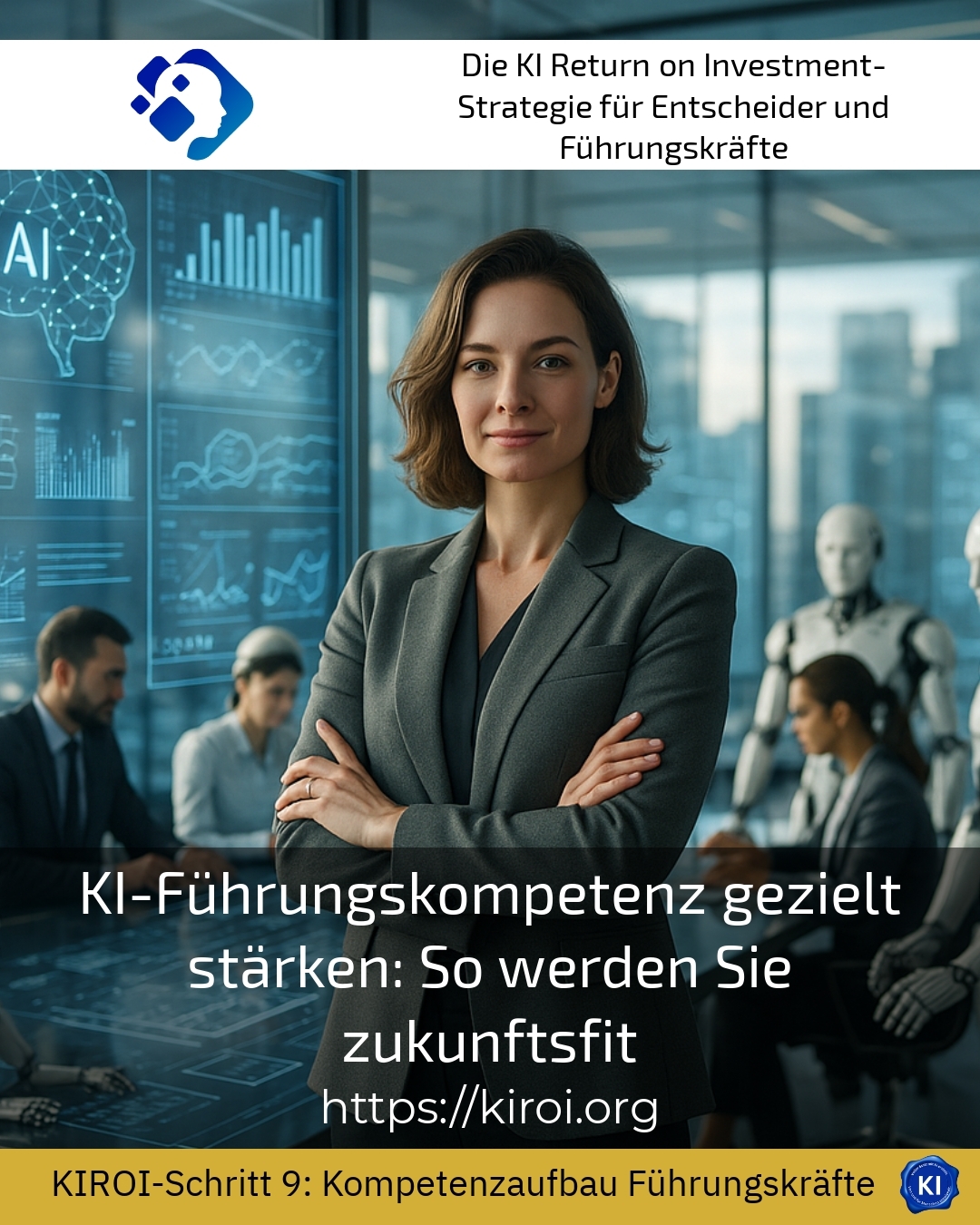
Have you ever wondered why some leaders seemingly navigate the digital transformation effortlessly, while others fail despite their best intentions? The answer often lies not in technical knowledge but in a specific skill that has become more crucial than ever today. Strengthening AI leadership skills deliberately It means preparing for a future that has already begun. Many leaders report feeling overwhelmed by the speed of technological change. At the same time, the pressure to make decisions whose implications will only become apparent in years to come is growing. In this tension between uncertainty and the pressure to act, a new understanding of leadership is emerging that goes far beyond traditional management approaches and requires a profound transformation of our own thinking.
The need for new leadership paradigms in dynamic times
The working world is changing fundamentally. Traditional hierarchies are dissolving. New forms of collaboration are emerging almost daily. In this environment, tried-and-tested management methods are no longer sufficient. Leaders must learn to deal with ambiguity while still providing guidance. They must understand technological developments without having to become technology experts themselves. Finding this balance poses significant challenges for many. For example, a medium-sized company in the logistics sector realized that while its management level possessed operational excellence, it was uncertain when making strategic technology decisions. The consequence was a months-long delay in important digitalization projects. Another example shows a trading company whose management was initially skeptical of automated processes. Only through targeted support did an understanding of the opportunities that lie in the integration of intelligent systems develop. One financial services provider also reported that its executives initially struggled to recognize and utilize the possibilities of data-driven decision making.
Targeted strengthening of AI leadership skills through systematic development
Targeted development of these competencies begins with self-reflection. Leaders must first question their own mindsets and assumptions. This is not about devaluing past achievements. Rather, the focus is on expanding one’s own horizons. Clients often report that through this reflection, they have gained entirely new perspectives on their organization. They suddenly recognize connections that had previously remained hidden. These insights form the foundation for sustainable change. One manufacturing company used this approach to transform its entire leadership culture. The results were remarkable: higher employee satisfaction, faster decision-making processes, and significantly improved innovation capabilities. A technology company, in turn, relied on regular rounds of reflection in which leaders shared their experiences with new technologies and learned together. A healthcare provider also implemented structured development programs that helped executives navigate technological changes in a constructive way.
Best practice with a AIROI customer
A traditional family business in the manufacturing sector faced the challenge of preparing its leadership team for the digital future. The second generation had successfully led the company through several economic crises, but the impending technological transformation required new skills and ways of thinking. As part of a transruptive coaching process, we supported the management team over an eighteen-month period in this development. First, we jointly analyzed the existing leadership competencies and identified areas for development that were particularly relevant to the intended transformation. In regular coaching sessions, we worked on concrete challenges that arose in day-to-day operations and required new skills. The leadership team learned to align with technological developments and assess their relevance to their business model. They developed a sense of when external expertise is useful and how to effectively incorporate it. Particularly valuable was the realization that leadership in times of change primarily means creating spaces for experimentation and learning from mistakes. After completing the coaching process, not only did the individual leadership behavior change, but the corporate culture as a whole as well. The organization became more open to change and was able to implement new technologies faster and more successfully than before.
Practical strategies for everyday leadership
Implementing new leadership skills in everyday life requires concrete strategies and continuous practice. It is not enough to accumulate theoretical knowledge. What is crucial is practical application in real situations. Many leaders underestimate the importance of small, consistent steps. They expect big breakthroughs, whereas sustainable change usually arises through persistent work on details. For example, a consulting company experimented with new meeting formats that offered more room for creative thinking and critical reflection. The leaders learned to ask better questions instead of immediately giving answers. An insurance company introduced so-called learning circles where leaders from different departments exchanged their experiences with new technologies. A media company also embarked on cross-functional projects that enabled executives to look beyond their traditional areas of expertise and gain new perspectives.
The role of communication and transparency
Effective communication forms the foundation of future-oriented leadership. In times of technological upheaval, uncertainties arise at all levels of an organization. Employees wonder how their work will change and what skills will be in demand in the future. Leaders cannot completely eliminate these uncertainties. However, through transparent communication, they can build trust and provide orientation. An energy supply company established regular dialogue formats in which the management informed about strategic considerations and technological developments openly. The employees appreciated this openness and became more actively involved in change processes. A pharmaceutical company, in turn, invested in the communication skills of its leadership because it recognized that technical competence alone was not enough to successfully manage change. One automotive supplier also reported that improved communication at the management level helped reduce resistance to new technologies and increase acceptance.
Targeted strengthening of AI leadership competencies in the context of organizational transformation
Individual competence development and organizational change are closely intertwined. Leaders who expand their own skills act as catalysts for change within their teams and the entire organization. At the same time, corporate culture influences how quickly and sustainably new competencies can be developed. Understanding and consciously shaping this interaction is a central aspect of future-proof leadership. Clients often report that they only realized how strongly organizational structures influenced their actions through their own development work. This insight enabled them to work specifically on structural changes. A telecommunications company used the competence development of its leaders as a starting point for a comprehensive cultural change. A mechanical engineering company recognized that the development of individual leaders was not sufficient and established team-based learning formats. A service company from the tourism industry also linked individual development with organizational change processes.
Best practice with a AIROI customer
An international trading company sought support in transforming its leadership culture in the context of increasing automation. The previous leadership culture was strongly characterized by control and clear hierarchies, which had worked well in the past. However, the introduction of intelligent systems in different business areas required a different leadership approach that placed more emphasis on trust and empowerment. As part of the transruptive coaching project, we worked closely with top management to first develop a shared understanding of the necessary changes. In workshops and individual coaching sessions, the leadership team reflected on their own beliefs and behaviors and identified areas where adjustments seemed meaningful. Working with concrete scenarios that showed how leadership can change in an increasingly automated working world and what new opportunities this opens up was particularly helpful. The leaders gradually developed more confidence in their own ability to deal with uncertainty and to use it productively in their teams. After about twelve months, the leadership behavior had noticeably changed, and the organization was able to implement new technologies much more smoothly than before. Employees reported a more positive work environment and a greater willingness to embrace change.
Ethical dimensions of sustainable leadership
The ethical aspects of technological decisions are becoming increasingly important. Leaders must be able to consider not only economic but also societal and ethical implications of their decisions. This requires a broader understanding of responsibility and the ability to adopt different perspectives. For example, a financial company established an ethics committee that advises on technological decisions and ensures that various stakeholder interests are taken into account. A retail company developed guidelines for the responsible use of data-driven technologies that take into account both customer interests and employee concerns. A healthcare company also intensively addressed ethical issues and integrated this reflection into its leadership development. These examples show that ethical competence is an essential component of future-proof leadership.
Establishing continuous learning as a fundamental attitude
The speed of technological developments makes continuous learning a necessity. Leaders cannot assume that knowledge acquired once remains permanently relevant. They must develop a mindset that understands learning as an integral part of their leadership role. This means consciously planning time for reflection and development and actively shaping learning processes. For example, a software company introduced so-called learning budgets for leaders, which they can use independently to develop their skills. A logistics company established regular learning trips where leaders visit innovative companies and gather new insights. A consulting company also relied on collaborative learning, where leaders mentor each other and learn from each other. These approaches show that continuous learning can be integrated into the leadership routine in various ways. Accompanying transruptive coaching can help develop individual learning strategies and support their implementation [1].
My AIROI Analysis
Developing leadership skills for an increasingly technology-driven future is not an optional addition; it is a strategic necessity. My experience from numerous mentoring projects shows that leaders who actively engage in their own development are significantly more successful in navigating transformation processes. This is not primarily about technical knowledge but about the ability to contextualize technological developments and assess their relevance for one’s own organization. I find the connection between individual competence development and organizational change particularly important. Leaders who work in isolation, without considering the organizational context, often hit limitations. Conversely, organizational change projects often fail because leaders are not sufficiently prepared for their new role. The integration of both perspectives is therefore crucial for sustainable success. The ethical dimension of future-oriented leadership deserves special attention. Technological decisions have far-reaching consequences that go beyond the immediate business context. Leaders who take this responsibility seriously and incorporate different perspectives into their decisions build trust among employees, customers, and society as a whole. Continuous learning forms the foundation upon which all other competencies are built. The willingness to question one’s own assumptions and adopt new perspectives distinguishes future-oriented leaders from those who cling to outdated patterns. Specifically strengthening AI leadership competence ultimately means developing an attitude that understands change as an opportunity and actively shapes it.
Further links from the text above:
[1] AIROI Methodology for Leadership Development
For more information and if you have any questions, please contact Contact us or read more blog posts on the topic Artificial intelligence here.






 Deutsch
 English (UK)