
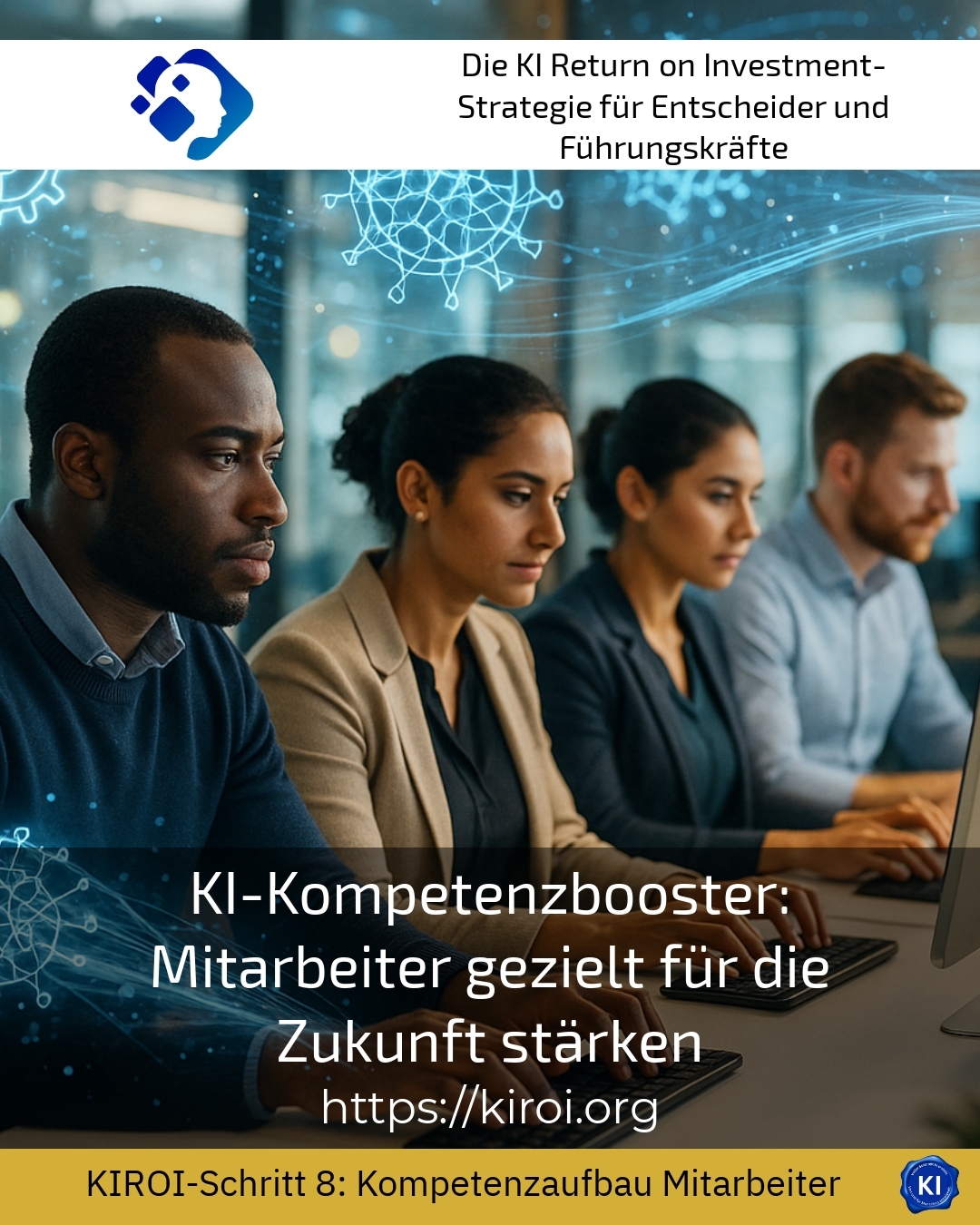
Digital transformation is changing workplaces at a rapid pace, and many companies today are wondering how best to prepare their workforce for these changes. The AI Skills Booster: Targeted Employee Development for the Future is becoming the decisive factor for success for organisations of all sizes. As algorithms and automated systems take over more and more tasks, entirely new demands are simultaneously being placed on human skills and competencies. Those who do not act now risk falling behind. In this article, you will learn which concrete strategies have proven effective in practice and how you can sustainably empower your teams.
Why the AI competence booster has become indispensable today
The world of work is undergoing fundamental change. Intelligent systems are now permeating almost every area of business. New interfaces between humans and machines are emerging, from customer service to product development. This is no longer just about technical understanding. Instead, employees need a holistic range of skills that combine critical thinking with digital know-how. Studies show that companies with targeted qualification programmes react significantly more resiliently to market changes [1]. This insight has far-reaching consequences for personnel development.
In manufacturing companies, for example, we are already seeing how intelligent assistance systems complement the work of skilled workers. For instance, a machine operator uses predictive maintenance tools to identify potential failures early on. Quality control benefits from image recognition systems that identify defects faster than the human eye. At the same time, new requirements are emerging in the logistics sector for warehouse staff who must collaborate with autonomous transport systems. All these developments require continuous further training and an open attitude towards change.
The financial sector, in turn, exemplifies how quickly job profiles can change. Today, customer advisors work with intelligent analysis tools that generate portfolio recommendations. Compliance officers use automated systems for fraud detection and risk analysis. Even in asset management, hybrid working models are emerging where human expertise and algorithmic precision work together. This transformation requires not only technical training but also a fundamental redefinition of professional identities.
Strategies for a Successful AI Competency Booster in Organisations
The implementation of effective qualification measures begins with an honest assessment. What skills are already present, and where are the critical gaps? Many companies report conducting skill mappings before planning concrete training measures. It has been shown that individual learning paths often achieve better results than standardised, one-size-fits-all programmes. transruptions coaching can provide valuable impetus during this phase and support companies in strategic planning [2].
In the healthcare sector, for example, modular continuing education concepts have proven successful, gradually introducing nursing staff to digital documentation systems. Doctors, in turn, use specialised workshops to effectively integrate diagnostic support systems into their daily work. Administrative staff in hospitals learn to use intelligent appointment scheduling tools and automated billing processes. These sector-specific approaches demonstrate that successful competency development must always be context-dependent.
Retail offers further insightful examples of successful qualification strategies. Sales staff are increasingly being trained in the use of recommendation algorithms that generate personalised product suggestions. Store managers work with data-driven inventory management systems that optimise reordering. In e-commerce, new roles are emerging for content managers who create product descriptions using intelligent text tools. All these developments highlight the need for continuous professional development at all levels of the hierarchy.
Best practice with a KIROI customer
A medium-sized company in the manufacturing sector faced the challenge of preparing its workforce for new intelligent production systems. Management recognised early on that technical training alone would not be enough to create the necessary acceptance. Together with transruptions-Coaching, a comprehensive support programme was developed that involved both skilled workers and management. In the first phase, we conducted intensive workshops where fears and concerns could be openly addressed. Employees were given space to articulate their worries regarding job security and the pressure to change. Subsequently, we developed individual learning pathways that built upon existing competencies and defined realistic development goals. The involvement of experienced skilled workers as internal multipliers, who shared their knowledge with colleagues, was particularly valuable. After twelve months, over eighty percent of participants reported increased confidence in using the new systems. Productivity increased measurably, while employee turnover decreased significantly. This example impressively shows how holistic support enables sustainable change.
The Role of Leaders in the AI Competency Booster
Leaders are in a key position for digital transformation. They must not only develop new skills themselves but also guide their teams through change processes. This goes beyond classic change management. Rather, leaders need a deep understanding of the possibilities and limitations of intelligent systems. Only then can they formulate realistic expectations and adequately support their employees. Clients often report that a lack of leadership competence is the biggest stumbling block in transformation projects.
In the banking sector, for example, team leaders need to understand how algorithmic credit decisions work in order to coach their advisors accordingly. In the insurance industry, department heads are learning to monitor automated claims processes and intervene in escalations. In human resources, on the other hand, new requirements are emerging for HR managers who work with intelligent recruiting tools and must also consider ethical aspects. These diverse challenges require specialised leadership development [3].
The communications industry particularly clearly shows how leadership roles are changing. Editorial managers today coordinate teams in which human journalists collaborate with automated text generators. Marketing directors manage campaigns that are optimised in real-time by intelligent systems. Creative directors need to understand how generative tools are changing creative processes and opening up new possibilities. All these developments require a rethink in leadership culture and continuous reflection on one's own role.
Practical implementation and sustainable anchoring
The successful implementation of qualification programmes requires careful planning and realistic goal setting. Many companies make the mistake of wanting to change too much at once. Instead, an iterative approach has proven successful, where small successes are built up step by step. transruptions-Coaching supports organisations in establishing sustainable structures that remain effective even after the project is completed. Integration into daily work is crucial for long-term success.
In the automotive industry, learning factories have become established, where skilled workers can test new technologies under realistic conditions. Development engineers use simulation environments to practice using intelligent design tools. Production staff train on digital twins of their workplaces before new systems go into operation. These practical approaches significantly reduce inhibitions and accelerate competence building.
The energy sector, in turn, illustrates how sector-specific requirements can be incorporated into qualification programmes. Grid technicians are learning to handle intelligent control systems for renewable energies. Customer advisors are being trained in the use of consumption analysis tools that identify individual saving potentials. Maintenance teams work with predictive systems that calculate the probability of plant failures. These examples demonstrate that successful competence development must always integrate sector-specific knowledge [4].
Best practice with a KIROI customer
An international service provider approached us because the introduction of intelligent customer communication systems met with significant resistance. Employees in the service sector feared being replaced by automated chatbots. These fears were understandable and had to be taken seriously before technical training could make any sense. We started with extensive one-on-one discussions, which gave equal space to concerns and hopes. It became clear that many employees were indeed interested in new tasks if they were offered a clear perspective. Together, we developed a concept that emphasised the strengths of human communication and positioned automated systems as support. Service employees increasingly took on more complex consulting tasks, while standard queries were handled automatically. In parallel, we established a mentoring programme where technically adept colleagues acted as contact persons. After implementation, both customer satisfaction and employee satisfaction increased measurably. This project impressively demonstrates that technological change and human needs do not have to be mutually exclusive.
Measurable successes and continuous improvement
The effectiveness of training measures must be regularly reviewed and adjusted. Both quantitative and qualitative indicators should be taken into account. Pure participant numbers say little about actual competence gains. Instead, practice-oriented assessments that measure the transfer to daily work are recommended. Many organisations establish systematic feedback loops for this purpose, enabling continuous improvement.
In the pharmaceutical sector, for example, qualification successes are measured by concrete process improvements. Researchers document how quickly they can productively deploy new analysis tools. Quality managers report efficiency gains in the documentation and evaluation of study data. Production employees demonstrate their increased confidence in handling automated filling systems in practical tests. These concrete proofs of success create transparency and motivate further development.
The telecommunications industry has developed innovative approaches to measuring success that can serve as a model. Technicians are tested in simulated fault scenarios after training, which replicate real-world conditions. Sales representatives demonstrate their ability to use intelligent product configurators in a customer-oriented manner. Network specialists prove their understanding of automated capacity planning in practical exercises. These approaches combine qualification with concrete proof of competence and create commitment.
My KIROI Analysis
The systematic development of competencies for an increasingly automated world of work is no longer an optional measure, but a strategic necessity for every future-oriented company. AI Skills Booster: Targeted Employee Development for the Future proves to be an effective approach that combines technical knowledge with human skills. My experience from numerous accompanying projects shows that successful transformation always puts people at the centre. Technology alone does not create sustainable change if employees are not brought along.
I particularly value the realisation that qualification cannot be completed with a one-off training session. Rather, organisations require continuous learning structures that foster adaptability as a core competency. The presented examples from various industries illustrate that industry-specific approaches are more successful in this regard than generic programmes. At the same time, the best-practice cases show how important psychological support is alongside technical qualification. Fears and resistance must be taken seriously before learning successes can be achieved.
For the future, I recommend that companies invest in skills development early on, utilising external support. Transruptions coaching can assist in developing tailored programmes and embedding them sustainably. Investing in human skills is ultimately the best safeguard against disruptive change, because competent and confident employees can overcome any technological challenge. The question is no longer whether companies should upskill their workforce, but only how quickly and comprehensively they do so.
Further links from the text above:
[1] McKinsey – Reskilling in the Age of AI
[2] transruptions-Coaching – Support for Digital Transformation
[3] Harvard Business Review – Leadership and Digital Transformation
[4] World Economic Forum – Future of Jobs Report
For more information and if you have any questions, please contact Contact us or read more blog posts on the topic Artificial intelligence here.











 Deutsch
  English (UK)