
Have you ever wondered why brilliant business ideas so frequently founder on reality, even though the planning appeared flawless? The answer lies in a fundamental fallacy that almost every company commits. Leaders invest months in developing sophisticated concepts, only to discover that the market reacts completely differently than expected. The strategy for change does not fail due to a lack of intelligence or a lack of commitment. It fails because no one previously tested systematically where the vulnerabilities lie. What if, however, you already knew every possible mistake before investing even a single euro? What if your strategy for change could fail a hundred times over without your business suffering any harm?
The traditional approach and its hidden weaknesses
In most organisations, strategy development follows a set pattern. First, consultants or internal teams analyse the current situation. Subsequently, senior managers define ambitious goals. After that, detailed action plans are drawn up. Finally, implementation begins. This linear approach appears logical and structured. However, it harbours a dangerous blind spot.
Reality is far more complex than any planning session can depict. For example, a medium-sized manufacturing company is planning the introduction of new production processes. The calculation takes into account investment costs and expected efficiency gains. However, nobody considers that experienced employees might leave the company. A retail company develops an expansion strategy for new locations. The market analysis shows promising figures. Yet no one simulates what happens if a disruptive online competitor appears in this exact segment. A logistics service provider optimises its supply chains. The calculations yield impressive cost reductions. However, nobody models the impact of geopolitical disruptions on supplier relationships.
These examples illustrate the core problem of average corporate strategies. They are based on assumptions about a future that no one can predict. They factor in known variables and ignore unknown risks. They optimise for expected scenarios and fail during unexpected developments. Average companies solve this problem by developing the strategy and then implementing it, hoping for the best. They only react to problems once they have already materialised. This reactive stance costs time, money and market share.
Why traditional risk analyses are inadequate
Many managers will object that their planning processes do indeed include risk assessments. This assessment is not incorrect. However, it falls far short. Traditional risk analyses suffer from several systematic biases.
The human mind tends to underestimate extreme events. Psychologists call this phenomenon the availability heuristic. We assess risks according to how easily we can imagine similar events. An automotive supplier assesses the risk of a pandemic as low because no one in the management team has experienced anything comparable. A financial services provider underestimates regulatory changes because the last major reform happened years ago. A mechanical engineering company ignores technological disruptions because its own industry has appeared stable up to now.
Then there is confirmation bias. Teams unconsciously look for information that confirms their strategy. They overlook or downplay warning signs. An energy supplier is planning massive investments in conventional technologies. Critical voices within the company are dismissed as worrywarts. A retail company is expanding aggressively even though initial locations are already loss-making. The negative development is interpreted as a start-up phase. A technology company is sticking to its product strategy even though customer feedback contains clear criticism. The feedback is classified as unrepresentative.
The limits of human imagination
Even the most experienced strategists cannot anticipate all possible developments. The combinatorics are simply too overwhelming. A medium-sized company must consider dozens of variables. Each variable can take on different states. The number of possible scenarios explodes exponentially. No strategy workshop can capture this complexity.
A pharmaceutical company has to monitor regulatory developments in different countries simultaneously. It has to assess competitors' research findings. It has to analyse demographic trends. It has to anticipate technological breakthroughs. It has to take changes in the healthcare system into account. Each of these factors interacts with the others. The complexity exceeds human capacity. A property developer faces similar challenges. Interest rate trends, construction costs, migration movements, political decisions and social preferences form an impenetrable web. A telecommunications provider has to look at technological, regulatory and competitive factors simultaneously.
Rethinking the strategy for change with AIROI
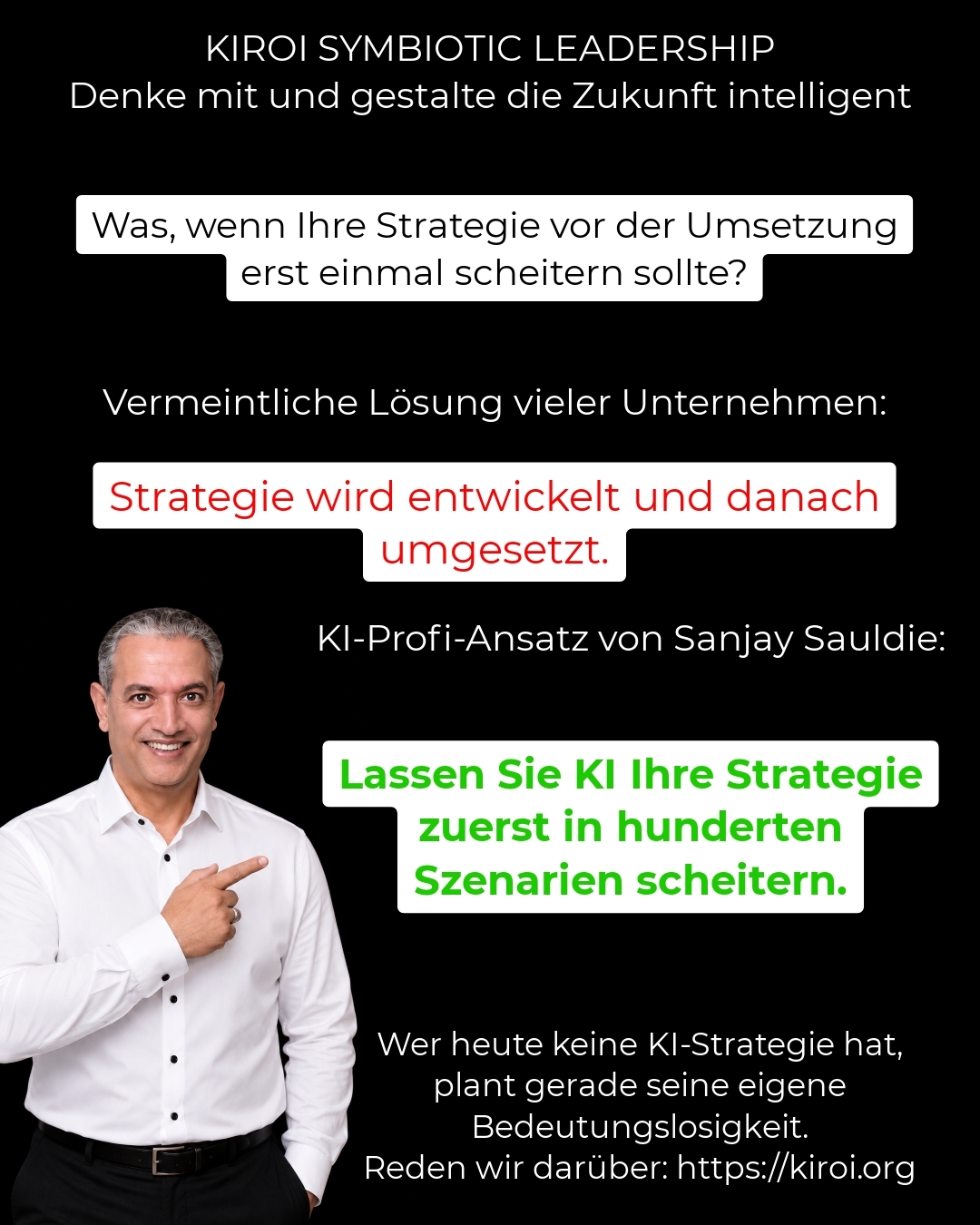
Artificial intelligence paves the way for a radically different approach. The AIROI methodology uses machine learning to systematically test strategies before they are implemented. The core idea is as simple as it is revolutionary: let AI make your strategy fail first across hundreds of scenarios. Gather all potential errors virtually. Optimise your plan based on these insights. Only then do you begin execution.
This approach reverses the traditional logic. Instead of solving problems after they have occurred, you identify them beforehand. Instead of learning from your own mistakes, you learn from simulated mistakes. Instead of acting reactively, you act proactively. The strategy for change thereby becomes more robust and adaptable.
The Artificial intelligence can run through thousands of scenarios in a short time. It combines variables that no human team would ever think of together. It identifies vulnerabilities that are overlooked in traditional risk analyses. It quantifies the impact of various developments on your strategy's success. An insurance company tests its new product strategy against various loss scenarios. It simulates natural disasters, pandemics and cyber attacks. It models the behaviour of competitors and customers. In the end, a strategy is created that works under many different conditions.
Best practice with a AIROI customer
An internationally active mechanical and plant engineering company faced a pivotal decision regarding its future market positioning in emerging regions, with significant investments in new production capacities planned and management requiring a sound basis for decision-making that went beyond traditional market analyses. The transruptions coaching accompanied the leadership team in implementing an AI-supported scenario analysis that modelled more than three hundred different future trajectories, taking into account factors such as currency fluctuations, political stability, local competitive developments, infrastructure investments of the target countries and technological paradigm shifts. The simulation showed surprisingly clearly that the region originally favored would harbour significant risks under certain plausible conditions, whereas an alternative location choice achieved better results in more than seventy per cent of the simulated scenarios. The company adapted its strategy for change accordingly and chose a staggered market entry with flexible exit options, which proved to be farsighted within the first eighteen months, as geopolitical developments would indeed have made the original preference problematic. Clients in similar situations frequently report that this forward-looking analysis not only avoids financial losses, but also significantly strengthens the leadership team's confidence in the decisions made.
How the AIROI methodology works in practice
The process begins with comprehensive data collection. Internal information such as financial metrics, process data, and employee surveys are incorporated. External data such as market trends, competitor behaviour, and macroeconomic indicators complete the picture. The Artificial intelligence analyse these datasets and identify relevant variables and their interactions.
The system then automatically develops scenarios. It systematically varies individual parameters. It combines different developments with one another. It weights scenarios according to their probability of occurrence. A chemical company thus gains insights into hundreds of possible futures. Each of these futures tests the planned strategy for its robustness. A building materials manufacturer identifies the conditions under which its expansion plans would be jeopardised. A software company understands which technological developments could render its product strategy obsolete.
The results are presented visually and made accessible to human decision-makers. Transruption coaching supports management teams in interpreting the insights and translating them into concrete measures. The focus is on action-orientation and practical applicability. Theoretical perfection gives way to pragmatic improvement.
Practical fields of application for predictive strategy simulation
The potential applications are diverse and relevant across industries. A consumer goods manufacturer uses the methodology to optimise product launches. It simulates competitor reactions to various price points. It models consumer behaviour under different economic conditions. It tests marketing strategies against various media landscapes.
A logistics company applies the approach to its network planning. It simulates failures of individual nodes. It models demand fluctuations in different regions. It tests the impacts of energy price trends on its cost structure. A healthcare provider optimises its capacity planning using scenario simulation. It models demographic trends and their impacts on demand. It simulates regulatory changes and their financial consequences. It tests various staffing strategies against different labour market trends.
In each of these cases, the organisation learns from virtual errors instead of real setbacks. It gains time and saves resources. It develops strategies that can work under many different conditions. The probability of failure decreases significantly.
My AIROI Analysis
The systematic simulation of strategy scenarios using Artificial intelligence marks a paradigm shift in corporate management. Organisations that adopt this approach gain significant competitive advantages over traditionally operating competitors. The ability to make mistakes virtually and learn from them before real resources are deployed represents an evolutionary leap.
My observations from accompanying numerous transformation projects clearly show: companies that rigorously test their change strategy before implementation achieve their goals more often and faster than those that follow the traditional path. The investment in predictive analytics often pays off within a few months through avoided poor decisions and optimised resource allocation.
At the same time, my analysis warns against overinflated expectations. Artificial intelligence does not replace human judgment and strategic intuition. However, it significantly broadens the horizon of what is possible. It makes implicit knowledge explicit and quantifiable. It democratises access to complex analyses that were previously reserved for large corporations. The future belongs to organisations that combine human creativity with machine analytical power. Transruption coaching offers precisely this combination. It supports leaders in unlocking the potential of intelligent systems without neglecting the human factor. It provides impetus for new ways of thinking and accompanies the cultural change that is essential for successful transformation [1]. The question is no longer whether companies will use AI-driven strategy simulation. The question is simply who will do so first and thereby secure decisive advantages [2].
Further links from the text above:
[1] AIROI Framework - Strategic AI Implementation
[2] transruptions Coaching – support for digital transformation
Are you a leader and would you like to learn how you can genuinely introduce AI into your company in a valuable and sustainable way, away from the hype? Take part Contact us or read more blog posts on the topic Artificial intelligence here.








 Deutsch
  English (UK)