
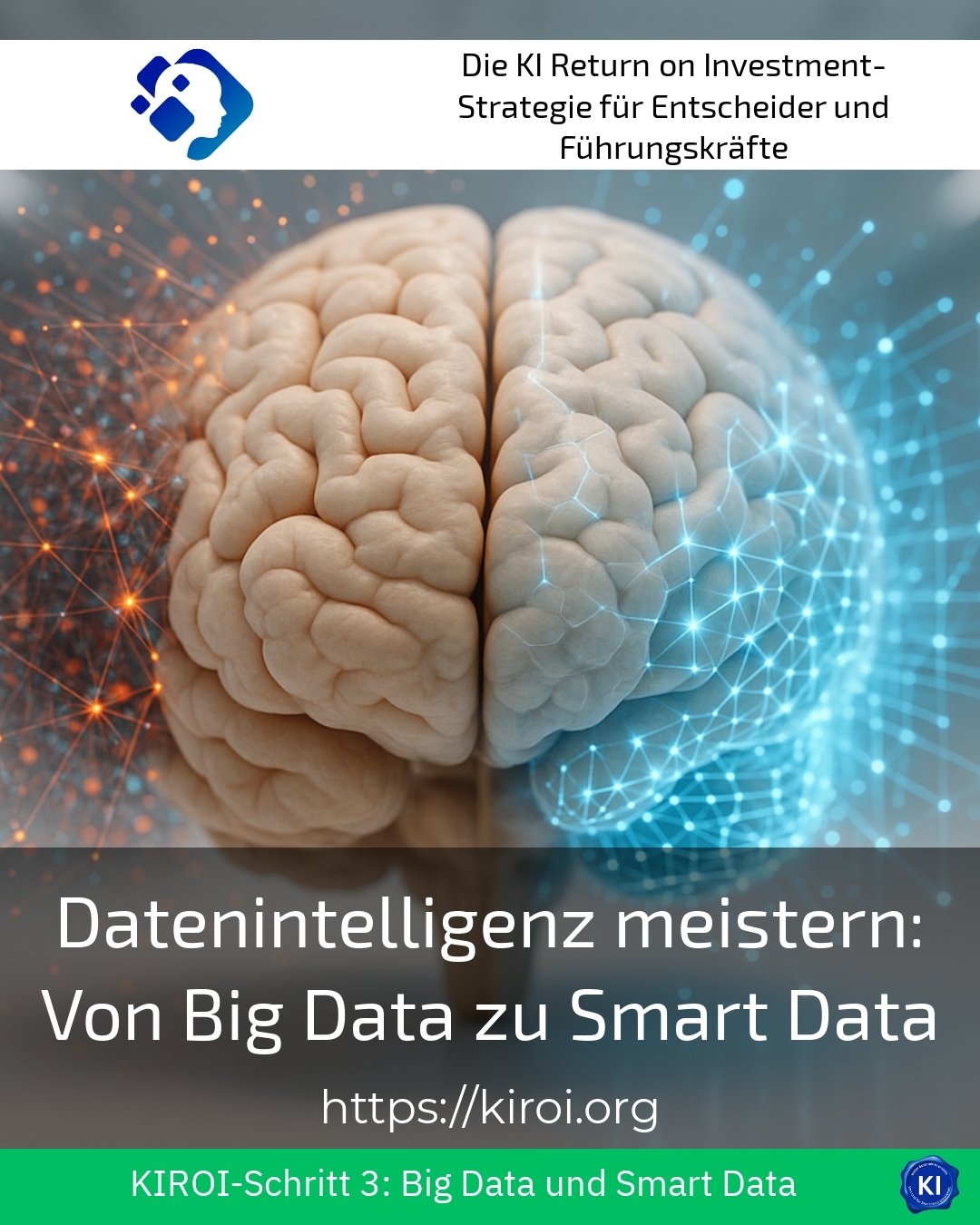
Imagine your company swimming daily in an ocean of information, yet you're fishing blind for the valuable pearls that could determine your success. This is precisely where the journey from mere data collection to true Mastering Data Intelligence because it is only when companies learn to extract usable insights from the sheer volume of raw data that those competitive advantages emerge which, in today's dynamic world of business, make the crucial difference between market leaders and laggards.
The transformation of mass data into strategic insights
Gigantic amounts of data are generated daily in almost every organisation. These arise from customer interactions, production processes, and digital transactions. However, the true value of this information often remains untapped. The key lies not in collecting but in intelligently processing it. Companies must understand that quantity alone does not create quality. Clients, for example, frequently report overflowing databases with no actual recommendations for action.
For example, a logistics company collected delivery data for years without making concrete use of it. Only through targeted analysis did insights into optimal delivery routes emerge. A retailer had millions of till receipt data but failed to recognise purchasing patterns. And a financial service provider stored customer data without predicting churn risks. These examples clearly show how unused potential lies dormant within organisations.
Best practice with a AIROI customer
A medium-sized trading company approached our transruption coaching with a specific challenge. The company possessed extensive sales data from five different sales channels. However, a unified view of customer behaviour was completely lacking. As part of the support, we jointly developed a data integration strategy. First, the teams identified relevant data sources and their quality level. Subsequently, they established clear processes for data cleansing and harmonisation. The actual transformation was achieved through the implementation of analytical tools with real-time dashboards. Within six months, the company was able to precisely identify customer segments. The personalised marketing measures led to a significant increase in conversion rates by considerable percentage points. Particularly noteworthy was the newly acquired ability to predict seasonal demand fluctuations. This significantly improved inventory management and significantly reduced overstock.
Mastering data intelligence through intelligent analysis methods
The transition from raw information to actionable insights requires well-thought-out analysis methods. Various technologies play a central role in this transformation process. Machine learning enables the automatic recognition of patterns in complex datasets. Predictive analytics supports businesses in predicting future developments with increased probability. Natural Language Processing opens up the possibility of systematically evaluating unstructured text data [1].
An insurance company uses these technologies for automated claims processing. This has significantly reduced processing times. A telecommunications provider automatically analyses customer inquiries using speech recognition. This continuously improves service quality. An energy supplier forecasts electricity consumption by integrating weather data. These practical applications demonstrate the enormous potential of intelligent data utilisation.
The role of data quality in the transformation process
High-quality insights arise exclusively from high-quality source data. Therefore, data quality forms the foundation of any successful analysis strategy. Incomplete datasets inevitably lead to flawed conclusions. Outdated information generates misleading recommendations for action with potentially negative consequences. Inconsistent data formats significantly hinder the integration of various sources.
Clients frequently report challenges with data cleansing. A pharmaceutical company discovered duplicate customer data records to a significant extent. An automotive supplier struggled with different product names across various systems. A construction company found that project data was incompletely captured. These situations require systematic quality assurance processes as a basis for valid analyses.
Mastering the Strategic Implementation of Data Intelligence
The successful introduction of intelligent data utilisation requires a well-thought-out strategic approach. Technology alone does not solve problems without corresponding organisational change. Employees must understand and accept the importance of data-based decisions. Leaders should act as role models and actively promote data-driven decision-making processes. Cultural changes require time and continuous support from experienced partners [2].
Transruption coaching supports companies precisely in this transformation. A mechanical engineering company gradually introduced data-based production control. The impetus from the coaching helped to overcome resistance within the team. A media company established data-driven editorial decisions with external support. A healthcare provider optimised patient flow through systematic appointment analysis. These projects show how important professional support is during such changes.
Best practice with a AIROI customer
An internationally active manufacturing company sought support in digitising its quality control processes. The initial situation was characterised by manual inspection processes and paper-based documentation. As part of the transruption coaching, we jointly developed a vision for data-driven quality assurance. The team first identified all relevant inspection parameters and their interrelationships. Sensors at critical production points now continuously captured real-time measurements. The analysis of this data enabled the early detection of quality deviations. Predictive maintenance approaches significantly reduced unplanned machine downtimes. Employees received intensive training on interpreting the new dashboards. The integration of data analysis into existing workflows was particularly important. Following implementation, the teams report increased transparency and faster response times. The scrap rate measurably decreased, and customer satisfaction rose accordingly.
Ethical aspects of intelligent data usage
Alongside technical issues, ethical considerations are playing an increasingly important role. The responsible handling of information requires clear guidelines and transparent processes. Data protection regulations set legal frameworks for data usage. Furthermore, moral obligations towards customers and employees are arising. Algorithms can unintentionally amplify biases and produce discriminatory results [3].
A recruitment agency reviewed its selection algorithms for possible discrimination. A credit institution established accountability requirements for automated credit decisions. An e-commerce company introduced transparency rules for personalised pricing. These examples illustrate how companies can actively take on ethical responsibility. The balance between efficiency and fairness requires continuous reflection.
Future prospects and technological developments
Technological development is progressing relentlessly, constantly opening up new possibilities. Edge computing enables data analysis directly at the source without any time delay. Quantum computers promise exponentially faster calculations for complex analysis scenarios. Federated learning allows machine learning while preserving data protection. These technologies will fundamentally change the way data is used.
An automotive manufacturer is already testing edge computing for autonomous vehicle functions. A chemical company is researching quantum computing for molecular simulations. A hospital network is investigating federated learning for data-protection-compliant research. These pilot projects are providing impetus for future applications in various industries. Companies should carefully observe these developments and build up expertise at an early stage.
Mastering the Success Factors for Sustainable Data Intelligence
Long-term success in intelligent data utilisation is based on several crucial factors. Leaders must recognise and communicate the strategic importance of data. Investments in technology and employee skill development are equally necessary. Agile working methods allow for rapid adaptation to changing requirements. External support can bring valuable perspectives and experience.
A consumer goods company successfully established a data literacy programme for all employees. A logistics service provider created a central data governance structure with clear responsibilities. A technology group systematically fosters exchange between specialist departments and data experts. These organisational measures form the foundation for sustainable data competence.
My AIROI Analysis
The transformation of raw data into strategically valuable insights presents companies with multifaceted challenges. Technical aspects only form part of the equation. Organisational changes and cultural adjustments are at least equally important. The projects I've supported clearly show that sustainable success requires time and patience. Quick technical solutions often fail due to a lack of employee buy-in.
The discrepancy between available data volumes and their actual use seems particularly noteworthy to me. Many companies diligently collect information without a clear exploitation strategy. Defining concrete questions before data collection significantly improves the quality of the results. Furthermore, I observe a growing sensitivity to ethical aspects of data usage. I consider this a positive development for the entire economy.
Transruption coaching has proven to be a valuable accompaniment for complex transformation projects. The combination of technical understanding and change management expertise enables comprehensive support. Companies benefit from external perspectives and proven methodologies. The future belongs to those organisations that not only collect data but also use it intelligently.
Further links from the text above:
[1] IBM – Natural Language Processing explained
[2] Harvard Business Review – Data Analytics Insights
[3] Federal Commissioner for Data Protection and Freedom of Information
For more information and if you have any questions, please contact Contact us or read more blog posts on the topic Artificial intelligence here.









 Deutsch
  English (UK)