
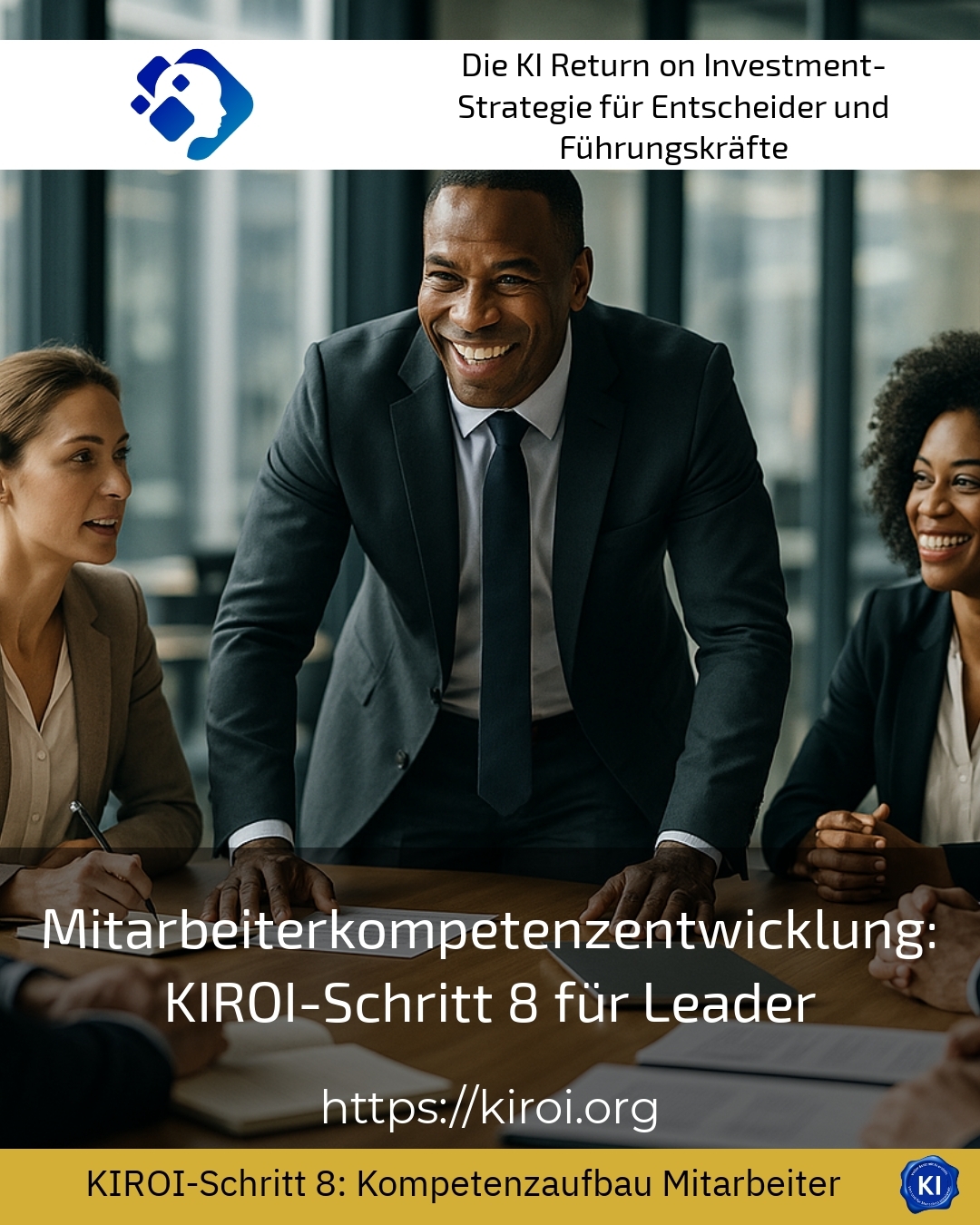
Employee competence development is a crucial factor in making companies competitive in the long term. It is particularly important for managers to understand how they can specifically promote the skills of their employees. KIROI Step 8 for Leaders supports exactly this: it guides leaders in the sustainable development of their teams and provides impulses for targeted development of individual potential.
Employee competence development as the key to company success
At the heart of employee competence development lies the continuous promotion of skills that are both professional and social in nature. Leaders often face challenges in motivating employees to develop their competencies and adapt to change. For instance, in small and medium-sized enterprises or the manufacturing sector, innovative training can help impart technical skills more quickly. In the service sector, on the other hand, the development of communication and problem-solving skills is particularly relevant.
In practice, methods such as mentoring, coaching and job rotation have proven effective. For instance, a manufacturing company introduced systematic job rotation, where employees regularly learn about new work areas. This increased their flexibility and understanding of the overall processes. In the IT services sector, managers are increasingly relying on individual coaching to strengthen skills in project management and customer interaction. And a hospital used regular workshops to improve teamwork and communication skills among nursing staff.
KIROI Step 8: Focused Support for Competence Development
KIROI Step 8 is specifically aimed at leaders who want to take on the role of facilitators and guides in employee competence development. This step encompasses three key aspects: analysing the current competence level, agreeing on individual development plans, and providing ongoing support throughout the learning processes.
A prime example from the financial sector demonstrates how a leadership team motivated employees to enhance their digital skills through regular feedback discussions and targeted coaching. In the logistics sector too, step 8 supports managers in developing employees practically through project-related training. Last but not least, public administrations also benefit from systematic support by offering qualified further training for managers and employees that addresses current challenges.
BEST PRACTICE with one customer (name hidden due to NDA contract) This organisation used KIROI step 8 to coach leaders during a change process. The intensive support led to employees embracing the new working methods more quickly and actively contributing to the department's further development. The result was a noticeable increase in motivation and expertise within the team.
Practical tips for implementation in everyday leadership
Leaders should regularly evaluate their employees' development needs and establish individual development plans. Structured development discussions can be beneficial here, considering not only technical skills but also so-called methodological and social competencies. This enables holistic development, empowering employees to master complex challenges both independently and as part of a team.
In addition, it makes sense to combine learning phases with concrete practical projects. In retail, for example, sales staff can be trained through role-play-based training, while at the same time testing new techniques at the POS. A digital platform offering learning videos, podcasts, and discussion forums can also support the learning process on an ongoing basis. It is important that the manager remains present as a dialogue partner and provides feedback on learning progress.
Cross-team learning is also promoted through mastermind groups or peer coaching. This allows leaders in the healthcare industry to create networks in which employees learn from each other and develop solutions together. Such formats also help to improve internal communication and strengthen the sense of togetherness.
The crucial role of leadership in the process of employee competency development
Leaders significantly shape the learning and development process through their behaviour. They create framework conditions that allow employees to test new skills and integrate them into their daily work. The KIROI concept supports this by focusing not only on individual development but also on the systematic embedding of development processes.
An example from the software sector shows that leaders can motivate employees to take on more responsibility through regular retrospectives and feedback loops. This has a positive impact on the team's innovation capacity and efficiency. In manufacturing companies, managers use digital competency models to specifically identify skills and manage employee training in a needs-oriented manner. This allows skill gaps to be reliably closed.
My analysis
Employee competence development is at the heart of successful leadership. The KIROI Step 8 provides guidance on how leaders can specifically support their teams and systematically strengthen individual competencies. In this regard, an individual needs analysis, tailor-made development agreements, and continuous support are crucial. Practice-oriented methods such as coaching, mentoring, and project and team-oriented learning formats effectively complement the process.
In particular, the use of feedback, the promotion of methodological competence, and the utilisation of digital tools enhance the sustainability of competence development. Leaders act as catalysts, not only managing projects but also empowering employees to act successfully in a dynamic environment. Thus, employee competence development becomes a central resource for company success.
Further links from the text above:
Popular methods for developing the skills of company employees
11 Methods of Staff Development & Benefits
Successful Competence Development: 9 Tips and 3 Methods
Competency Management in Practice
Competence Development: Definition + Successful Examples
Competence Development – The 25 Most Important Employee Skills
Successful Competence Development in 5 Steps
Competence Development Meaning and Methods
For more information and if you have any questions, please contact Contact us or read more blog posts on the topic Artificial intelligence here.







 Deutsch
  English (UK)