
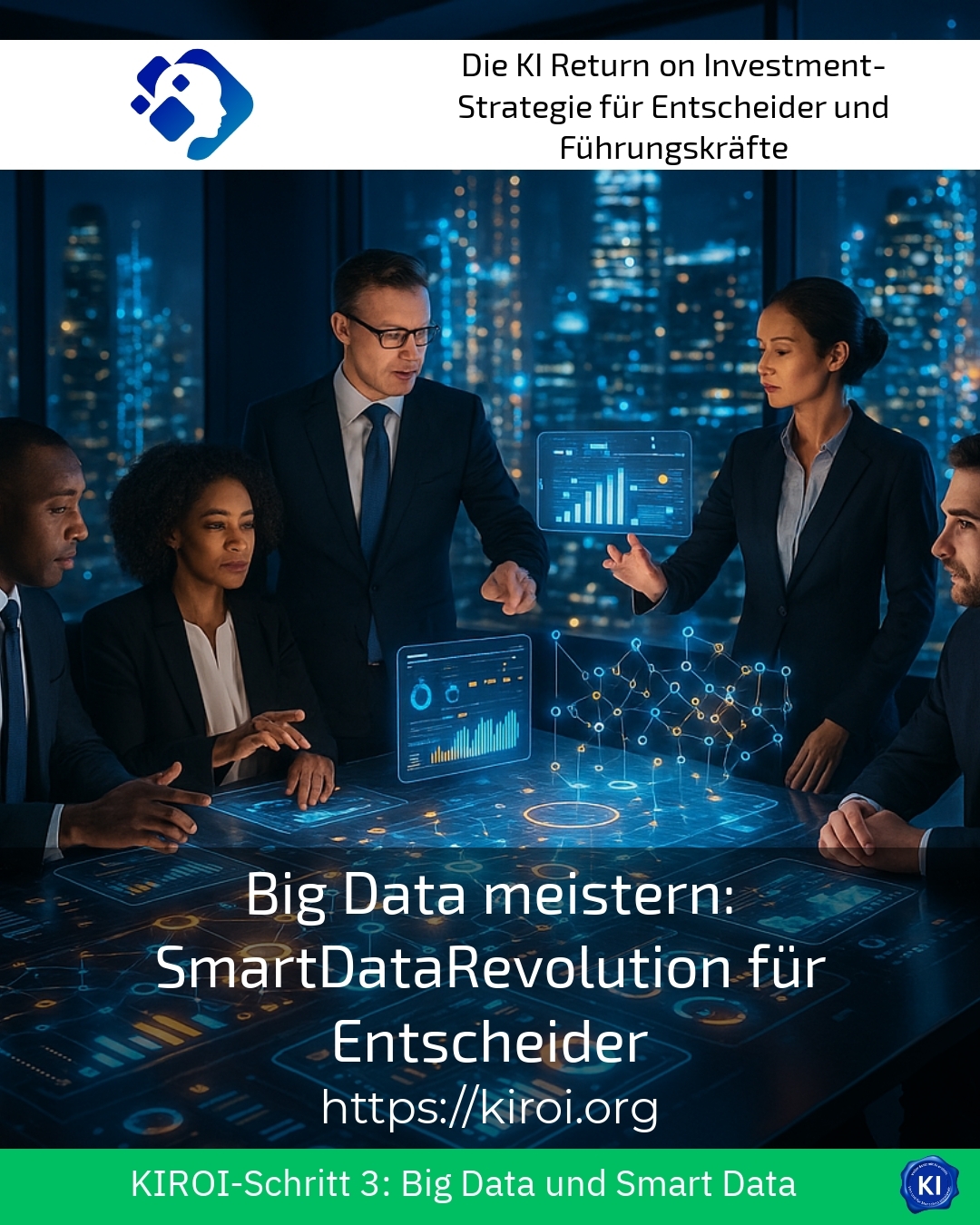
Imagine that your company could not only collect millions of data points every day, but also actually understand and profitably use them. The SmartDataRevolution for Decision Makers has already begun, and those who do not act now risk losing ground to the competition. While traditional analysis methods are reaching their limits, intelligent data strategies are opening up entirely new horizons for forward-thinking leaders. In a world characterised by exponentially growing amounts of information, the ability to use data wisely determines the success or failure of entire business models.
Why the SmartDataRevolution is becoming indispensable for decision-makers today
Digital transformation has initiated fundamental change in almost all economic sectors. Leaders face the challenge of drawing the right conclusions from the flood of available information. This is no longer just about collecting and storing data. Rather, companies must learn to use this resource strategically. For example, a logistics company analyses traffic patterns and weather data to optimise delivery routes. This reduces fuel costs and noticeably shortens delivery times. At the same time, customer satisfaction improves through more precise time windows.
In retail, clever providers use purchase histories and in-store movement data. They recognise patterns and can adapt their product range accordingly. This creates personalised shopping experiences that delight and retain customers. Insurance companies, in turn, rely on predictive models for risk assessment. These models analyse historical claims data and external factors simultaneously. The result is fairer premiums and more accurate risk assessment.
Financial service providers have also recognised the signs of the times. They analyse transaction patterns in real-time for fraud detection. Suspicious activities are automatically flagged and reviewed. This allows banks to protect their customers more effectively against criminal activities.
Best practice with a KIROI customer
A medium-sized trading company faced the challenge of managing its inventory more efficiently. Previous processes regularly led to overstocking of some products while simultaneously causing shortages of other items. Together, within the framework of transruption coaching, we developed a comprehensive data strategy that intelligently linked various information sources. The system took into account seasonal fluctuations, regional differences, and current market trends. Within six months, warehousing costs were reduced by approximately eighteen percent. At the same time, the availability of in-demand products improved significantly. Employees frequently reported a noticeable reduction in their daily workload. The support provided by KIROI enabled the company to implement this transformation in a structured and sustainable manner.
The Smart Data Revolution for decision-makers in practical implementation
Many leaders wonder how to transition to a data-driven company culture. The key lies in a step-by-step approach that brings everyone involved along. First, a thorough inventory of existing data sources is recommended. Subsequently, teams jointly define concrete use cases and objectives. Technology only follows once the strategic foundations have been laid.
The potential is particularly impressive in the manufacturing industry. Sensors on production facilities continuously record operating parameters such as temperature and vibration. Intelligent algorithms detect deviations from the normal state early on. This allows maintenance work to be planned proactively. Unplanned downtime is significantly reduced, and productivity measurably increases. One mechanical engineering company was able to reduce its downtime by almost thirty percent.
Remarkable applications are also emerging in healthcare through intelligent data use. Hospitals analyse patient flows, thereby optimising their capacity planning. Pharmaceutical companies are accelerating the development of new active ingredients through comprehensive data analyses. And health insurance providers can offer their policyholders personalised prevention programmes. These programmes are based on individual health data and scientific findings.
The energy sector also benefits from intelligent analysis methods. Utilities are forecasting electricity demand more precisely than ever before. This allows renewable energy sources to be integrated optimally into the grid. Network operators can identify potential disruptions before they lead to failures. This is how the energy transition is supported and accelerated by data-driven solutions.
Cultural change as a success factor for the Smart Data Revolution
However, technology alone is not enough for a successful transformation. Companies must develop a culture that promotes and values data-driven decisions. This often requires a rethink at all hierarchical levels. Leaders should lead by example and transparently justify their decisions. Teams need the necessary skills and tools for independent analysis.
A telecommunications provider has mastered this challenge in an exemplary manner. The company invested heavily in the further training of its employees. At the same time, decision-making processes were decentralised and supported with data tools. Customer advisors can now carry out analyses independently and create suitable offers. Customer satisfaction subsequently increased significantly.
A similar picture emerges in tourism with successful companies. Hotels use booking data and reviews for continuous improvements. Tour operators analyse trends and preferences for tailored offers. Airlines optimise their pricing through complex demand models. However, all these applications require employees who can work with data.
Best practice with a KIROI customer
A service company from the financial sector approached us with a desire for greater efficiency. Up to that point, existing customer data was only being used in a rudimentary way for marketing purposes. As part of our support, we jointly developed a comprehensive concept for data utilisation. First, we identified relevant data sources and systematically assessed their quality. Subsequently, we trained key employees in modern analysis methods and tools. The transruption coaching provided important momentum for the necessary cultural change within the company. After approximately nine months, the company was able to demonstrate initial measurable successes. The conversion rate for campaigns improved by an average of twenty-five percent. Clients frequently report similar developments after being systematically supported by KIROI.
Challenges and solutions for modern leaders
The path to a data-driven organisation is rarely straightforward. Many companies struggle with data silos built up over years. Different departments use different systems without common standards. Integrating this heterogeneous landscape requires time and patience. But it is indispensable for a holistic view of the business.
Data protection and compliance are further important aspects. Companies must ensure that they comply with legal requirements. At the same time, customers expect their information to be handled responsibly [1]. An automotive manufacturer has therefore developed transparent policies for data usage. Customers can decide for themselves which information they want to share. This builds trust and promotes the acceptance of new services.
The quality of the available data is crucial for the success of the analysis. Incorrect or incomplete information leads to false conclusions. This is why smart companies invest in robust data cleaning processes. For example, a media company has established a dedicated data quality team. This team continuously checks and improves existing datasets.
Exciting applications are emerging in the construction industry by linking various data sources. Project managers combine weather data with delivery times and personnel availability. This allows construction projects to be planned more realistically and delays to be minimised. Property developers analyse demographic trends for better location decisions. And facility managers optimise building operations through continuous consumption analyses [2].
Understanding and correctly applying technological fundamentals
Decision-makers do not need to know and understand every technical detail. However, a basic understanding of the possibilities is definitely helpful. Cloud technologies today enable flexible and scalable infrastructures for data analysis. Machine learning automates recurring tasks and recognises complex patterns. Visualisation tools make results understandable and tangible for all involved parties.
For example, a pharmaceutical company uses machine learning for drug discovery. Algorithms analyse molecular structures and predict potential effects. This allows promising candidates to be identified more quickly. The time to market for new drugs could potentially be significantly reduced.
Retail companies are increasingly relying on real-time analytics at the point of sale [3]. Till systems record not only sales but also customer behaviour. This information is immediately fed into optimisation algorithms. Prices and placements can be dynamically adjusted. In this way, a grocer significantly reduced their write-offs for perishable goods.
The logistics sector particularly benefits from real-time tracking and predictive analytics. Freight forwarders know the location of their vehicles at all times. Algorithms calculate optimal routes, taking current traffic conditions into account. Customers receive precise delivery windows and can plan their time more effectively. This increases satisfaction while simultaneously reducing costly failed deliveries.
Best practice with a KIROI customer
A medium-sized manufacturing company wanted to fundamentally improve its production planning. Until then, decisions were mainly based on the experience of individual employees. However, this valuable knowledge was not documented and was at risk in the event of staff changes. As part of the KIROI project, we combined existing expert knowledge with systematic data analysis. Together, we developed models that take into account both historical patterns and current developments. Transruption coaching supported the change process on a human and organisational level. Experienced employees were trained as data experts and involved in the process. Today, the company reports significantly improved planning accuracy and higher employee satisfaction. The structured support provided by KIROI proved to be a decisive success factor in this transformation.
Future prospects and strategic recommendations
The development in the field of intelligent data utilisation is progressing rapidly. New technologies such as edge computing enable analyses directly at the point where data is generated. This reduces latency times and sensitive information does not necessarily have to be transmitted. For industrial companies, this opens up entirely new possibilities for process control.
Decision-makers should actively engage with these developments and evaluate opportunities. A structured approach helps to maintain an overview. First, it is advisable to identify concrete use cases with high business value. Pilot projects enable the accumulation of experience with manageable risk. Successful approaches can then be systematically scaled.
Collaborating with experienced partners can significantly accelerate the transformation process. External support brings fresh perspectives and proven methods. This is not about off-the-shelf, pre-packaged solutions. Rather, good partners assist in developing individual strategies. They provide impetus and help overcome typical hurdles.
Media companies are already experimenting with personalised content based on usage data. Streaming services recommend content that matches individual preferences. Publishers are testing dynamic pricing models for digital subscriptions. And advertisers are receiving ever more precise target audience analyses for their campaigns.
My KIROI Analysis
Based on my many years of experience supporting transformation projects, a clear picture emerges. The SmartDataRevolution for Decision Makers is not a temporary fad, but a fundamental shift in the business world. Companies that set the right course now will gain sustainable competitive advantages. This depends less on the latest technology than on a clear strategy. Successful transformations always begin with a deep understanding of one's own business goals and challenges. Only when these foundations are clear can technology unleash its full potential.
The human dimension of this change seems particularly important to me. Data and algorithms do not replace experienced employees, but rather support them in making better decisions. Companies should therefore invest heavily in the further development of their teams. At the same time, a culture is needed that allows for experimentation and learns from mistakes. The SmartDataRevolution for Decision Makers requires courage and perseverance, but it richly rewards these qualities. Clients often report surprising insights during the transformation process. They discover connections that were previously hidden. And they develop completely new business ideas based on their data. This journey is worthwhile for any company that wants to be successful in the long term. Structured support from experienced partners like KIROI can provide crucial impetus and significantly ease the path.
Further links from the text above:
[1] Data Protection and Big Data – Legal Foundations
[2] Bitkom – Digital Transformation in Business
[3] ifo Institute – Studies on Digitalisation
For more information and if you have any questions, please contact Contact us or read more blog posts on the topic Artificial intelligence here.









 Deutsch
  English (UK)