
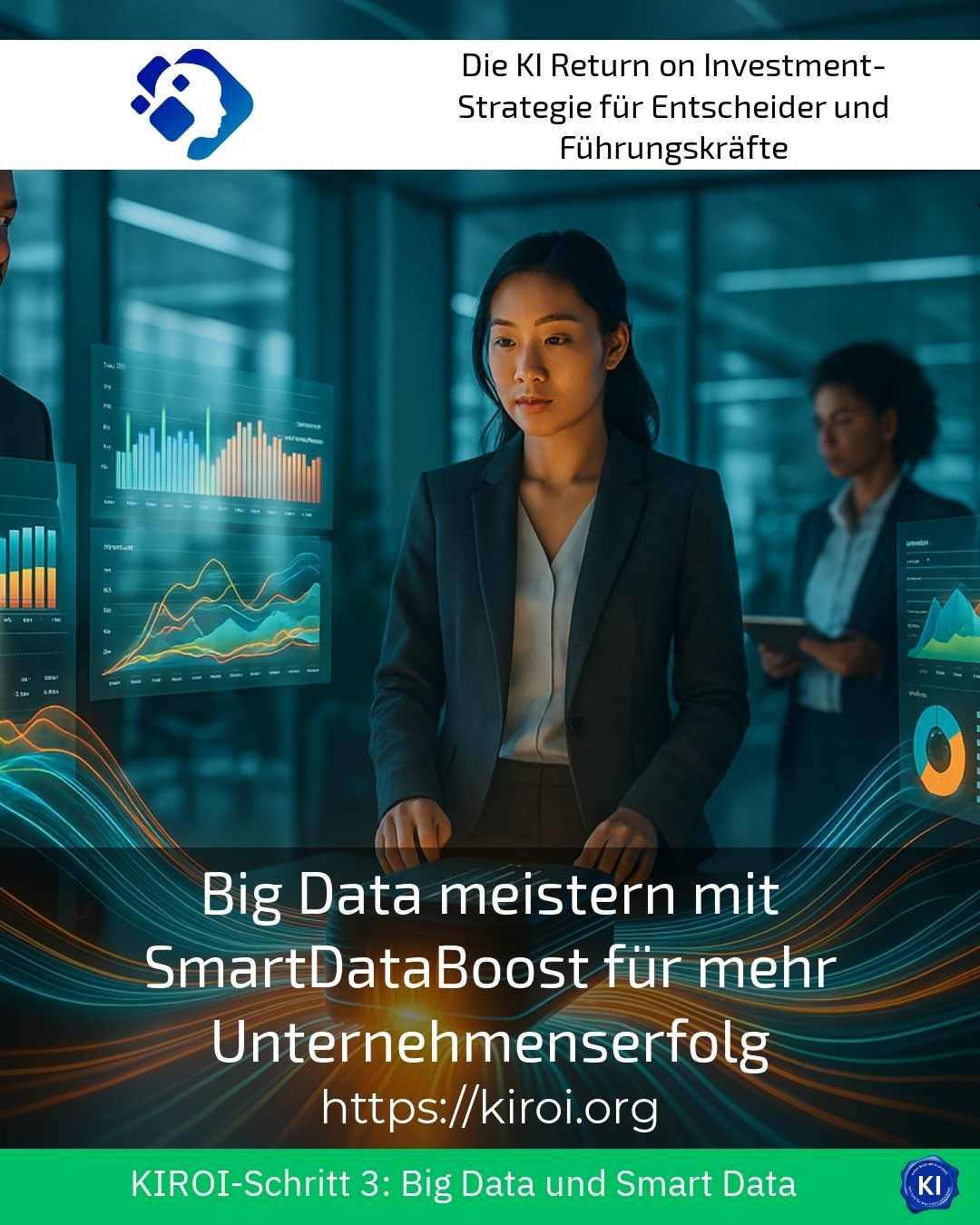
The transformation of the business world through intelligent data analysis has long since begun and presents companies with completely new challenges that are difficult to overcome without professional support. Those who want to remain competitive today must understand that Mastering Big Data with SmartDataBoost for greater business success is not an empty promise, but has become a strategic necessity. Many executives report feeling overwhelmed by the sheer flood of information. The good news is: there are proven ways to navigate this complexity. And this is precisely where transruptions-coaching guides companies on their individual journey to becoming data-driven organisations.
Understanding the challenges of modern data strategies
Companies today face a paradoxical situation. On one hand, they have more information than ever before. On the other hand, they struggle to derive real insights from it. This discrepancy often leads to frustration and missed opportunities. For example, manufacturing companies collect millions of sensor data points from their production facilities. Yet, only a few systematically use this data for process optimisation. Financial service providers analyse transaction patterns and often recognise critical developments too late. Retailers meticulously observe their customers' purchasing behaviour, while simultaneously failing to implement personalised offers. These examples clearly show that the mere availability of information does not create a competitive advantage.
The real challenge lies in the meaningful integration of different data sources. An engineering company needs to link production figures with quality data and supply chain information. An insurance group requires the integration of claims statistics, customer behaviour, and external risk factors. And a logistics company faces the task of matching route planning, vehicle utilisation, and customer requirements in real time. Such complex integrations are rarely successful without external support and strategic guidance.
Mastering Big Data with SmartDataBoost through structured processes
The key to success lies in a systematic approach. First, companies must honestly assess their data situation. What information already exists within the company? What is the quality of this information? And what gaps need to be filled? This inventory forms the foundation of any successful strategy. transruptions-coaching supports organisations through targeted impulses and practical methodology.
Best practice with a AIROI customer
A medium-sized pharmaceutical company approached us because management was overwhelmed by the complexity of their research data. The organisation had years of clinical trial results scattered across various systems. No one could keep track of what insights had already been gained. Frustration within the research team grew steadily. Through our coaching programme, we first developed a clear inventory of all available information sources. Subsequently, we collaboratively defined priorities for data integration and trained employees in new analysis methods. After six months, those responsible reported a significant improvement in research efficiency. Study designs could be developed more quickly because historical insights were now systematically accessible. The time saved on literature searches was estimated by those involved to be around forty percent.
Technological foundations and their practical implementation
Modern analysis platforms today offer possibilities that would have been unthinkable just a few years ago. Cloud-based solutions enable the processing of enormous amounts of information without the need for one's own data centres. Machine learning identifies patterns that would remain hidden from human analysts. And real-time dashboards visualise complex correlations in an easily understandable manner at a glance. However, being able to utilise these technical options requires more than just software licences.
An automotive supplier needs to understand which algorithms are suitable for quality control [1]. A bank requires clarity on which analysis methods comply with regulatory requirements. And an energy provider faces the question of how to meaningfully combine consumption forecasts with weather data. These strategic decisions are made easier with experienced guidance that understands different industries and their specific requirements.
The role of corporate culture in digital transformation
Technology alone is never enough for sustained success. People within an organisation must understand and want to embrace new possibilities. This cultural dimension is often underestimated. Production employees often fear being replaced by automated analyses. Controllers worry about their traditional role as number providers. And managers sometimes feel overwhelmed by the speed of change. Taking these fears seriously and addressing them constructively is among the most important tasks when supporting transformation projects.
For example, a chemicals company told us about considerable resistance in middle management. The executives there felt their decision-making autonomy was threatened by data-driven recommendations. A retail company experienced similar reservations from experienced buyers who didn't want to replace their gut feeling with algorithms. And in a telecommunications company, entire departments initially refused to adapt their working methods. In all these cases, careful change management, which involved those affected rather than bypassing them, proved helpful.
SmartDataBoost for greater business success: Specific fields of application
The practical applications of intelligent data utilisation extend across almost all areas of business. In sales, predictive models enable the identification of promising leads before they themselves become active [2]. In personnel management, analyses assist in recognising fluctuation risks and developing appropriate countermeasures. And in procurement, market analyses help to optimise purchasing strategies and negotiate better terms.
For example, a consumer goods manufacturer uses social media analysis to identify trends early on. A construction company optimises its calculations and reduces cost overruns through project data analysis. And a healthcare provider noticeably improves patient care by evaluating treatment data. These examples illustrate the enormous potential that lies in systematic information utilisation.
Best practice with a AIROI customer
An international engineering group approached us with a desire for fundamental improvements to its service processes. The challenge was to predict maintenance needs at customers' sites before failures occurred. The company already possessed extensive sensor data from its globally installed equipment. However, a clear strategy for utilising this valuable source of information was lacking. Together, we developed a roadmap for the step-by-step implementation of predictive maintenance approaches. We placed particular emphasis on involving the service technicians, whose expert knowledge was indispensable for algorithm development. The pilot phase began with ten selected major customers, whose feedback was continuously incorporated. After one year, the company reported a significant reduction in unplanned downtime. Customer satisfaction improved measurably, and the service margin increased due to more efficient deployment planning. The positive response from the technicians, who felt like co-creators of the new solution, was particularly pleasing.
Avoiding risks and pitfalls in data projects
Not every analytics project leads to success. Companies often report on failed initiatives that have swallowed up a lot of money. The reasons for such failures are varied and instructive. Sometimes clearly defined goals are missing, and the project gets bogged down in technical details. In other cases, there's a lack of data quality, leading even sophisticated analyses to false conclusions. And often, the necessary time for change processes is underestimated.
For example, a media company invested significant sums in a personalisation platform without first checking the data foundation. The result was irrelevant recommendations that deterred users rather than enthused them. An industrial company launched an ambitious analytics project without sufficient involvement from the specialist departments. The developed dashboards were simply ignored by the users. And a financial service provider significantly underestimated the regulatory effort involved in using customer data. Such mistakes can be avoided through careful planning and experienced support.
Mastering Big Data with SmartDataBoost: The Path to a Data-Driven Organisation
The transformation to a truly data-driven company is not a sprint, but a marathon. It requires perseverance, continuous learning, and a willingness to adapt [3]. It's not about changing everything at once. Rather, a step-by-step approach with clearly defined milestones is recommended. Small successes build trust and motivation for larger undertakings.
A food manufacturer began its journey with a manageable pilot project for sales forecasting. The positive results convinced sceptical managers and paved the way for more far-reaching initiatives. An insurance company started with the automation of simple claims and then successively expanded the application. And a logistics service provider initially optimised individual routes before controlling the entire network using data. These examples show that patient approaches are often more successful than exaggerated ambitions.
My AIROI Analysis
Having supported numerous companies with their data initiatives has provided me with valuable insights, which I would like to summarise here. Firstly, it repeatedly becomes clear that technological excellence alone is not sufficient. Companies that involve their employees from the outset achieve significantly better results than those that impose changes from the top down. The human component remains the decisive success factor.
Furthermore, I observe that realistic expectations are essential for project success. Those who hope for immediate miracles will inevitably be disappointed. The development of a data-driven culture takes time, patience, and continuous investment. At the same time, companies should have the courage to learn from mistakes and make course corrections. No plan survives first contact with reality unscathed.
Ultimately, working across different industries has taught me that every organisation must find its own way. There are no ready-made solutions, and that's a good thing. The uniqueness of each company demands individual solutions. This is exactly where transruptions coaching comes in: as support that provides impetus, creates orientation, and helps companies develop their very own data strategy. The future belongs to those who are prepared to pursue this path consistently.
Further links from the text above:
[1] McKinsey: The Data-Driven Enterprise
[2] Harvard Business Review: Insights from Data Analytics
[3] Gartner: Data and Analytics Research
For more information and if you have any questions, please contact Contact us or read more blog posts on the topic Artificial intelligence here.








 Deutsch
  English (UK)