
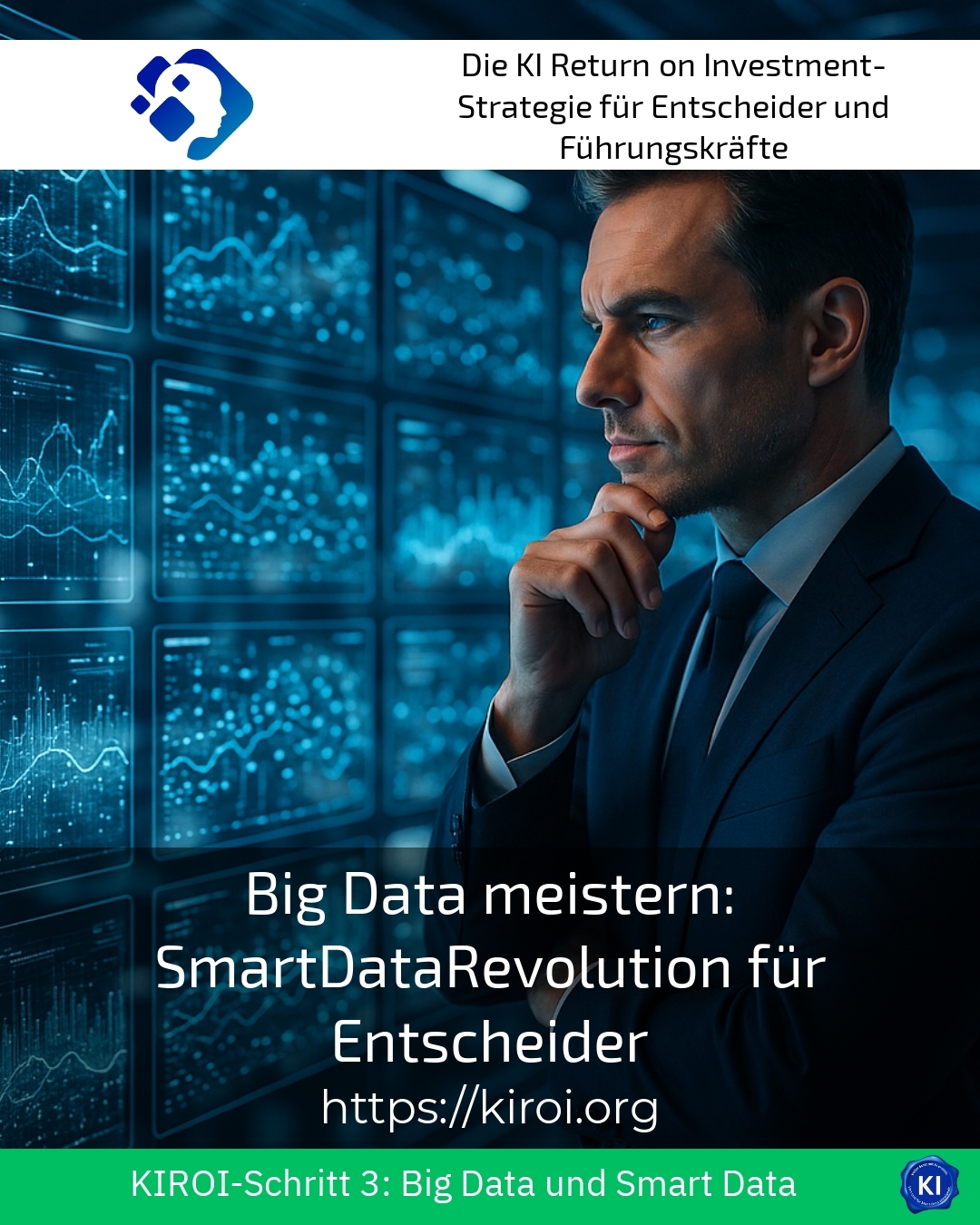
Digital transformation is changing companies at a rapid pace. Leaders face one central challenge. They must understand and utilise gigantic amounts of data. SmartDataRevolution for Decision Makers offers valuable guidance here. Those who act now secure decisive competitive advantages. This article will show you concrete paths and practical approaches. You will learn how modern data strategies can advance your company.
Why leaders need to rethink things now
The business world is undergoing a fundamental change. Data has become the most valuable resource. At the same time, the sheer volume overwhelms many organisations. Traditional analysis methods are reaching their limits. Therefore, decision-makers need new perspectives and tools. The SmartDataRevolution for Decision Makers addresses this very challenge.
A medium-sized mechanical engineering company collected production data for years. However, this data remained unused in various systems. It was only a structured approach that brought the breakthrough. Suddenly, those responsible recognised hidden patterns. Maintenance cycles could be optimised, and downtimes were significantly reduced.
A logistics company was struggling with fluctuating delivery times. The analysis of historical transport data revealed surprising connections. Weather conditions influenced certain routes more than expected. With this knowledge, the company adjusted its planning. Customers reported noticeably more reliable deliveries.
Impressive opportunities are also emerging in the retail sector. A supermarket chain analysed purchasing behaviour over several years. In doing so, they discovered seasonal patterns beyond obvious trends. Product range design was adapted accordingly. Such companies frequently report significantly lower warehousing costs.
Data-driven decisions with the SmartDataRevolution for decision-makers
Intuition alone is no longer sufficient. Successful leaders combine experience with analytical insights. However, this approach requires a new mindset. It's not about blind faith in technology. Instead, intelligent systems support human judgment.
A pharmaceutical company used this approach in research planning [1]. The evaluation of previous studies highlighted promising research directions. Resources were deployed more effectively. The development time for new products was significantly reduced.
In the financial sector, data-driven analyses help with risk assessment. A regional bank reviewed its lending processes. Historical default patterns were systematically evaluated. The result was a more nuanced creditworthiness check. Both customers and the bank benefited from this.
Insurers employ similar methods for damage prognosis. Patterns in past claims are identified. This allows preventive measures to be initiated earlier. Customers receive more personalised advice and more suitable offers. This strengthens customer loyalty sustainably.
Best practice with a AIROI customer
An internationally active automotive supplier faced a complex challenge, as production planning was based on outdated forecasting methods and regularly led to over or underproduction. Transruption coaching supported the company in realigning its data architecture over an eight-month period. Initially, all relevant data sources were identified and linked, bringing together production figures, quality data, and supplier information. Executives received intensive coaching on data-driven decision-making and learned to interpret analysis results correctly. A central dashboard was developed, which clearly displays real-time information and provides recommendations for action. Employees were gradually introduced to the new way of working, with change management aspects receiving particular attention. After implementation, those responsible reported a reduction in warehousing costs by around thirty percent and significantly improved delivery reliability to end customers.
Understanding technology as an enabler
Modern technologies enable entirely new forms of analysis. Algorithms recognise patterns in fractions of a second. Humans would need weeks for the same task. Nevertheless, humans remain at the centre of all decisions. Technology supports, but does not replace, judgement.
An energy supplier uses sensor data from its entire network [2]. Anomalies are detected and reported early. Technicians can intervene proactively before faults occur. This increases supply security and reduces costs simultaneously.
In agriculture, data analyses are revolutionising traditional cultivation methods. Soil sensors continuously provide information on moisture and nutrients. Irrigation and fertilisation are carried out according to need and with resource conservation. Crop yields improve with a simultaneous reduction in resource use.
The construction industry also benefits from intelligent data analysis. Project progress is compared with historical data. Risk of delays can be identified early on. Project managers can take countermeasures in good time and keep to deadlines.
Cultural change as a success factor of the Smart Data Revolution for decision-makers
Technology alone does not guarantee success. Organisations must adapt their culture. Data-driven working requires new skills and ways of thinking. Leaders play a key role model function in this. They must actively embody and promote the change.
A media company recognised this need early on. Management underwent intensive training. Subsequently, all departments were gradually involved. Today, teams make data-driven decisions independently. The speed of response to market changes has multiplied.
Similar potential is evident in healthcare. A clinic group systematically analysed treatment pathways. Doctors received decision support based on comparable cases. Treatment outcomes improved and complication rates decreased. Documentation quality increased as a positive side effect.
HR managers use data analytics for better recruitment. Successful career paths are compared with hiring data. This creates more precise requirement profiles for open positions. Misplacements become less frequent and employee satisfaction increases.
Best practice with a AIROI customer
A traditional family business in the textile sector wanted to strengthen its market position through modern analytical methods, but the organisation initially showed distinct resistance to change. Transruption coaching initially supported the management team in developing a clear vision for the company's digital future. In several workshops, employee concerns were taken seriously and constructively addressed, while acknowledging the strengths of their existing working methods. Step by step, initial pilot projects were implemented, which quickly showed visible successes and convinced sceptics. The sales department received a tool for analysing customer behaviour and purchasing patterns, which significantly improved the quality of advice. Production planners gained insights into demand forecasts and were able to adjust their planning accordingly, leading to less overproduction. After about a year, a new work culture had been established, in which data-based arguments were naturally incorporated into discussions and decisions were justified more transparently.
Plan strategic implementation
Successful implementations follow a structured approach. First, goals and priorities are defined. Then, an inventory of existing data and systems is taken. Only then does the step-by-step implementation of new solutions begin.
A tourism company proceeded in exactly this way [3]. All booking data was first consolidated and cleaned. Subsequently, meaningful analyses of customer behaviour emerged. Marketing campaigns became more targeted, and price adjustments more precise. Utilisation improved noticeably during the off-season.
Telecommunications providers use similar approaches for customer retention. Usage behaviour is continuously analysed and evaluated. Churn risks are identified and addressed at an early stage. Targeted offers keep customers with the company.
Educational institutions are also discovering the potential of modern data analyses. Learning progress is recorded and evaluated individually. Teachers receive indications of individual learners' support needs. Tuition becomes more personal and effective.
Consider ethical dimensions
With great data power comes great responsibility. Data protection and ethical principles must be adhered to. Transparency with customers and employees is essential. Trust forms the foundation of any successful data strategy.
A trading company communicates openly about its data usage. Customers can decide for themselves what information they share. This transparency strengthens trust and customer loyalty. At the same time, data quality improves through voluntary disclosures.
In human resources, ethical boundaries are particularly important. Algorithms must not amplify or entrench discrimination. Regular reviews ensure fair outcomes. Human oversight remains essential in all personnel decisions.
Strict ethical standards also apply in the healthcare sector. Patient data is subject to special protection and the highest security requirements. Anonymisation techniques still enable valuable analyses for research. This leads to medical progress while safeguarding data protection.
My AIROI Analysis
Supporting numerous companies has yielded important insights. Success does not come about through technology alone, but through its intelligent integration into business processes. Managers must develop a basic understanding of data-driven methods themselves and continuously build on this expertise. The SmartDataRevolution for Decision Makers is not a one-off project, but an ongoing transformation process that requires patience and perseverance. Organisations that proceed incrementally and involve their employees achieve more sustainable results than those that try to do too much too quickly.
Companies that view data analysis not as an end in itself, but as a means to achieve specific business objectives, are particularly successful. The human remains at the centre of all decisions, while technology supports and empowers them. Resistance to change is normal and should be taken seriously, as scepticism often hides legitimate questions and valuable experience. Transruption coaching has proven effective in supporting complex transformation projects because it considers both technical and human aspects. The future belongs to organisations that understand and responsibly use data as a strategic resource, without neglecting ethical principles.
Further links from the text above:
[1] McKinsey: Big Data as the Next Frontier for Innovation
[2] Gartner: Data Analytics Insights
[3] Harvard Business Review: Data Strategy Articles
For more information and if you have any questions, please contact Contact us or read more blog posts on the topic Artificial intelligence here.









 Deutsch
  English (UK)