
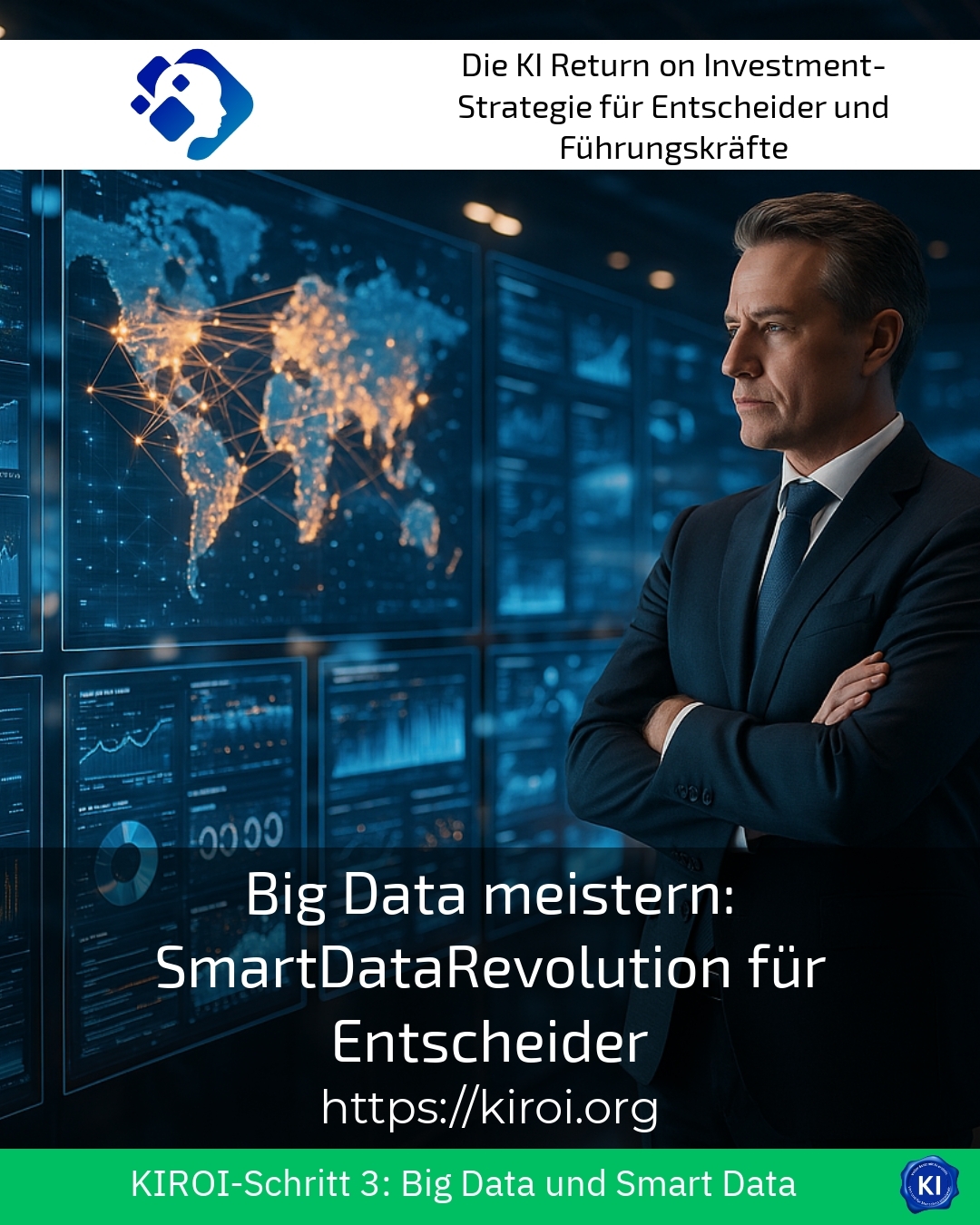
The digital transformation has long begun and presents leaders with entirely new challenges. Data volumes are growing exponentially and overwhelming traditional analysis methods. Those who do not act today as decision-makers will lose out tomorrow. SmartDataRevolution for Decision Makers offers a structured approach to mastering this complexity. Companies that intelligently manage their information flows create sustainable competitive advantages. This is not just about technology, but above all about strategic thinking. This article will show you how, as a leader, you can set the right course.
Why modern information processing is becoming a top priority
The business landscape has fundamentally changed. Previously, experience and gut feeling were sufficient for making important decisions. Today, leaders require structured, real-time information. This development affects all industries equally. The impact is particularly evident in the manufacturing sector. Manufacturing companies now collect millions of sensor data points daily. This information enables predictive maintenance and optimised production processes. However, without intelligent processing systems, these potentials remain untapped.
A medium-sized mechanical engineering company from Baden-Württemberg impressively illustrates this development. The company collected production data for years without systematic analysis. Only by introducing modern analysis tools did the management recognise hidden patterns. Production downtimes could henceforth be predicted early on. This significantly reduced downtime. Companies from the automotive supply industry report similar experiences. There, networked systems enable end-to-end quality control. Defective components are identified during manufacturing. This saves considerable costs and strengthens customer trust.
The Smart Data Revolution for Decision-Makers in an Industrial Context
Industrial companies face particular challenges in information utilisation. Heterogeneous machine parks make uniform data collection difficult. Older systems often lack interfaces for modern systems. Retrofits require significant investment and careful planning. At the same time, pressure from international competitors is growing. Asian manufacturers have caught up technologically in many areas. German companies must therefore consistently expand on their strengths. The intelligent use of existing information offers great potential here.
An example from the chemical industry illustrates the opportunities. Process industries work with complex production procedures. Temperature, pressure, and flow rates must be precisely controlled. Minor deviations can lead to quality problems. Modern analysis systems detect such deviations early. They automatically recommend corrective actions to the plant operators. This improves product quality and reduces waste. Energy consumption can also be reduced through optimised process management. Sustainability goals are thus more easily achievable.
Best practice with a AIROI customer
An internationally operating company from the process industry approached us with a complex problem. The management had recognised that existing information was not being optimally utilised. Different sites worked with different systems and standards. Consistent reporting was therefore hardly possible. Strategic decisions were often based on incomplete foundations. As part of the transruption coaching support, we first analysed the existing system landscape. In doing so, we identified considerable redundancies and inconsistencies in the data holdings. Together with the management team, we developed a roadmap for gradual harmonisation. The involvement of the specialist departments at all sites was particularly important. Acceptance could only be ensured through the active participation of the employees. After intensive project work, the company now has a central information system. Managers can carry out cross-site comparisons in real time. Production bottlenecks are recognised early and can be compensated for by shifting capacity. Customer satisfaction has measurably increased because delivery dates are being met more reliably. This project impressively shows how structured support can facilitate complex transformation processes.
Strategic dimensions of intelligent information utilisation
Successful use of large amounts of information requires more than technical solutions. Decision-makers must first define clear strategic goals. What questions should be answerable? What decisions should be based on better foundations? These considerations determine the requirements for the technical infrastructure. Many projects fail because this preliminary work is neglected. Technology is introduced for its own sake. The concrete business benefit remains unclear. Employees quickly lose interest in new systems. The investments do not pay for themselves as planned [1].
The importance of strategic planning is particularly evident in the logistics sector. Freight forwarding companies have extensive information on transport routes and delivery times. GPS data, traffic information, and weather data enable precise forecasts. However, many companies do not yet fully utilise these possibilities. A leading logistics service provider has fully automated its tour planning. Algorithms take hundreds of influencing factors into account simultaneously. Dispatchers now only focus on exceptional situations. This has significantly increased efficiency. At the same time, employee job satisfaction has risen. Monotonous planning tasks have been replaced by more demanding activities.
Cultural Aspects of the Smart Data Revolution for Decision-Makers
Technology alone does not transform an organisation. The corporate culture must support the change. Leaders play a crucial role in setting an example in this regard. If boards and managing directors demand data-driven decisions, other levels will follow. Conversely, initiatives fail if top management continues to make decisions based on gut feeling. This cultural dimension is often underestimated. Clients frequently report resistance within the organisation. Long-serving managers feel threatened by new analysis methods. Their experience suddenly seems to be worth less. Sensitive communication and active involvement are needed here.
A company trading in consumer goods illustrates this challenge. In the future, the purchasing department should use algorithm-driven demand forecasts. Initially, experienced buyers reacted negatively, fearing a loss of their importance within the company. Transruption coaching provided intensive support throughout the change process. We worked with the affected teams on a new understanding of their roles. The algorithms take over the routine forecasts for standard products, while the buyers focus on complex procurement situations and supplier relationships. This division of labour is now valued by all involved. Forecast accuracy has measurably improved, and at the same time, employees continue to feel valued.
Technological Foundations and Practical Implementation
The technical implementation of modern information strategies requires careful planning. Cloud solutions offer flexible and scalable possibilities today. Companies no longer need to operate their own data centres. Instead, they use the infrastructures of established providers. This significantly reduces the barriers to entry. However, new questions arise regarding data security and compliance [2]. German companies in particular are particularly sensitive to this. Storing sensitive business information on external servers requires clear regulations. Contracts must contain unambiguous agreements on data protection and access rights.
These requirements are particularly evident in the financial sector. Banks and insurance companies process highly sensitive customer data. Regulatory requirements restrict the scope for manoeuvre. Nevertheless, many institutions have made significant progress. Credit decisions are increasingly based on automated risk models. Fraud detection systems analyse transaction patterns in real time. Suspicious activities are reported immediately. This protects customers from financial losses. There are also innovative applications in the insurance sector. Telematics tariffs assess individual driving behaviour. Careful drivers benefit from lower premiums. These personalised offers would not be possible without modern analytical methods.
Best practice with a AIROI customer
A medium-sized financial services company sought support in modernising its analytical capabilities. The existing systems had grown over decades and were barely maintainable. Reports were created manually and were often out of date. Management recognised that strategic decisions required better foundations. As part of our support, we first carried out a comprehensive inventory. This revealed that a lot of valuable information lay dormant and unused in various systems. Together, we developed a concept for integrating these scattered sources. The regulatory requirements of the financial supervisory authorities were particularly challenging. All changes had to be carefully documented and audited. Through close collaboration with the compliance department, we were able to meet all requirements. The new system now enables real-time analysis of business development. Managers receive automated alerts for critical deviations. Reaction times to market changes have significantly decreased. Customer advisors also benefit from improved analytical tools. They can give their clients more well-founded recommendations. Customer satisfaction has demonstrably increased since then.
Skills development and further training as success factors
The best systems are of little use without qualified employees. Companies must invest specifically in skills. This isn't just about technical abilities; analytical thinking and the ability to interpret are becoming increasingly important. Leaders need a basic understanding of modern analysis methods. Only then can they ask the right questions and critically evaluate results. Further training programmes should consider different target groups. Analysts need in-depth methodological knowledge. Managers need strategic understanding of application possibilities. Employees in specialist departments must be able to use the tools in their day-to-day work [3].
An example from the healthcare sector demonstrates successful competency development. A hospital network wanted to optimise its resource planning. Bed occupancy forecasts were to be based on historical patterns in future. This required the controlling department to develop new analytical skills. External training provided the necessary methodological knowledge. At the same time, internal experts were trained as multipliers. They now support colleagues with specific application questions. This ensures sustainable knowledge transfer. Nursing staff were also involved in the training. They now use mobile applications for documentation. The data collected is automatically fed into the analyses. This integration has significantly increased acceptance.
Realistically assess risks and challenges
Despite all odds, the use of large amounts of information also carries risks. Decision-makers should assess these realistically. Data protection violations can cause significant reputational damage. Algorithms can contain systematic biases. These so-called biases lead to discriminatory decisions. Companies bear responsibility for fair and transparent processes. Regular reviews of the models used are therefore essential. Dependence on technical systems also deserves attention. Failures can paralyse critical business processes. Redundant structures and contingency plans create security here.
These challenges are evident in retail. Personalised advertising relies on extensive customer profiles. However, customers expect their information to be handled respectfully. Overly targeted advertising can be perceived as intrusive. The line between helpful and invasive quickly becomes blurred. Successful retailers find the right balance here. They use analytical capabilities to improve the shopping experience. At the same time, they respect their customers' privacy. Transparent communication about data usage builds trust. Opt-out options give customers control over their own preferences.
Making the Smart Data Revolution a Success for Decision-Makers
Successful transformation requires a holistic approach. Technology, processes, and people must be viewed together. Isolated initiatives from individual departments rarely lead to success. Instead, an overarching strategy with clear responsibilities is needed. Management must actively drive and support the change. Project teams require sufficient resources and scope for action. Regular progress reviews ensure advancements are secured. Flexibility allows for adjustments when circumstances change. This is how an information-driven corporate culture is gradually created.
Companies from the energy industry have successfully followed this path. Energy suppliers have extensive consumption data from their customers. Smart meters provide detailed information on usage behaviour. This enables innovative tariff models and efficiency advice. At the same time, suppliers are optimising their grids based on current load forecasts. Renewable energies with fluctuating generation can be better integrated. The energy transition is thus technically manageable. Industrial customers also benefit from these developments. They receive precise information on their energy consumption. Potential savings become visible and can be specifically addressed.
My AIROI Analysis
Dealing with large amounts of information has become indispensable for decision-makers today. Those who ignore this development risk falling behind in the competition. At the same time, practice shows that technical solutions alone are not enough. Successful transformation requires a smart combination of strategy, technology, and corporate culture. Leaders must actively shape and embody change. They need a fundamental understanding of modern analytical methods. Only in this way can they ask the right questions and make informed investment decisions.
Our experience from numerous projects shows recurring patterns of success. Companies that proceed step-by-step achieve more sustainable results. Large transformation projects often overwhelm the organisation. An iterative approach with quick initial successes is better. These create trust and acceptance for further steps. Involving employees from the very beginning is crucial. Those affected must become participants. Fears and resistance deserve serious attention. Open communication about goals and impacts builds trust. Transruption coaching can provide valuable impetus and support change processes here.
Finally, I would like to emphasise that every company must find its own way. There are no standard solutions. The specific industry, company size and starting situation determine the right approach. External support can help to identify blind spots. It brings in experience from other contexts and broadens the perspective. The investment in analytical skills pays off in the long term. It creates the basis for sound decisions in an increasingly complex world.
Further links from the text above:
[1] McKinsey Digital Insights on Digital Transformation
[2] BSI – Federal Office for Information Security
[3] Bitkom – Digital Transformation in Business
For more information and if you have any questions, please contact Contact us or read more blog posts on the topic Artificial intelligence here.







 Deutsch
  English (UK)